Passer au format impression
 Lire la suite







































 Pour les œuvres ou reproductions dont un côté mesure plus de 105 cm (environ 41 pouces), le cadre sera expédié sous forme de kit démonté. Cette méthode garantit une livraison sécurisée et prévient tout dommage pendant le transport.


A Descent Into Baroque Anxiety
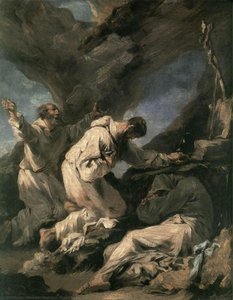
In the shadowy recesses of the Kunsthistorisches Museum in Vienna lies one of Alessandro Magnasco’s most harrowing masterworks, "Interrogations in Jail." Created around 1710, this painting is far more than a mere historical tableau of cruelty; it is a visceral, psychological descent into the heart of Baroque anxiety. The composition centers on a figure suspended by ropes, his body contorted in a state of agonizing vulnerability above a cold table. Surrounding him, a group of grim jailers move through the gloom, their presence marked by the glint of swords and the terrifying silhouette of an iron maiden. Through this scene, Magnasco invites the viewer to witness not just a moment of physical torment, but a profound meditation on the fragility of human existence when confronted by the crushing weight of institutional authority.
The atmosphere of the work is thick with dread, achieved through Magnasco’s signature use of chiaroscuro. The stark, dramatic contrast between deep, impenetrable shadows and sudden, piercing flashes of light creates a sense of instability and movement. This technique does not merely illuminate the scene; it heightens the emotional tension, making the viewer feel as though they are peering into a secret, forbidden corner of history. The artist’s brushwork is remarkably expressive, utilizing rapid, fragmented strokes that mirror the agitation and chaos of the interrogation itself. There is a restless energy in every line, a flickering quality that suggests the very air in the stone cell is heavy with the scent of decay and the echoes of silent screams.
The Language of Shadows and Symbolism
Magnasco’s mastery lies in his ability to weave complex historical anxieties into a singular, haunting image. Painted during an era of intense religious fervor and political upheaval following the Thirty Years’ War, the artwork reflects a broader European preoccupation with justice, persecution, and the abuse of power. Every object within the frame serves as a symbol of this systemic oppression. The iron maiden, a centerpiece of dread, stands as a silent sentinel of mechanical cruelty, while the book resting on the table suggests the cold, bureaucratic recording of confessions—a chilling reminder that even pain is documented by the state. The muted palette of browns, grays, and ochres reinforces this sense of claustrophobia, stripping away any possibility of warmth or escape.
For the discerning collector or interior designer, "Interrogations in Jail" offers a profound opportunity to introduce a piece of immense character and intellectual depth into a space. A high-quality reproduction of this work serves as a powerful focal point, commanding attention through its dramatic narrative and sophisticated tonal range. It is an artwork for those who appreciate the darker, more contemplative side of the Baroque period—a piece that does not merely decorate a wall but provokes thought, invites conversation, and brings a sense of historical gravity to any curated environment. To possess such a work is to hold a fragment of the human struggle, rendered with unparalleled expressive power.
Questions et réponses
Puis-je voir «Interrogations in Jail» de Alessandro Magnasco sur mon propre mur avant de l'acheter ?
La page Aperçu en RA de «Interrogations in Jail» de Alessandro Magnasco utilise la réalité augmentée pour visualiser l'œuvre dans votre propre espace, à partir d'un appareil compatible.
L'œuvre « Interrogations in Jail » se trouve-t-elle dans le pays de son créateur ?
Non - l'œuvre est conservée à l'étranger. Alessandro Magnasco est né(e) en Italie, tandis que le musée qui conserve l'original de « Interrogations in Jail » se situe en Austria.
En quelle année "Interrogations in Jail" a-t-il été réalisé ?
L'œuvre «Interrogations in Jail» de Alessandro Magnasco date de 1710.
 Aperçu en situation
 Envoyer
 Partager
 Détails de l'œuvre
 Guide
Guide

 Télécharger l'image
 Articles similaires
 Radiographie
 Diaporama
 Q&A
Q&A Statistiques