 Aperçu en situation
 Envoyer
 Partager
 Détails de l'œuvre

 Télécharger
 Articles similaires
 Radiographie
 Diaporama
St John the Baptist
 Huile
Huile- Art mural
- Mannerist Style
 1550
1550 120.0 x 92.0 cm
 Galleria Borghese
 Lire la suite
Reproduction à l'huile faite à la main
Huile sur toile peinte à la main, avec cadre et dimensions personnalisés, réalisée sur commande par nos artistes. ( Commander l'impression Télécharger l'image haute résolution)




P118B $10

P118H $10

P118W $10

P438Z $10

P508JH $12

P508YH $12

P805H $10

P805Z $10

P919BZ $10

P919G $10

P919XJ $10

P959ZH $10

P968JZ $12

W106C $8

W218G $10

W218JH $8

W218Y $10

W307PJ $10

W316G $10

W316PJ $8

W316Y $10

W398PJ $8

W4111J $10

W500HY $15

W500JH $15

W692G $12

W849H $8

W940BG $15

W953PJ $8




Choisissez parmi nos formats prédéfinis qui respectent les proportions originales de l’œuvre.

Vous pouvez saisir vos propres dimensions pour l'adapter à un cadre ou à un espace spécifique. Si la taille sélectionnée ne correspond pas aux proportions de l'image d'origine, nous recadrerons l'œuvre ou prolongerons la peinture avec des éléments peints à la main supplémentaires. Une maquette numérique vous sera envoyée pour approbation avant le début de la production.
Veuillez noter que l'aperçu à l'écran ne reflète pas le recadrage ou l'extension réels. Seule la maquette montrera fidèlement la composition finale.
Bien que des tailles personnalisées soient disponibles, nous vous recommandons de sélectionner une dimension dans la liste prédéfinie afin de préserver les proportions d'origine.
Après la commande, l’équipe OriginalUniqueArt.com contactera le client par e-mail pour recueillir ses instructions et lui fournira une maquette d’aperçu
Livraison dans le monde entier () en 3 à 4 semaines au lieu des 5 semaines habituelles. (16 août). Aucun compromis sur la qualité.

Livraison express gratuite dans le monde entier

Toile de lin de qualité supérieure

Assurance transport complète

Garantie de remboursement des droits de douane

Garantie de fidélité des couleurs

Politique de retour de 60 jours (uniquement en cas de défaut)

Garantie de remboursement à 100%

Offre de tarifs dégressifs
 L'option verre n'est disponible que pour les dimensions inférieures à 110 cm.

St John the Baptist
Technique de reproduction
Format de la reproduction
-


Prix total
$ 300
Description de l'œuvre
Agnolo Bronzino’s Enigmatic St. John the Baptist
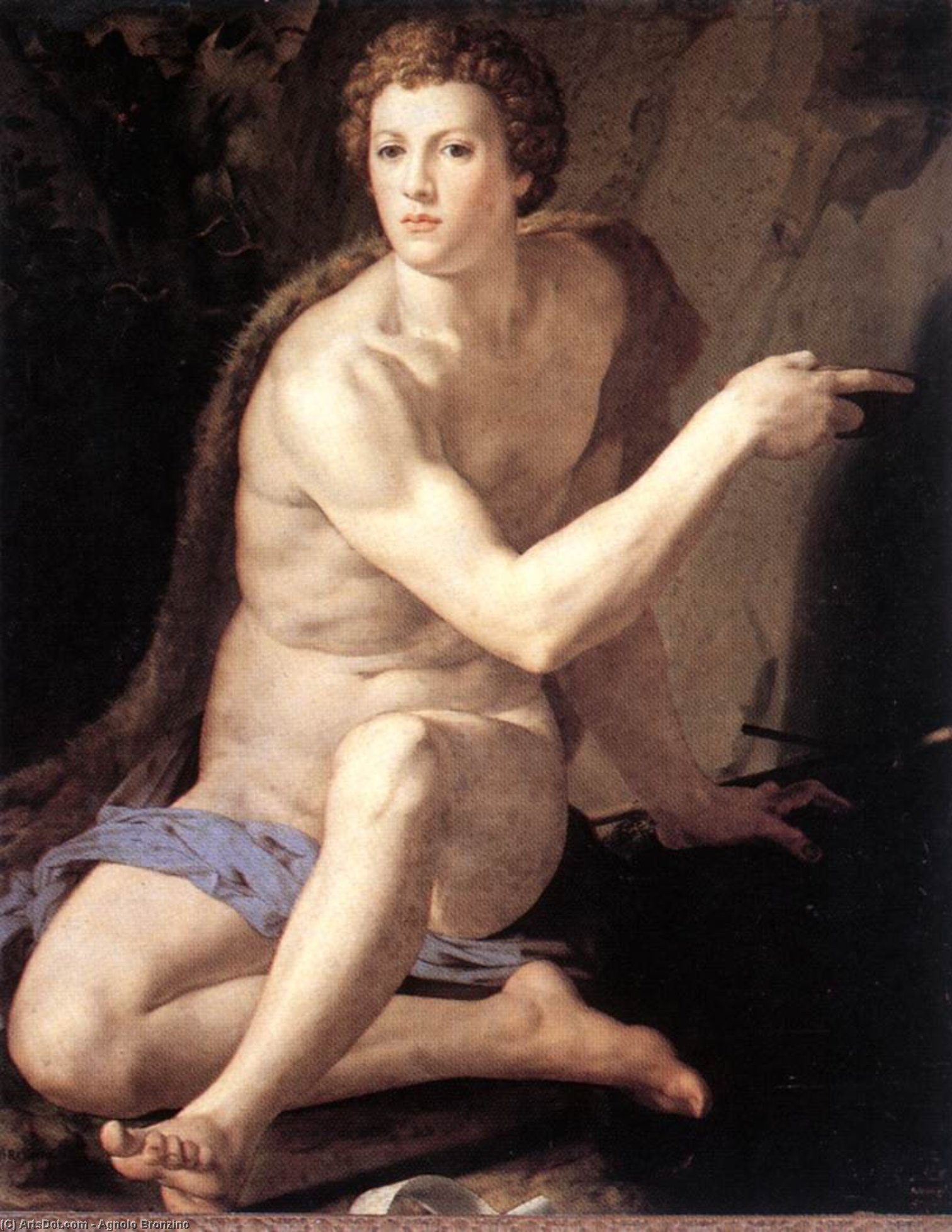
Agnolo Bronzino's "St. John the Baptist," painted in 1550 and currently residing within the Galleria Borghese in Rome, is a masterful embodiment of Mannerist artistry—a period characterized by its deliberate elegance, stylized forms, and subtle psychological depth. This arresting image transcends mere portraiture; it’s an exploration of religious iconography interwoven with a profound sense of introspection and restrained emotion. The painting immediately draws the eye to the figure of St. John himself, seated on the ground in a pose that is both dynamic and subtly unsettling. His muscular physique, rendered with Bronzino's signature cool precision, contrasts sharply with the vulnerability suggested by his exposed nudity and downward-pointing hand – a gesture simultaneously inviting and enigmatic.
Bronzino’s technique is immediately recognizable: a meticulous layering of glazes that create an almost luminous surface. The colors are muted yet rich, dominated by deep blues, browns, and ochres, contributing to the painting's overall sense of stillness and formality. Notice how the folds of his garment are not simply painted but built up through countless thin layers, creating a tactile quality that invites close examination. This painstaking attention to detail is characteristic of Bronzino’s work, reflecting his position as one of Florence’s most sought-after court painters – a role demanding both technical mastery and an ability to capture the refined sensibilities of his aristocratic patrons.
The Symbolism of Restraint
Beyond its formal beauty, “St. John the Baptist” is laden with symbolic meaning. The figure's nudity, while reflecting his baptismal origins, also speaks to a deeper sense of vulnerability and exposure. He’s not depicted as a heroic warrior or triumphant prophet; instead, he embodies a quiet contemplation, a man wrestling with his role as herald of Christ. The blue cloth draped around him is particularly significant – often interpreted as representing the heavens, suggesting John's connection to divine revelation. The upward pointing hand, a gesture frequently associated with prophecy and judgment, adds another layer of complexity, hinting at the weighty responsibility he carries.
Furthermore, Bronzino’s choice of pose—the twisting torso, the slightly angled head—is deliberately unnaturalistic, a hallmark of Mannerism. This departure from classical ideals wasn't simply an aesthetic preference; it served to heighten the emotional intensity and psychological complexity of the subject. Bronzino was less interested in capturing a realistic likeness than in conveying a particular mood or state of mind – a quality that distinguishes his work from the more naturalistic styles prevalent during the High Renaissance.
Context within Florentine Art
To understand Bronzino’s “St. John the Baptist,” it's crucial to consider its place within the broader artistic landscape of Florence in the mid-16th century. Following the innovations of Leonardo da Vinci and Michelangelo, artists like Bronzino were pushing the boundaries of representation, exploring new ways to express emotion and create visual drama. He was influenced by Jacopo Pontormo’s innovative style but ultimately forged his own distinct voice—one characterized by a cool composure and refined detail markedly different from Pontormo’s often emotionally charged works. Bronzino's work reflects the patronage of Cosimo I de' Medici, Grand Duke of Tuscany, who commissioned numerous portraits and allegorical paintings to decorate the lavish palaces and chapels of Florence.
A Reproduction for Your Space
OriginalUniqueArt offers meticulously crafted hand-painted reproductions of Agnolo Bronzino’s “St. John the Baptist,” capturing the artist's exquisite detail and evocative atmosphere with unparalleled fidelity. Whether you are a seasoned art collector, an interior designer seeking to elevate your space, or simply an admirer of Renaissance beauty, our reproduction provides a stunning way to experience this iconic masterpiece. Each reproduction is created using traditional techniques and archival-quality materials, ensuring its longevity and preserving the rich colors and textures of Bronzino’s original work. Bring the enigmatic gaze of St. John into your home and immerse yourself in the timeless elegance of Mannerist art.
Biographie de l'artiste
Premières années et formation
Agnolo di Cosimo, connu sous le nom de Bronzino ou Il Bronzino, est né à Florence, en Italie, le 17 novembre 1503. Fils d'un boucher, il commença sa formation artistique auprès de Raffaellino del Garbo, puis devint l’apprenti du Pontormo, un peintre maniériste renommé.Style artistique et influences
Le style de Bronzino se caractérise par des figures élégantes, calmes et réservées, souvent dépourvues de l'agitation et de l'émotion que l'on retrouve dans les œuvres de son maître, Pontormo. Ses portraits, en particulier ceux de la noblesse florentine, sont réputés pour leur attention minutieuse aux détails et ont influencé la portraiture des cours européennes pendant des siècles.Œuvres notables
- Vénus, Cupidon, Folly et le Temps (c. 1544-45), actuellement à la National Gallery de Londres
- Portraits de Cosimo I de' Medici et de son épouse Eleonora di Toledo, illustrant la maîtrise de Bronzino dans la portraiture maniériste
- Portraits idéalisés des poètes Dante (c. 1530, actuellement à Washington, D.C.) et Pétrarque
Héritage et vie ultérieure
Bronzino devint le peintre officiel de la cour du duc de Toscane et occupa ce poste pendant la majeure partie de sa carrière. Il fut également membre fondateur de l'Accademia delle Arti del Disegno à Florence en 1563. Bronzino est décédé le 23 novembre 1572, à Florence.- Découvrez plus d’œuvres d’Agnolo Bronzino sur https://OriginalUniqueArt.com/@/agnolo_bronzino
- Explorez le mouvement artistique baroque florentin et son influence sur l'art occidental sur https://OriginalUniqueArt.com/@@/a@d3cpvx
- Découvrez davantage sur le mouvement artistique de la Renaissance italienne et son impact sur l'art occidental sur /fr/art/show/art-d3cpud-fr/
- 17 novembre 1503 : né à Florence, en Italie
- 1539 : a reçu le patronage des Médicis pour le mariage de Cosimo I de' Medici avec Eleonora di Toledo
- 23 novembre 1572 : décédé à Florence

Agnolo Bronzino
1503 - 1572 , Italie
L'essentiel de l'artiste
- Artistes Influents:
- Pontormo
- Raffaellino del Garbo
- Date De Décès: 23 novembre 1572
- Date De Naissance: 17 novembre 1503
- Influences Artistiques:
- Portraits européens
- Courtoisie italienne
- Lieu De Naissance: Florence, Italie
- Mouvement Artistique: Manierisme
- Nationalité: Italienne
- Nom Complet: Agnolo Bronzino
- Œuvres Notables:
- Vénus, Cupidon et le Temps
- Portraits des Médicis
- Portrait de Dante
- Portrait de Pétrarque
Articles connexes

John Singer Sargent : Les 25 Œuvres Maîtresses d'un Portraitiste Éminent | OriginalUniqueArt
Plongez dans l'univers de John Singer Sargent : découvrez les 25 œuvres qui ont marqué l'histoire de l'art. Portraits impressionnants, réalisme exquis et couleurs vibrantes. Retrouvez ces chefs-d'œuvre en reproduction haute définition sur OriginalUniqueArt.com.

Constable : Les 25 Chefs-d'Œuvre du Maître Anglais | OriginalUniqueArt
Plongez dans l'univers de John Constable avec les 25 œuvres incontournables du maître anglais. Découvrez l'histoire, la technique et l'émotion derrière ses paysages romantiques. Reproductions de qualité muséale sur OriginalUniqueArt.com.

L'Huile sur Toile : Exploration Historique et Technique d'un Médium Artistique Intemporel
Explorez l'histoire fascinante de la peinture à l'huile, des techniques ancestrales aux maîtres flamands comme Van Eyck. Découvrez les secrets des pigments, liants et glacis pour comprendre cet art intemporel.

The Enduring Legacy of Oil on Canvas: Technique, History & Aesthetic Impact
Explore the rich history & techniques of oil painting – from Renaissance masters to Impressionism. Discover pigments, layering methods, and why this timeless medium endures. Expert insights for artists & art enthusiasts.

The Enduring Power of Painting: A Historical & Contemporary Exploration of Form and Emotion
Explore the rich history & enduring techniques of oil painting with OriginalUniqueArt. Discover masterpieces, learn about art collecting, and find authentic handmade reproductions crafted by skilled artists.