Salvator Rosa muotokuva

Salvator Rosa -maalaukset: Gallerian silmin 100 kuuluisinta teosta

Päivitetty marraskuu 2026 · järjestetty suosituimmuuspisteiden mukaan (jokaisen teoksen haut, vierailut ja tilaukset) · 274 teosta taiteilijalta Salvator Rosa luettelossamme

Lyhyesti

Gallerian silmissä Salvator Rosa's tunnetuin maalaus on The Baptism of the Eunuch (1660), jonka alkuperäinen teos on esillä Chrysler Museum of Art -museossa, kaupungissa Norfolk. Pythagoras Nousi Hadessta (1662) ja Landscape with St Jerome (1670) täydentävät kolmikon, jonka jokainen silmä tunnistaa. Galleria esittelee Salvator Rosa teoksista 274 tunnetuimmat 100 teosta alla; jokainen on alkuperäisteos, josta kerrotaan vuosi, museo sekä teoksen erityispiirteet.

1615 – 1673, Napoli Baroque style Eniten teoksia: Bavarian State Painting Collections

Gallerian 10 parasta Salvator Rosa -maalausta

1
The Baptism of the Eunuch (1660) tekijä Salvator Rosa

The Baptism of the Eunuch

1660 · Oil On Canvas · Chrysler Museum of Art, Norfolk

In "The Baptism of the Eunuch" by Salvator Rosa, a profound moment of spiritual transformation unfolds within a rugged landscape. Created in 1660, the scene captures the precise instant of a man's rebirth through water. A figure, dressed in a white robe, receives the sacrament from another person. This act of baptism occurs amidst a natural setting where rocks rise from the earth, grounding the sacred event in a physical,…

2
Pythagoras Nousi Hadessta (1662) tekijä Salvator Rosa

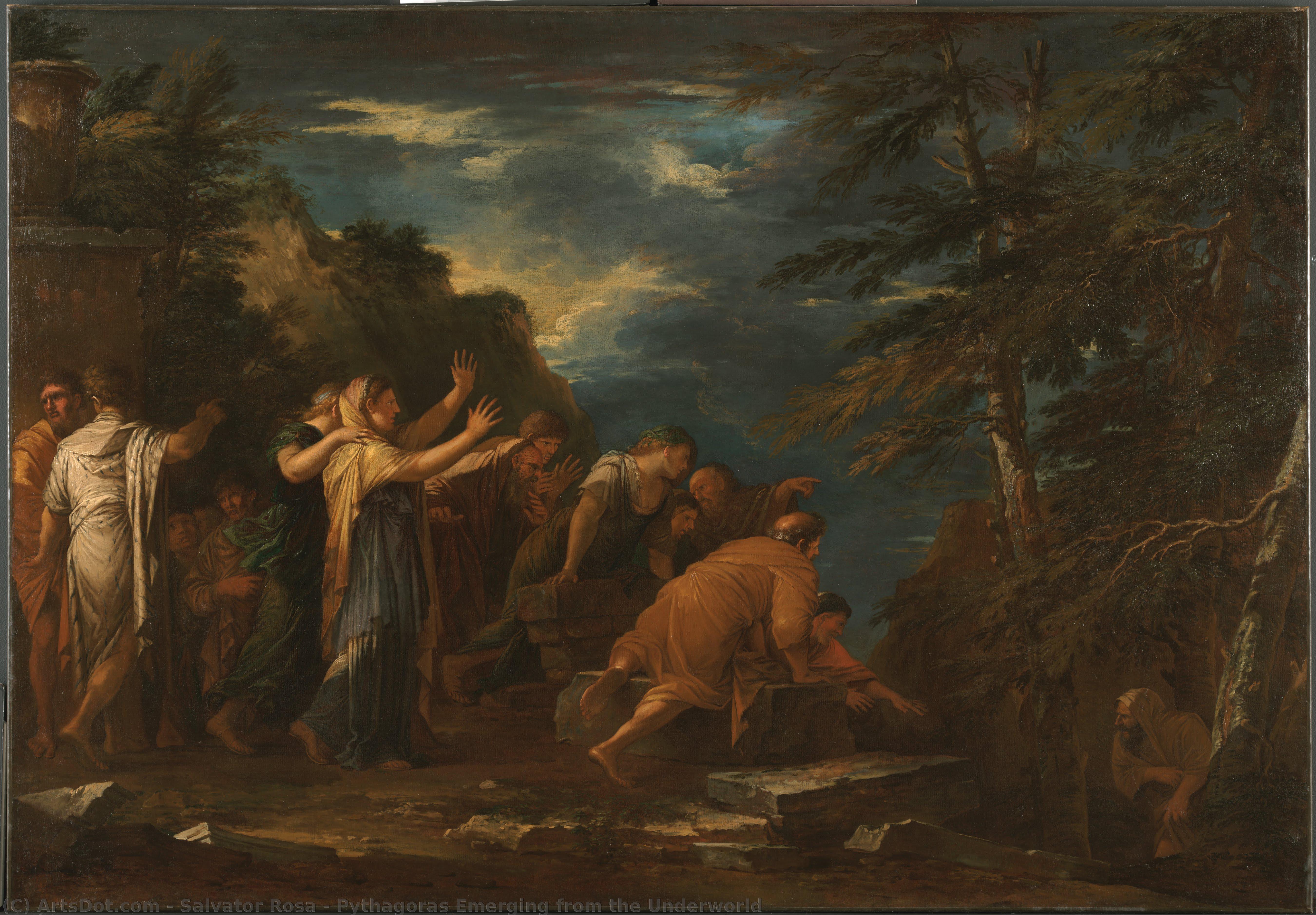
Pythagoras Nousi Hadessta

1662 · Öljyväri kankaalle · Kimbell Art Museum, Fort Worth

Pythagoras Emerging from the Underworld – Salvator Rosa’s Dramatic Vision of Myth and Philosophy Salvator Rosa’s “Pythagoras Emerging from the Underworld” is more than just a painting; it's a testament to Baroque artistry infused with profound philosophical contemplation. Executed in 1662, this monumental canvas—now housed at the Kimbell Art Museum in Fort Worth—captures a pivotal moment from Greek mythology: Pythagoras’s arduous journey back from Hades, guided by two women symbolizing…

3
Landscape with St Jerome (1670) tekijä Salvator Rosa

Landscape with St Jerome

1670 · Oil On Canvas · Condé-museo, Chantilly

A rugged, mountainous gorge dominates the vertical composition, creating a sense of isolation through deep, narrow canyons. The landscape is defined by jagged, irregular rock faces and the skeletal, tangled branches of overhanging trees. Earthy tones of ochre, deep brown, and muted green establish a somber atmosphere, while a luminous patch of sky at the top center provides a sharp contrast to the shadows below. Within this untamed environment, a…

4
Head of a Man with a Turban (1652) tekijä Salvator Rosa

Head of a Man with a Turban

1652 · Oil On Canvas · Birmingham Museum and Art Gallery, Birmingham

A single light source strikes the left side of a weathered face, carving it out of a heavy, ink-black void. The man’s gaze is steady, meeting the viewer with a quiet, stoic intensity. He wears a voluminous turban, its cream and ochre folds catching the light, revealing the coarse texture of the cloth. Deep shadows swallow the right side of his head, merging his beard and the nape of his…

5
Tobias and the Angel (1662) tekijä Salvator Rosa

Tobias and the Angel

1662 · Oil On Canvas · Condé-museo, Chantilly

The canvas holds a vertical tension, a sudden movement between the heavens and the earth. A celestial figure descends, cutting through a darkness that feels heavy and thick. This is the moment of intervention, where the divine enters the realm of the mortal. Light does not merely illuminate; it strikes. It catches the curve of a reaching hand and the pale skin of a kneeling figure, leaving the rest of…

6
Return of Astrea (1642) tekijä Salvator Rosa

Return of Astrea

1642 · Oil On Canvas · Kunsthistorisches Museum, Wien

A heavy, weathered stone structure anchors the left side of the canvas, its crumbling edges catching the light. Beside it, a gnarled tree leans into the frame, its dark branches reaching like fingers toward a vast, cloud-filled sky. In the lower foreground, rustic figures move through the shadows of the ruins. A man in white and blue stands amidst the earthy tones of ochre and sienna. Above this earthly realm,…

7
Daniel in the Lion's Den (1662) tekijä Salvator Rosa

Daniel in the Lion's Den

1662 · Oil On Canvas · Condé-museo, Chantilly

Salvator Rosa painted Daniel in the Lion's Den as a profound exercise in religious art. This oil on canvas work emerged after 1662, a period when the artist sought to expand his reputation beyond the rugged landscapes for which he was known. The composition belongs to a larger, cohesive cycle of five thematically linked Biblical stories. These paintings were executed for Carlo de' Rossi, intended to decorate a private chapel…

8
Crucifixion of Polyclitus (1650) tekijä Salvator Rosa

Crucifixion of Polyclitus

1650 · Oil · National Museum in Warsaw, Varsova

In this dramatic Baroque oil painting, we find ourselves witnessing a moment of profound martyrdom. The composition is built upon a restless diagonal, pulling the eye from a crowded, agitated group of figures in the lower left toward the central figure of Polyclitus, suspended upon the cross in the upper right. The landscape is not a place of peace; it is a rugged, mountainous terrain of craggy rocks and turbulent…

9
Jesus carrying the cross (1667) tekijä Salvator Rosa

Jesus carrying the cross

1667 · Oil · Condé-museo, Chantilly

A heavy, wooden cross dominates the composition, its diagonal thrust cutting through a turbulent scene of physical and spiritual struggle. Christ is caught in a moment of intense exertion, his body strained under the burden of the timber. Around him, a crowd of onlookers and tormentors creates a sense of claustrophobic chaos. The arrangement of figures is agitated, driving the eye across the canvas in a series of sharp, conflicting…

10
Witches at their Incantations (1646) tekijä Salvator Rosa

Witches at their Incantations

1646 · Oil On Canvas · National Gallery, Lontoo

The shadows deepen as we encounter Witches at their Incantations, a work that pulls the viewer into a dark, nocturnal ritual. Painted by Salvator Rosa about 1646, the scene captures a gathering of figures caught in the midst of a witches' sabbath. This macabre assembly unfolds beneath a heavy, cloud-covered sky, where the line between the human and the monstrous begins to blur. It is a moment of profound unrest,…

Salvator Rosa -taideteokset, sijoitukset 11–100

11Group of Warriors (1644) tekijä Salvator RosaGroup of Warriors1644 · Bavarian State Painting Collections 12Self-Portrait as Philosopher of Silence (1641) tekijä Salvator RosaSelf-Portrait as Philosopher of Silence1641 · National Gallery 13Landscape with Bather (1660) tekijä Salvator RosaLandscape with Bather1660 · Yale University Art Gallery 14Saint John the Baptist Baptizing Christ in the Jordan (1655) tekijä Salvator RosaSaint John the Baptist Baptizing Christ in the Jordan1655 · Kelvingrove Art Gallery and Museum 15Jeremie pulled from the cistern (1622) tekijä Salvator RosaJeremie pulled from the cistern1622 · Condé-museo 16Armed Robbers in Rocky Countryside (1644) tekijä Salvator RosaArmed Robbers in Rocky Countryside1644 · Bavarian State Painting Collections 17Jonah Preaching to the People of Niniveh (1645) tekijä Salvator RosaJonah Preaching to the People of Niniveh1645 · Statens Museum for Kunst 18Prometheus on the Rock (1644) tekijä Salvator RosaPrometheus on the Rock1644 · Bavarian State Painting Collections 19Mountain Landscape (1644) tekijä Salvator RosaMountain Landscape1644 · Bavarian State Painting Collections 20Landscape with Saint Anthony Abbot and Saint Paul the Hermit (1662) tekijä Salvator RosaLandscape with Saint Anthony Abbot and Saint Paul the Hermit1662 · Scottish National Gallery 21Study for 'Il Genio di Rosa' tekijä Salvator RosaStudy for 'Il Genio di Rosa' 22Astraea Leaves The Earth (1665) tekijä Salvator RosaAstraea Leaves The Earth1665 · Kunsthistorisches Museum 23An Evangelist (1635) tekijä Salvator RosaAn Evangelist1635 · Israelin museo 24The War People of Gideon (1644) tekijä Salvator RosaThe War People of Gideon1644 · Bavarian State Painting Collections 25Allegory of Study (1647) tekijä Salvator RosaAllegory of Study1647 · John and Mable Ringlingin taidemuseo 26Scenes of Witchcraft: Night (1640) tekijä Salvator RosaScenes of Witchcraft: Night1640 · Clevelandin taidemuseo 27Scenes of Witchcraft: Evening (1640) tekijä Salvator RosaScenes of Witchcraft: Evening1640 · Clevelandin taidemuseo 28Scenes of Witchcraft: Day (1640) tekijä Salvator RosaScenes of Witchcraft: Day1640 · Clevelandin taidemuseo 29Scenes of Witchcraft: Morning (1640) tekijä Salvator RosaScenes of Witchcraft: Morning1640 · Clevelandin taidemuseo 30A Philosopher (1643) tekijä Salvator RosaA Philosopher1643 · Kedleston Hall 31The Founding of Thebes (1645) tekijä Salvator RosaThe Founding of Thebes1645 · Statens Museum for Kunst 32The Martyrdom of Saint Januarius and his Fellows (1650) tekijä Salvator RosaThe Martyrdom of Saint Januarius and his Fellows1650 · Städel Museum 33Head of a Philosopher, called 'Democritus' (1659) tekijä Salvator RosaHead of a Philosopher, called 'Democritus'1659 34Bandits robbing Travellers (1656) tekijä Salvator RosaBandits robbing Travellers1656 · Knole House 35Anchorites Tempted by Demons (1660) tekijä Salvator RosaAnchorites Tempted by Demons1660 · Galleria Nazionale d'Arte Antica 36Three Marys at the Tomb (1665) tekijä Salvator RosaThree Marys at the Tomb1665 · John and Mable Ringlingin taidemuseo 37Christ expelling the Money Changers from the Temple (1664) tekijä Salvator RosaChrist expelling the Money Changers from the Temple1664 · Attingham Park 38The Angel Leaving the House of Tobias (1662) tekijä Salvator RosaThe Angel Leaving the House of Tobias1662 39Cavalieri in Marcia (1673) tekijä Salvator RosaCavalieri in Marcia1673 40Self-Portrait (1650) tekijä Salvator RosaSelf-Portrait1650 · Detroit Institute of Arts 41Saint Simon the Apostle (1673) tekijä Salvator RosaSaint Simon the Apostle1673 · Georgia Museum of Art 42Landscape with Armed Men (1640) tekijä Salvator RosaLandscape with Armed Men1640 · Los Angelesin maakunnallinen taidemuseo 43St. Francis in Ecstasy tekijä Salvator RosaSt. Francis in EcstasyThe Phillips Collection 44Fall of the Giants tekijä Salvator RosaFall of the Giants 45Saint Humphrey (Onuphrius) (1660) tekijä Salvator RosaSaint Humphrey (Onuphrius)1660 · Minneapolis Institute of Art 46Landscape with an "Arco Naturale" (1651) tekijä Salvator RosaLandscape with an "Arco Naturale"1651 · Statens Museum for Kunst 47Odysseus and Nausicaa (1655) tekijä Salvator RosaOdysseus and Nausicaa1655 · Los Angelesin maakunnallinen taidemuseo 48Sleeping Warrior (1644) tekijä Salvator RosaSleeping Warrior1644 · Bavarian State Painting Collections 49Ceres and Phytalus (1662) tekijä Salvator RosaCeres and Phytalus1662 · Los Angelesin maakunnallinen taidemuseo 50Witches at their Incantations tekijä Salvator RosaWitches at their Incantations 51A Cavalry Battle (1652) tekijä Salvator RosaA Cavalry Battle1652 · Auckland Art Gallery Toi o Tāmaki 52Desolate Landscape with Two Figures (1662) tekijä Salvator RosaDesolate Landscape with Two Figures1662 · Scottish National Gallery 53Landscape with Mercury and the Dishonest Woodman (1652) tekijä Salvator RosaLandscape with Mercury and the Dishonest Woodman1652 · National Gallery 54Landscape with Warriors (1644) tekijä Salvator RosaLandscape with Warriors1644 · Bavarian State Painting Collections 55Landscape with Armed Men (1640) tekijä Salvator RosaLandscape with Armed Men1640 · Los Angelesin maakunnallinen taidemuseo 56Glaucus and Scylla (1661) tekijä Salvator RosaGlaucus and Scylla1661 · Los Angelesin maakunnallinen taidemuseo 57The Raising of Lazarus tekijä Salvator RosaThe Raising of LazarusCondé-museo 58Still Life (1673) tekijä Salvator RosaStill Life1673 · Bavarian State Painting Collections 59Youth with An Effigy of Diana of Ephesus (1657) tekijä Salvator RosaYouth with An Effigy of Diana of Ephesus1657 · Royal Collection 60River Landscape with Apollo and the Cumean Sibyl (1655) tekijä Salvator RosaRiver Landscape with Apollo and the Cumean Sibyl1655 · Wallace Collection 61Rocky Landscape with a Huntsman and Warriors (1670) tekijä Salvator RosaRocky Landscape with a Huntsman and Warriors1670 · Louvre 62The Finding of Moses (1650) tekijä Salvator RosaThe Finding of Moses1650 · Kimbell Art Museum 63Bandits on a Rocky Coast (1656) tekijä Salvator RosaBandits on a Rocky Coast1656 · Metropolitan Museum of Art 64Standing Warror with Shield (1657) tekijä Salvator RosaStanding Warror with Shield1657 · Los Angelesin maakunnallinen taidemuseo 65Saint John the Baptist Revealing Christ to the Disciples (1655) tekijä Salvator RosaSaint John the Baptist Revealing Christ to the Disciples1655 · Kelvingrove Art Gallery and Museum 66Pythagoras and the Fisherman (1662) tekijä Salvator RosaPythagoras and the Fisherman1662 · Staatliche Museen zu Berlin 67Rocky Landscape (1644) tekijä Salvator RosaRocky Landscape1644 · Bavarian State Painting Collections 68A Pass with Travellers attacked by Bandits (1627) tekijä Salvator RosaA Pass with Travellers attacked by Bandits1627 · Knole House 69Bay in a Calm Sea (1644) tekijä Salvator RosaBay in a Calm Sea1644 · Bavarian State Painting Collections 70Sea Storm (1644) tekijä Salvator RosaSea Storm1644 · Bavarian State Painting Collections 71Sea Bay with Rocky Coast (1644) tekijä Salvator RosaSea Bay with Rocky Coast1644 · Bavarian State Painting Collections 72Landscape with Riders (1644) tekijä Salvator RosaLandscape with Riders1644 · Bavarian State Painting Collections 73Sea Storm (1644) tekijä Salvator RosaSea Storm1644 · Bavarian State Painting Collections 74Mountain Landscape (1644) tekijä Salvator RosaMountain Landscape1644 · Bavarian State Painting Collections 75Rocky Coast at a Bay (1644) tekijä Salvator RosaRocky Coast at a Bay1644 · Bavarian State Painting Collections 76Bay by Turbulent Sea (1644) tekijä Salvator RosaBay by Turbulent Sea1644 · Bavarian State Painting Collections 77Seastorm (1644) tekijä Salvator RosaSeastorm1644 · Bavarian State Painting Collections 78Wild rocky landscape (1644) tekijä Salvator RosaWild rocky landscape1644 · Bavarian State Painting Collections 79Sea bay with castle ruins (1644) tekijä Salvator RosaSea bay with castle ruins1644 · Bavarian State Painting Collections 80Coastal Landscape with Castle (1644) tekijä Salvator RosaCoastal Landscape with Castle1644 · Bavarian State Painting Collections 81Lucrezia as Poetry (1641) tekijä Salvator RosaLucrezia as Poetry1641 · Wadsworth Atheneum Museum of Art 82Evening Landscape (1640) tekijä Salvator RosaEvening Landscape1640 83Harbour with Ruins (1640) tekijä Salvator RosaHarbour with Ruins1640 · Szépművészeti Múzeum 84St John Preaching (1660) tekijä Salvator RosaSt John Preaching1660 · York Art Gallery 85Rocky Landscape with Figures (1660) tekijä Salvator RosaRocky Landscape with Figures1660 86The Finding of Moses (1660) tekijä Salvator RosaThe Finding of Moses1660 · Detroit Institute of Arts 87The Return of the Prodigal Son (1660) tekijä Salvator RosaThe Return of the Prodigal Son1660 · National Gallery of Canada 88A Seaport (1651) tekijä Salvator RosaA Seaport1651 · Statens Museum for Kunst 89Southern Harbour (1651) tekijä Salvator RosaSouthern Harbour1651 · Statens Museum for Kunst 90Rocky landscape with figures (1651) tekijä Salvator RosaRocky landscape with figures1651 91Landscape with figures (1651) tekijä Salvator RosaLandscape with figures1651 92Landscape with Tower and Boat (1660) tekijä Salvator RosaLandscape with Tower and Boat1660 · Condé-museo 93Christ resurrected tekijä Salvator RosaChrist resurrectedCondé-museo 94the Witches' Sabbath (1654) tekijä Salvator Rosathe Witches' Sabbath1654 · Museum of Fine Arts 95Glaucus and Scylla (1661) tekijä Salvator RosaGlaucus and Scylla1661 · Art Gallery of South Australia 96Diogenes Throwing Away His Drinking Cup. (1651) tekijä Salvator RosaDiogenes Throwing Away His Drinking Cup.1651 · Statens Museum for Kunst 97Wooded Landscape (1650) tekijä Salvator RosaWooded Landscape1650 98Portrait of the Artist's Wife Lucrezia (1657) tekijä Salvator RosaPortrait of the Artist's Wife Lucrezia1657 · Galleria Nazionale d'Arte Antica 99Diogenes Casting away his Cup (1650) tekijä Salvator RosaDiogenes Casting away his Cup1650 · Museum of Fine Arts 100Landscape with a Wide River, Waterfall and Three Figures (1665) tekijä Salvator RosaLandscape with a Wide River, Waterfall and Three Figures1665 · John and Mable Ringlingin taidemuseo

Salvator Rosan kuuluisat maalaukset aikakausittain

Aiheet, jotka vangitsivat Salvator Rosain katseen

Nämä neljä aihetta toistuvat näissä alkuperäisteoksissa useimmin, jokaisesta löytyy hienoin esimerkki.

Museot, joissa Salvator Rosa'n alkuperäisteokset sijaitsevat

Tämän sivun teoksista eniten sisältävät 8 museota.

Museo Kaupunki Salvator Rosa teokset Tämän listan maalaukset
Bavarian State Painting Collections, MünchenBavarian State Painting Collections München 21 Group of Warriors, Armed Robbers in Rocky Countryside, Prometheus on the Rock
Condé-museo, ChantillyCondé-museo Chantilly 9 Landscape with St Jerome, Tobias and the Angel, Daniel in the Lion's Den
Statens Museum for Kunst, KööpenhaminaStatens Museum for Kunst Kööpenhamina 10 Jonah Preaching to the People of Niniveh, The Founding of Thebes, Landscape with an "Arco Naturale"
Los Angelesin maakunnallinen taidemuseo, Los AngelesLos Angelesin maakunnallinen taidemuseo Los Angeles 7 Landscape with Armed Men, Odysseus and Nausicaa, Ceres and Phytalus
Clevelandin taidemuseo, ClevelandClevelandin taidemuseo Cleveland 5 Scenes of Witchcraft: Night, Scenes of Witchcraft: Evening, Scenes of Witchcraft: Day
National Gallery, LontooNational Gallery Lontoo 7 Witches at their Incantations, Self-Portrait as Philosopher of Silence, Landscape with Mercury and the Dishonest Woodman
John and Mable Ringlingin taidemuseo, SarasotaJohn and Mable Ringlingin taidemuseo Sarasota 4 Allegory of Study, Three Marys at the Tomb, Landscape with a Wide River, Waterfall and Three Figures
Kunsthistorisches Museum, WienKunsthistorisches Museum Wien 4 Return of Astrea, Astraea Leaves The Earth

Salvator Rosa, yksi tunnusomainen maalaus vuosikymmeneltä

Teokset vuosikymmenittäin

Valitse vuosikymmen nähdäksesi sen määrittäneen alkuperäisteoksen.

Salvator Rosan maalaukset: gallerian vastaukset

Mikä Salvator Rosa -taideteos on kaikkien kuuluisin?Paljasta vastaus

The Baptism of the Eunuch (1660), Chrysler Museum of Art, Norfolk. Seuraavina ovat Pythagoras Nousi Hadessta (1662) ja Landscape with St Jerome (1670).

Kuinka vanha Salvator Rosa oli valmistuessaan teos The Baptism of the Eunuch?Paljasta vastaus

45 vuotta vanha: The Baptism of the Eunuch on peräisin vuodelta 1660, ja Salvator Rosa on syntynyt vuonna 1615.

Mitkä ovat Salvator Rosa'n 10 parasta maalausta?Paljasta vastaus

The Baptism of the Eunuch, Pythagoras Nousi Hadessta, Landscape with St Jerome, Head of a Man with a Turban, Tobias and the Angel, Return of Astrea, Daniel in the Lion's Den, Crucifixion of Polyclitus, Jesus carrying the cross ja Witches at their Incantations. Yllä oleva sijoitus kertoo kunkin teoksen vuosiluvun ja museon.

Kuinka monta teosta Salvator Rosa loi?Paljasta vastaus

Katalogissamme on 274 teosta taiteilijalta Salvator Rosa, aikaväliltä 1627–1673.

Missä Salvator Rosa'n kuuluisimmat alkuperäisteokset sijaitsevat?Paljasta vastaus

Pääasiassa Bavarian State Painting Collections (München), Condé-museo (Chantilly) ja Statens Museum for Kunst (Kööpenhamina). Yllä oleva museotaulukko listaa ne kaikki.

Milloin Salvator Rosa maalasi kuuluisimmat teoksensa?Paljasta vastaus

Aikakaudella 1640s: 36 sivun 100 teoksista on tehty silloin, joista Return of Astrea.

Mitkä ovat Salvator Rosa'n varhaisimmat ja viimeisimmät kuuluisat teokset?Paljasta vastaus

Tällä sivulla vanhin on A Pass with Travellers attacked by Bandits (1627) ja uusin Cavalieri in Marcia (1673).

Mihin aiheisiin Salvator Rosa palasi useimmin?Paljasta vastaus

Sky (25), People (25) ja Figures (18), yhteensä 100 teosta tällä sivulla.

Mitä tekniikkaa Salvator Rosa käytti eniten?Paljasta vastaus

Oil On Canvas, 50 teoksesta sivun 100 teoksesta.

Mihin taidesuuntaukseen Salvator Rosa kuuluu?Paljasta vastaus

Baroque style, tämän sivun alkuperäisteosten perusteella.

Mitä Salvator Rosa -taiteilijan alkuperäisteoksia Bavarian State Painting Collections -museossa on?Paljasta vastaus

Group of Warriors, Armed Robbers in Rocky Countryside ja Prometheus on the Rock: Bavarian State Painting Collections, München -ssä on 21 tämän sivun teoksista.

Salvator Rosa: taiteilija

Nuoruus, perhe ja koulutus

Napolin esikaupunkialueella, tarkemmin ottaen Arenellassa, Salvator Rosa saapuu maailmaan. Hänen syntymäaikansa on edelleen historiallinen kiistakysymys, ja se sijoittuu joko 20. kesäkuuta tai 21. heinäkuuta vuonna 1615. Hän syntyy perheeseen, jolla on erottuva sukutausta; hänen äitinsä, Giulia Greca Rosa, kuuluu yhteen Sisilian kreikkalaisista suvuista, kun taas hänen isänsä, Vito Antonio de Rosa, työskentelee maanmittaajana. Vesuviuksen varjo lankeaa hänen varhaislapsuutensa ylle – geologinen läsnäolo, joka tulee lopulta muovaamaan hänen visuaalista kieltään.

Konflikti määrittää hänen polkunsa kohti kutsumustaan. Hänen isänsä, tavoitellen pojalleen vakaampaa ja perinteisempää elämää, aikoo Salvator Rosan hakevan papiksi tai seuraavan uraa juristina. Somaschi-isien luostari on määränpää, joka hänelle on varattu. Pojan kiinnostus kuitenkin vetää muualle. Hän kääntyy pois uskonnollisesta elämästä ja tavoittelee taidetta salaa. Äidin veljen, Paolo Grecon, hiljaisessa suojeluksessa hän alkaa hallita ammattinsa perusteita. Tämä salainen koulutus jatkuu, kun hän siirtyy Francesco Fracanzanon ohjauksen piiriin, imien itseensä tekniset perusteet, jotka myöhemmin antavat hänelle voiman haastaa barokin aikakauden vakiintuneet esteettiset normit.

Taiteellinen ura Napolissa, Roomassa ja Firenzessä

Salvator Rosan uran kulku muuttuu jatkuvasti 1600-luvun Italian poliittisten ja sosiaalisten virtausten mukana. Vuonna 1635 hän jättää syntymäkotinsa Napolin ja suuntaa Roomaan, joka oli aikakauden kiistaton taiteen keskus. Hän palaa Napoliin vuonna 1637, mutta hänen läsnäolonsa kaupungissa muuttuu yhä levottomammaksi. Vuoteen 1648 mennessä taiteilija joutuu pakenemaan Napolista kokonaan, kun hän päätyy osalliseksi epäonnistuneeseen kapinaan espanjalaisia hallitsijoita vastaan. Tämä kapinallinen ajanjakso merkitsee lopullista murrosta hänen varhaisista vuosistaan.

Hänen myöhempi matkansa vie hänet Firentseen. Tämä toinen kausi kaupungissa tarjoaa erilaista vuorovaikutusta maailman kanssa. Ateljeen seinien ulkopuolella Rosa uppoutuu florentilaisten piirien älylliseen ja aistilliseen elämään. Hän viettää tuntinsa soittaen musiikkia, kirjoittaen runoutta ja opiskellen stoalaista filosofiaa. Tämä monivaiheinen elämäntapa antaa syvyyttä hänen myöhemmälle tuotannolleen, kun kirjallinen sana ja filosofinen ajattelu alkavat kietoutua yhteen hänen visuaalisen taiteensa kanssa.

Tekniikka ja tyyli

Salvator Rosan siveltimenjälki hylkää ne kiillotetut pinnat ja idealisoidut muodot, jotka määrittelivät suurta osaa barokin aikakaudesta. Sen sijaan hän syleilee epätavallista ja runsasta tyyliä, suosien raakaa ja kesyttämätöntä. Hän hallitsee mestarillisesti chiaroscuro-tekniikan, hyödyntäen valon ja varjon dramaattista vuoropuhelua muodon ja tunnelman veistämiseen. Tämä tekniikka tekee enemmän kuin vain määrittelee muotoja; se luo kankaalle jatkuvan jännityksen tunteen. Hänen maisemansa eivät ole idyllisiä pakopaikkoja pohdiskelulle, vaan ne luonnehditaan villiksi ja karuiksi. Myrskyisät taivaat ja rosoinen, kallioinen maasto hallitsevat hänen sommitelmiaan, heijastaen kiehtomusta luonnon arvaamattomaan voimaan.

Aihepiiri poikkeaa usein hänen aikalaistensa tavanomaisista uskonnollisista kohtauksista. Hän valitsee usein hämärämpiä ja esoteerisia aiheita, jotka on poimittu Raamatusta, mytologiasta ja filosofien elämästä. Tämä älyllinen kurinalaisuus muuttaa maiseman pelkästä taustasta aktiiviseksi ja keskeiseksi osalliseksi narratiivissa. Hänen käsissään ympäristöstä tulee moraalisen ja filosofisen pohdiskelun näyttämö. Hän esittää ihmishahmon usein marginaalisena, luonnon valtavan ja usein vihamielisen mittakaavan hämärtämänä.

Keskeiset teokset ja mestariteokset

Maalipinta muuttuu Salvator Rosan käsissä usein intensiivisen psykologisen pohdiskelun näyttämöksi. Vuoden 1641 teoksessa Self-Portrait as Philosopher of Silence, joka sijaitsee Lontoon National Galleryssä, taiteilija kohtaa katsojan hiljaisuuden linssin läpi. Tämä teos toimii meditaationa viisaudesta, hyödyntäen tummaa ja pohdiskelevia tunnelmaa oman identiteettinsä rakentamiseen. Samalla tavalla hänen vuoden 1645 Self-Portrait as a Philosopher -teoksensa National Galleryssä vahvistaa tätä ajattelevan miehen persoonaa, siirtyen pelkästä kuvauksesta kohti älyllisen kurinalaisuuden ilmaisua.

Luonto on Rosan käsissä harvoin rauhallinen tausta; se on myrskyisä voima. Noin vuonna 1640 syntyi Ruins in a Rocky Landscape, teos, joka on nykyään Cleveland Museum of Artissa. Se hyödyntää klassisia raunioita ja helmiäismäistä valoa viitaten jatkuvassa muutoksessa olevaan maailmaan. Tämä karuus ulottuu myös hänen mytologisiin ja allegorisiin sommitelmiinsa. Vuoden 1662 Pythagoras Emerging from the Underworld, joka sijaitsee Fort Worthin Kimbell Art Museumissa, käyttää dramaattista maisemakompositioita kuroakseen umpeen kuilun fyysisen ja metafyysisen välillä. Samalla tavalla Pietarin Hermitage-museossa oleva vuoden 1664 Democrito E Protagora hyödyntää filosofista allegoriaa, joka on sijoitettu dramaattisen maiseman keskelle.

Jopa uskonnolliset kertomukset kokevat muodonmuutoksen hänen siveltimensä alla. Vuonna 1660 luotu The Baptism of the Eunuch, joka kuuluu Norfolkin Chrysler Museum of Artin kokoelmiin, täyttää raamatullisen kohtauksen korkealla draamalla. Hänen kykynsä navigoida näiden moninaisten aiheiden välillä — mytologisesta pyhään — määrittelee hänen koko tuotantonsa syvyyden.

  • Self-Portrait as Philosopher of Silence (1641)
  • Pythagoras Emerging from the Underworld (1662)
  • Democrito E Protagora (1664)
  • The Baptism of the Eunuch (1660)
  • Ruins in a Rocky Landscape (noin 1640)

Perintö ja vaikutus

Salvator Rosan vaikutus heijastuu syvällä barokkitaiteen kehityksessä. Hänen poikkeamansa aikalaistensa ihanteellisista ja järjestyneistä maisemista luo jännitteen, joka muuttaa 1600-luvun maalaustaiteen suuntaa. Tämä vaikutus leviää vuosikymmenten halki, ulottuen myöhempien taiteilijoiden, kuten Luca Giordanon, teoksiin. Hän ei ainoastaan maalannut maisemia; hän rakensi visuaalisen kielen, jonka levottomuus ja voima säilyvät elävänä vielä pitkään hänen kuolemansa jälkeen.

Hänen romantisoituneet maisemansa ja historialliset maalauksensa säilyttävät vahvan läsnäolon 1600-luvulta aina 1800-luvun alkuun saakka. Nämä teokset toimivat romanttisen maisemamaalauksen prototyyppeinä, korvaten "piktorialiset" klassiset näkymät jollakin paljon arvaamattomammalla. Rauhallisten, pastoraalisten retriittien sijaan hän esittää luonnon villinä ja usein vihamielisenä. Tämä näkökulman muutos ennakoi sitä emotionaalista intensiteettiä, joka myöhemmin määritteli romanttisen liikkeen.

Hänen vision perintö löytyy ihmishahmon ja kesyttämättömän erämaan välisestä jännitteestä. Nostamalla maiseman keskeiseksi pääaiheeksi, sen sijaan että se olisi vain uskonnollisten tai mytologisten kertomusten tausta, hän muuttaa genrerajojen hierarkiaa. Hänen karut, kallioiset maastonsa ja myrskyisät taivastaansa tarjoavat pohjan ylevän estetiikalle, jossa luonto on kunnioitusta ja itsetutkiskelua herättävä voima, ei hallittu puutarha.

Missä teoksia voi nähdä tänään

Salvator Rosan levottoman uran fyysiset jäljet ovat siroteltuina Euroopan ja Amerikan suurten taidekeskusten eri puolille. Pietarissa Hermitaasimuseo säilyttää hänen varhaisen tyylinsä tarkkuuden teoksessa Portrait of a Man vuodelta 1640. Manner-Euroopan puolella Pariisin Louvre kantaa taiteilijan perintöä vuoden 1652 teoksella Heroic Battle. Nämä teokset ankkuroivat hänen läsnäolonsa 1600-luvun suurimpiin instituutioihin ja kokoelmiin.

Taiteilijan filosofiset ja mytologiset pohdiskelut ovat löytäneet tiensä myös erikoistuneisiin kokoelmiin. Lontoon National Galleryssa on esillä hänen vuoden 1645 Self-Portrait as a Philosopher -teoksensa, joka vangitsee hänen syvän kiinnostuksensa älylliseen ajatteluun. Fort Worthissa Kimbell Art Museumissa sijaitsee Pythagoras Emerging from the Underworld, vuoden 1662 sommitelma, joka korostaa hänen kykenevyyttään yhdistää myytti dramaattiseen maisemaan. Samaan aikaan New Yorkin Metropolitan Museum of Art säilyttää teoksen Bandits on a Rocky Coast vuodelta 1656, joka heijastaa sitä karua ja kesyttämätöntä luontoa, jota hän niin vahvasti suosi.