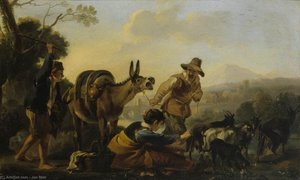
Jan Miel muotokuva

71 tunnetuinta Jan Miel -maalausta, jokainen ainutlaatuinen

Päivitetty marraskuu 2026 · järjestetty suosituimmuuspisteiden mukaan (jokaisen teoksen haut, vierailut ja tilaukset) · 71 teosta taiteilijalta Jan Miel luettelossamme

Lyhyesti

Scene from the Life of Tramps (Lazzaroni) (1650) on se Jan Miel -maalaus, joka herättää eniten huomiota; alkuperäisteos kuuluu museolle Hermitage-museo, Pietari. Sen jälkeen katse siirtyy kohteisiin Hunters at Rest (1650) ja Carnival Entertainment (1635). Jan Mielin 71 teoksemme joukosta nämä 71 ovat kuuluisimpia; jokainen on ainutlaatuinen alkuperäisteos, joka on esitelty vuosiluvun, museon ja sen syyn kera, miksi teos on säilyttänyt suosionsa.

1599 – 1663, Beveren Baroque Eniten teoksia: Hermitage-museo

Jan Miel -taiteilijan 10 parasta maalausta gallerian silmin

1
Scene from the Life of Tramps (Lazzaroni) (1650) tekijä Jan Miel

Scene from the Life of Tramps (Lazzaroni)

1650 · Oil On Canvas · Hermitage-museo, Pietari

A heavy, ochre light settles over the crumbling stone of ancient ruins. Here, the shadows are thick and deep, swallowing the corners of a chaotic street scene. Figures move through the haze of smoke and dust, their bodies caught in a sudden, sharp glare of sun. A man gestures with urgency, his hands carving shapes into the air, while others sit in the dirt, anchored by the weight of their…

2
Hunters at Rest (1650) tekijä Jan Miel

Hunters at Rest

1650 · Oil On Canvas · Hermitage-museo, Pietari

is an oil on canvas painting by the Flemish artist Jan Miel. Created about 1650, the work captures a quiet moment within a pastoral scene. It depicts a hunting party finding respite amidst the landscape. The scene is anchored by the presence of horses and the sturdy silhouette of a fortified tower.

3
Carnival Entertainment (1635) tekijä Jan Miel

Carnival Entertainment

1635 · Oil On Canvas · Bavarian State Painting Collections, München

In "Carnival Entertainment" by Jan Miel, we find ourselves amidst a dense and dynamic urban scene. The composition is crowded, capturing a street festival where a large group of figures occupies the foreground and middle ground. These individuals—musicians, dancers, and various onlookers—are arranged to create a sense of constant movement. The perspective is a ground-level view, which provides a palpable sense of depth through the careful layering of people and…

4
Sine Cerere et Baccho Friget Venus (1645) tekijä Jan Miel

Sine Cerere et Baccho Friget Venus

1645 · Oil

The oil painting titled Sine Cerere et Baccho Friget Venus presents a mythological scene of abundance. Jan Miel rendered this work in 1645. It captures a moment where classical deities gather amidst the symbols of harvest and intoxication. The figures exist within a lush, Baroque-style arrangement of life and plenty.

5
The Veneration of St. Lambert (1648) tekijä Jan Miel

The Veneration of St. Lambert

1648 · Oil On Canvas · Fitzwilliam Museum

The air in the grand, classical space feels heavy with the scent of incense and the weight of sudden grief. In the center of this dramatic scene, St. Lambert lies in repose, his body a pale, still anchor amidst a sea of movement. Above him, the celestial realm breaks through the gloom; an angel descends with fluid, sweeping drapery that seems to catch a wind from another world. The light…

6
Soothsayer at an inn (1644) tekijä Jan Miel

Soothsayer at an inn

1644 · Oil

The air at the roadside inn feels heavy with the scent of dust and old stone. Under a rugged stone archway, a group of travelers huddles in a moment of quiet tension. A woman in a garment of lapis blue leans toward a man, her presence a cool contrast to the earthy ochre and deep crimson that define the crowd. He is the soothsayer, a figure caught in the flickering…

7
Two hunters resting in a landscape (the standing hunter is a woman in men's clothes) (1639) tekijä Jan Miel

Two hunters resting in a landscape (the standing hunter is a woman in men's clothes)

1639 · Oil On Canvas · New York Historical Society, New York

The scene unfolds within the oil on canvas work titled Two hunters resting in a landscape (the standing hunter is a woman in men's clothes). This composition emerges from the hand of Jan Miel, a painter who brings a sense of immediate life to the quietude of the hunt. The work is dated 1639, capturing a specific moment of stillness amidst the natural world.

8
Three peasants having fun with music and dance (1639) tekijä Jan Miel

Three peasants having fun with music and dance

1639 · Oil On Panel · Rafael Valls Limited, City of Westminster

Three peasants having fun with music and dance by Jan Miel presents a lively genre scene centered on three figures engaged in rhythmic activity. The composition is dynamic, utilizing an intimate perspective that places the viewer in close proximity to the subjects. Within this shallow space, the central figure is captured mid-motion, a choice that establishes a sense of rhythmic movement throughout the scene. To the left of the main…

9
The Travelers' Dinner. Peasants Eating Near an Inn or Resting (1650) tekijä Jan Miel

The Travelers' Dinner. Peasants Eating Near an Inn or Resting

1650 · Oil On Canvas

The Travelers' Dinner. Peasants Eating Near an Inn or Resting is a genre painting by Jan Miel. This work emerged around 1650, a period when the artist was active within the artistic circles of the seventeenth century. The canvas captures a specific slice of rural life through the eyes of a painter who understood the weight of stone and the texture of coarse cloth.

10
An Italianate Landscape with Peasants Dancing (1650) tekijä Jan Miel

An Italianate Landscape with Peasants Dancing

1650 · Oil On Canvas · Nostell Priory, Wakefield

We are looking at An Italianate Landscape with Peasants Dancing, a work by Jan Miel. This piece dates to about 1650, a period when the artist was deeply engaged with the stylistic shifts occurring within the Italian Baroque. It is a significant example of how Miel navigated the transition from the gritty, everyday observations of the Bamboccianti to more expansive, classical compositions.

Jan Mieln kuuluisia maalauksia, numerot 11–71

11Falcon hunters in front of an inn in a ruin (1650) tekijä Jan MielFalcon hunters in front of an inn in a ruin1650 12The beggar (1650) tekijä Jan MielThe beggar1650 13Barber and roulette players (1650) tekijä Jan MielBarber and roulette players1650 14Military resting with a fortune teller (1650) tekijä Jan MielMilitary resting with a fortune teller1650 15Carnival parade in Rome (1660) tekijä Jan MielCarnival parade in Rome1660 16Hannibal's dream (1661) tekijä Jan MielHannibal's dream1661 17Figures in the vicinity of architectural ruins (1650) tekijä Jan MielFigures in the vicinity of architectural ruins1650 18The gathering of the hunters (1660) tekijä Jan MielThe gathering of the hunters1660 · Galleria Sabauda 19Boar hunt (1660) tekijä Jan MielBoar hunt1660 · Venarian palatsi 20Bear hunt (1659) tekijä Jan MielBear hunt1659 · Venarian palatsi 21Diana the Huntress (1658) tekijä Jan MielDiana the Huntress1658 · Venarian palatsi 22Adoration of the Shepherds (1650) tekijä Jan MielAdoration of the Shepherds1650 · Pushkinin Valtion Taidemuseo 23Serenade with dancers and musician (1650) tekijä Jan MielSerenade with dancers and musician1650 24The Race of the Berber Horses in Rome (1664) tekijä Jan MielThe Race of the Berber Horses in Rome1664 25Traveling theatre (1700) tekijä Jan MielTraveling theatre1700 26Harbour (1652) tekijä Jan MielHarbour1652 · Hermitage-museo 27La curea - curée - con corte Regale, Carlo Emanuele II e Franesca d (1661) tekijä Jan MielLa curea - curée - con corte Regale, Carlo Emanuele II e Franesca d1661 · Venarian palatsi 28Dance in the Trattoria (1647) tekijä Jan MielDance in the Trattoria1647 · Academy of Fine Arts Vienna 29LE BARBIER NAPOLITAIN tekijä Jan MielLE BARBIER NAPOLITAINLouvre 30St John the Baptist Preaching in the Desert tekijä Jan MielSt John the Baptist Preaching in the DesertNationalmuseum 31The Arch of Constantine in Rome (1648) tekijä Jan MielThe Arch of Constantine in Rome1648 · Barber Institute of Fine Arts 32Scene in front of a tavern (1638) tekijä Jan MielScene in front of a tavern1638 · National Museum in Warsaw 33Figures Feasting at a Fair in Prati, Outside the Walls of Rome, with the Saint Peter's Basilica and Monte Mario Beyond (1650) tekijä Jan MielFigures Feasting at a Fair in Prati, Outside the Walls of Rome, with the Saint Peter's Basilica and Monte Mario Beyond1650 34Deer hunt (1661) tekijä Jan MielDeer hunt1661 · Venarian palatsi 35The death of the deer (1660) tekijä Jan MielThe death of the deer1660 · Venarian palatsi 36The Courtyard of Palazzo Nardini in Rome (1650) tekijä Jan MielThe Courtyard of Palazzo Nardini in Rome1650 · Palazzo Barberini 37Hunters at Rest tekijä Jan MielHunters at RestMuseo del Prado 38Architectural Landscape (1638) tekijä Jan MielArchitectural Landscape1638 · Hermitage-museo 39Carnival Time in Rome (1653) tekijä Jan MielCarnival Time in Rome1653 · Museo del Prado 40The snack tekijä Jan MielThe snackMuseo del Prado 41Cottage with inhabitants tekijä Jan MielCottage with inhabitantsMuseo del Prado 42The local Barber tekijä Jan MielThe local BarberMuseo del Prado 43Popular scene tekijä Jan MielPopular sceneMuseo del Prado 44The Flight into Egypt tekijä Jan MielThe Flight into EgyptStatens Museum for Kunst 45Soldiers Resting tekijä Jan MielSoldiers RestingNationalmuseum 46Peasants Resting tekijä Jan MielPeasants RestingNationalmuseum 47Hunters Resting tekijä Jan MielHunters RestingNationalmuseum 48Fox hunting tekijä Jan MielFox huntingVenarian palatsi 49Jugglers passing – Carnival tekijä Jan MielJugglers passing – CarnivalNational Museum in Warsaw 50MARCHAND D'ESCARGOTS tekijä Jan MielMARCHAND D'ESCARGOTS 51Road in the Roman Campagna tekijä Jan MielRoad in the Roman CampagnaHermitage-museo 52PAYSAGE AVEC FIGURES tekijä Jan MielPAYSAGE AVEC FIGURES 53Maraudeurs italiens Une halte (autre titre) tekijä Jan MielMaraudeurs italiens Une halte (autre titre) 54Pastorale avec bergère endormie tekijä Jan MielPastorale avec bergère endormie 55The fugitive Erminia asks a fellow countryman for admission tekijä Jan MielThe fugitive Erminia asks a fellow countryman for admission 56Dianan saliin maalattuja metsästyskohtauksia (1660) tekijä Jan MielDianan saliin maalattuja metsästyskohtauksia1660 · Château de Versailles 57The vihuela player tekijä Jan MielThe vihuela playerMuseo del Prado 58LA DINEE DES VOYAGEURS tekijä Jan MielLA DINEE DES VOYAGEURSLouvre 59Genre Scene (1650) tekijä Jan MielGenre Scene1650 · Hermitage-museo 60Landscape with herders tekijä Jan MielLandscape with herdersMuseo del Prado 61LA HALTE MILITAIRE tekijä Jan MielLA HALTE MILITAIRELouvre 62Landscape with a Battle between Two Rams (1640) tekijä Jan MielLandscape with a Battle between Two Rams1640 · Metropolitan Museum of Art 63Hunters at Rest tekijä Jan MielHunters at RestHermitage-museo 64Shepherds and herd in a mountainous landscape tekijä Jan MielShepherds and herd in a mountainous landscapeMusée Calvet 65Carnival in the Piazza Colonna, Rome tekijä Jan MielCarnival in the Piazza Colonna, RomeWadsworth Atheneum 66Roman Lime Kiln with Peasants Gambling tekijä Jan MielRoman Lime Kiln with Peasants Gambling 67Italian Peasants outside a Tavern tekijä Jan MielItalian Peasants outside a TavernRoyal Collection 68Un savetier tekijä Jan MielUn savetier 69The bowls players tekijä Jan MielThe bowls players 70LE MENDIANT tekijä Jan MielLE MENDIANTLouvre 71Charlatan tekijä Jan MielCharlatanHermitage-museo

Jan Mieln kuuluisat maalaukset aikakausittain

Aiheet, jotka vangitsivat Jan Mielin katseen

Nämä neljä aihetta toistuvat näissä alkuperäisteoksissa useimmin, jokaisesta löytyy hienoin esimerkki.

Museot, joissa Jan Miel'n alkuperäisteokset sijaitsevat

Tämän sivun teoksista eniten sisältävät 8 museota.

Museo Kaupunki Jan Miel teokset Tämän listan maalaukset
Hermitage-museo, PietariHermitage-museo Pietari 8 Scene from the Life of Tramps (Lazzaroni), Hunters at Rest, Harbour
Museo del Prado, MadridMuseo del Prado Madrid 8 Hunters at Rest, Carnival Time in Rome, The snack
Venarian palatsi, Venaria RealeVenarian palatsi Venaria Reale 7 Boar hunt, Bear hunt, Diana the Huntress
Louvre, PariisiLouvre Pariisi 4 LE BARBIER NAPOLITAIN, LA DINEE DES VOYAGEURS, LA HALTE MILITAIRE
Nationalmuseum, TukholmaNationalmuseum Tukholma 4 St John the Baptist Preaching in the Desert, Soldiers Resting, Peasants Resting
National Museum in Warsaw, VarsovaNational Museum in Warsaw Varsova 2 Scene in front of a tavern, Jugglers passing – Carnival
Bavarian State Painting Collections, MünchenBavarian State Painting Collections München 1 Carnival Entertainment
Fitzwilliam MuseumFitzwilliam Museum 1 The Veneration of St. Lambert

Jan Miel vuosikymmenten varrelta: jokaisesta yksi ainutlaatuinen alkuperäisteos

Teokset vuosikymmenittäin

Valitse vuosikymmen nähdäksesi sen määrittäneen alkuperäisteoksen.

Jan Mieln maalaukset: kysymyksiä gallerialle

Mikä on Jan Miel tunnetuin teos?Paljasta vastaus

Scene from the Life of Tramps (Lazzaroni) (1650), Hermitage-museo, Pietari. Seuraavina ovat Hunters at Rest (1650) ja Carnival Entertainment (1635).

Missä iässä Jan Miel loi teoksen Scene from the Life of Tramps (Lazzaroni)?Paljasta vastaus

51 vuotta vanha: Scene from the Life of Tramps (Lazzaroni) on peräisin vuodelta 1650, ja Jan Miel on syntynyt vuonna 1599.

Mitkä ovat Jan Miel kymmenen kuuluisinta maalausta?Paljasta vastaus

Scene from the Life of Tramps (Lazzaroni), Hunters at Rest, Carnival Entertainment, Sine Cerere et Baccho Friget Venus, The Veneration of St. Lambert, Soothsayer at an inn, Two hunters resting in a landscape (the standing hunter is a woman in men's clothes), Three peasants having fun with music and dance, The Travelers' Dinner. Peasants Eating Near an Inn or Resting ja An Italianate Landscape with Peasants Dancing. Yllä oleva sijoitus kertoo kunkin teoksen vuosiluvun ja museon.

Kuinka monta Jan Miel -teosta tunnetaan?Paljasta vastaus

Katalogissamme on 71 teosta taiteilijalta Jan Miel, aikaväliltä 1635–1661.

Missä voi nähdä tunnetuimmat Jan Miel -alkuperäisteokset?Paljasta vastaus

Pääasiassa Hermitage-museo (Pietari), Museo del Prado (Madrid) ja Venarian palatsi (Venaria Reale). Yllä oleva museotaulukko listaa ne kaikki.

Mihin ajanjaksoon Jan Miel tunnituimmat maalauksensa sijoittuvat?Paljasta vastaus

Aikakaudella 1650s: 18 sivun 71 teoksista on tehty silloin, joista Scene from the Life of Tramps (Lazzaroni).

Mikä on Jan Miel kuuluisimmista maalauksista varhaisin ja mikä uusin?Paljasta vastaus

Tällä sivulla vanhin on Carnival Entertainment (1635) ja uusin Hannibal's dream (1661).

Mitä aiheita Jan Miel suosi?Paljasta vastaus

People (21), Landscape (15) ja Architecture (14), yhteensä 71 teosta tällä sivulla.

Mitä materiaaleja Jan Miel käytti eniten?Paljasta vastaus

Oil On Canvas, 34 teoksesta sivun 71 teoksesta.

Mihin taidesuuntaukseen Jan Miel kuuluu?Paljasta vastaus

Baroque, tämän sivun alkuperäisteosten perusteella.

Mitä Jan Miel alkuperäisteoksia voin nähdä museossa Hermitage-museo?Paljasta vastaus

Scene from the Life of Tramps (Lazzaroni), Hunters at Rest ja Harbour: Hermitage-museo, Pietari -ssä on 8 tämän sivun teoksista.

Jan Miel: taiteilijan muotokuva

Jan Miel: Silta hollantilaisen realismin ja barokin loiston välillä

Jan Miel (1599–1663) nousee esiin 1600-luvun taidemaailman keskeisenä hahmona, joka ilmentää flaamilaisen perinteen ja italialaisen innovaation kiehtovaa kohtaamista. Vaikka hänen syntymäpaikastaan on epävarmuutta – Beveren Belgiassa on vahva ehdokas, mutta myös Antwerpen ja ’s-Hertogenbosch ovat mahdollisia – Mielin varhaiset vuodet pysyvät suhteellisen hämärän peitossa, jättäen elämäkerralliset yksityiskohdat niukaksi. Tutkimusten valossa kuitenkin paljastuu hämmästyttävä taiteellinen matka, jota leimasivat tyylillinen kehitys ja yhteistyö, joka vakiinnutti hänen asemansa Rooman ja Torinon eloisassa kulttuuripiirissä.

Hänen muovaavat vuotensa kuluivat ensisijaisesti Antwerpenissa, missä hän imi vaikutteita merkittäviltä flaamilaisilta mestareilta, kuten Anthony van Dyckiltä. Vaikka hänen koulutuksensa tarkkaa laajuutta on vaikea todentaa, se antoi hänelle kiistatta kyvyn huolelliseen havainnointiin ja hienostuneeseen tekniikkaan – ominaisuuksiin, jotka määrittivät suurta osaa hänen myöhemmästä tuotannostaan. Tämä klassinen piirustustaito ja muotokuvataito loivat perustan urallle, joka lopulta ylitti alueelliset rajat.

Roomalainen muodonmuutos ja Bamboccianti-henki

Mielin saapuminen Roomaan noin vuonna 1636 merkitsi käännekohtaa hänen taiteellisessa kehityksessään. Hän liittyi nopeasti Bentvueghelsiin, vaikutusvaltaiseen hollantilaisten ja flaamilaislasten veljeskuntaan, joka asui Ikuisessa kaupungissa. Tämän veljeyden sisällä hän otti käyttöön mieleenpainuvan nimityksen ‘bieco’, mikä viittasi hänen omintakeiseen siristävään katseeseensa – piirteeseen, josta tuli osa hänen taiteellista identiteettiä. Tämä kuuluvuus loi syviä yhteyksiä laajempaan taideyhteisöön, johon Pieter van Laerin Bamboccianti-tyyli vaikutti voimakkaasti.

Tämä taidesuuntaus omistautui Rooman ja sen ympäristön alempien yhteiskuntaluokkien arkipäivän kohtauksille, hyläten korkearenessanssin ihanteellisen suuruuden jotain paljon välittömämpää ja konkreettisempaa tavoiteltaessa. Miel omaksui tämän suuntauksen koko sydämellään tuottaen lumoavia genremalauksia, jotka vangitsivat kaupunkielämän hengen poikkeuksellisella realismilla ja herkkyydellä. Hänen teoksissaan korostuivat usein:

  • Eläväiset katunäkymät, joita täyttivät matkailijat, kauppiaat ja työläiset.
  • Mestarillinen valon käyttö, joka herätti eloon roomalaisten kujien pölyisen ja aurinkoisen tunnelman.
  • Inhimillisen tunteen hienovaraiset vivahteet keskellä ruuhkaisia ja kaoottisia ympäristöjä.
  • Tarkka huomio kankaiden, kiven ja maan tekstuureihin.

Kehitys kohti klassismia ja hovielämän loistoa

Uran edetessä Mielin taiteellinen visio kävi läpi merkittävän muodonmuutoksen. Vaikka hän säilytti genremalauksen mestaruuden, hän alkoi siirtyä pois Bamboccianti-tyylin karusta realismista kohti klassisempia historiallisia maalauksia. Tämä muutos heijasti laajempaa eurooppalaisen taiteen trendiä, jossa barokin raaka energiaa alkoi tasapainottaa halu järjestyksestä, jaloituksesta ja klassisesta allegoriasta.

Tämä kehitys johti lopulta arvostettuihin tehtäviin, huipentuen hänen toimintaansa hovitaiteilijana Savoyn herttua Charles Emanuel II:n palveluksessa. Torinon hovin palveluksessa Mielin työt saivat muodollisemman ja loistokkaamman luonteen. Hänen varhaisten roomalaisten kohtaustensa intiimiys väistyi suuremman mittakaavan ja monimutkaisuuden tieltä, tavoitteena heijastaa kuninkaallisen suojelijansa valtaa ja arvovaltaa. Tämä kausi edustaa hänen ammatillisen saavutustensa huippua, jossa hänen flaamilaiset yksityiskohtien taitonsa kohtasivat eurooppalaisen aristokratian vaatiman suuret ja vaikuttavat narratiivit.

Jan Mielin historiallinen merkitys piilee hänen kykyssään navigoida näiden erilaisten maailmojen välillä. Hän oli taiteilija, joka kykeni löytämään kauneutta roomalaisen katujen orpojen vaatimattomista kamppailuista ja arvokkuutta antiikin eeppisistä tarinoista. Rakentamalla sillan pohjoisen tarkkanäköisen realismin ja etelän dramaattisen klassismin välille, Miel jätti pysyvän jäljen 1600-luvun taidehistoriaan varmistaen perintönsä barokin aikakauden todellisena kosmopoliittina.