Post-Impressionism
Self-portrait (Paula Modersohn-Becker)
Paula Modersohn-Becker (1876–1907) on luonut teoksen Self-portrait. Se kuuluu Post-Impressionism-liikkeeseen. Se on valmistettu materiaalilla Oil On Canvas.
- Oil On Canvas

 Esikatselu

 Käsinmaalattu öljymaalaus
 Jaa teos
 Jaa
 Teostiedot


 Lataa kuva
 Samanlaisia kohteita
 Röntgenkuvaus
 Diaesitys
 Kysymykset ja vastaukset

 Tilastot
Self-portrait lyhyesti
- Teoksen nimi
- Self-portrait
- Taiteilija
- Paula Modersohn-Becker (1876–1907)
- Taiteilijan syntymäpaikka
- Dresden, Saksa
- Tekniikka
- Oil On Canvas
- Taidesuuntaus
- Post-Impressionism
- Aikakausi
- Modern
- Aihe
- portrait, red hair, nostalgia, introspection, young girl, impressionism
Mitä Self-portrait esittää?
Identification of the Self-portrait
Self-portrait by Paula Modersohn-Becker is a work of self-representation by the German Expressionist painter and draftswoman. In this piece, the artist turns her gaze toward the viewer, capturing a moment of quiet intensity through her own likeness. The subject is a young girl characterized by fiery red hair.
The work functions as a direct encounter with the artist's presence. Through this intimate portrayal, Modersohn-Becker explores the psychological depth of the individual. The composition focuses on the subject's face and upper torso, establishing a sense of introspection.
Composition and Visual Elements
The composition centers on a close-up view of a young girl, focusing the viewer's attention on her face and upper torso. This tight framing emphasizes the subject's features and her direct gaze. A green shirt provides a solid block of color against the figure, while her red hair introduces a distinct visual element to the portrait. The background remains blurred, suggesting a simple interior room or a wall, which prevents any environmental distraction from the subject.
The arrangement relies on organic shapes that follow the natural contours of the girl's face and clothing. By utilizing a shallow depth of field, the artist isolates the subject from the surrounding space. This structural choice directs all visual energy toward the eyes and the immediate presence of the girl, creating a sense of intimacy through the minimal spatial depth.
Technique and Artistic Materials
Executed in oil on canvas, the work relies on a tactile, physical application of pigment. The artist employs thick impasto brushwork to build surface depth, creating a texture that appears rough and uneven across the composition. These heavy applications of paint provide a structural quality to the subject's features and clothing.
The application is defined by loose brushstrokes that prioritize immediate expression over precise, academic finish. Rather than seeking smooth transitions, the technique emphasizes the visible movement of the brush. This approach contributes to a hazy, dreamlike quality where edges are soft and blended, obscuring sharp details in favor of a more atmospheric presence.
Color and Lighting Details
The palette is defined by a muted, earthy arrangement. Browns, ochres, and creams establish the primary tonal structure, while subtle hints of pink provide a delicate counterpoint to the heavier pigments. These colors are chosen for their emotional resonance rather than for literal representation, grounding the subject in a somber, introspective atmosphere.
Lighting is diffused and notably flat. The work lacks strong highlights or deep shadows, which prevents the creation of sharp, dramatic modeling. This even distribution of light contributes to a hazy, dreamlike quality, obscuring fine details in favor of a soft, integrated presence. The absence of high-contrast illumination keeps the focus on the internal state of the subject rather than the external environment.
Artistic Style and Form
The work is characterized by an Impressionistic and Post-Impressionistic style. It utilizes a recognizable simplicity of form to define the subject, moving away from the rigid constraints of academic realism. The composition relies on organic shapes that follow the natural contours of the girl's features and clothing, creating a sense of fluid continuity rather than sharp, anatomical precision.
Execution is defined by soft, blended lines and loose brushstrokes. This technique avoids hard edges, favoring a hazy effect that integrates the subject into the surrounding space. The application of paint emphasizes texture through rough, uneven impasto, which contributes to the work's intimate and contemplative quality.
Related Works by the Artist
The artist's exploration of the self through various formal approaches is evident in other significant compositions. In Self-portrait with a Camellia Branch, held at the Museum Folkwang in Essen, she continues her investigation of identity. This interest in the female form and the psychological presence of the subject is further reflected in Female head, self portrait, 1905, currently in the collection of the Kunsthalle Bremen.
Other works demonstrate her use of symbolic objects to anchor the subject. In Self-portrait With Two Flowers, she utilizes botanical elements to shift the focus toward an internal reality. This method of using specific attributes to define the persona is also present in Self-portrait nude with amber necklace (1906), a work held in a private collection.
Self-portrait korkearesoluutioiset kuvat
Tekijänoikeudet: teos on vapaasti käytettävissä, taiteilija kuoli vuonna 1907.
Paula Modersohn-Becker, Self-portrait. Tekijänoikeudet vapaat.
Kysymyksiä teoksesta Self-portrait ja vastauksia niihin
Mitä tekniikkaa Paula Modersohn-Becker:n "Self-portrait" on käytetty?
Teoksen Paula Modersohn-Becker:n "Self-portrait" tekniikka on Oil On Canvas. Vedosten tavoitteena on jäljitellä tämän tekniikan ulkoasua.
Mitä aiheita teoksessa Paula Modersohn-Becker:n "Self-portrait" esiintyy?
Paula Modersohn-Becker:n "Self-portrait" esittää: portrait, red hair, nostalgia, introspection, young girl, impressionism, earth tones.
Onko Paula Modersohn-Becker:n "Self-portrait" vapaasti käytettävissä oleva teos?
Tekijänoikeustiedot teokselle Paula Modersohn-Becker:n "Self-portrait": teos on vapaasti käytettävissä – tekijänoikeussuoja on päättynyt. Tämä määrittää, voidaanko kuvasta tehdä vapaasti jäljennöksiä.
Kuka on luonut teoksen "Self-portrait"?
"Self-portrait" on Paula Modersohn-Becker:n luoma teos. Tällä sivulla olevat tiedot kuvaavat Paula Modersohn-Becker:n alkuperäistä työtä.
Mihin tyylisuuntaan "Self-portrait" kuuluu?
Teoksen Paula Modersohn-Becker:n "Self-portrait" tyylisuunta on Post-Impressionism. Tämä luokittelu sijoittaa teoksen muiden samankaltaisten taiteilijoiden ja teosten joukkoon.
Mihin vaiheeseen Paula Modersohn-Beckerin kehityksestä "Self-portrait" edustaa?
"Self-portrait" edustaa taiteilijan Paula Modersohn-Becker tuotantokautta Early Period."
Mikä selittää teoksen Paula Modersohn-Becker:n "Self-portrait" tekijänoikeustilanteen?
Paula Modersohn-Becker:n "Self-portrait" on vapaasti käytettävissä – tekijänoikeussuoja on päättynyt. Tekijänoikeuden voimassaolo lasketaan taiteilijan kuolinvuodesta, joka oli 1907.
Miten "Self-portrait" asettuu osaksi Paula Modersohn-Becker'n teemoja ja tyyliä?
"Self-portrait" jakaa Paula Modersohn-Becker'n muiden teosten kanssa Post-Impressionism-tyylin sekä toistuvat teemat: self-portrait series, exploration of identity, early works showcasing style, impressionism, post-impressionism, loose brushwork, light focus, nostalgia.
Miten "Self-portrait" sijoittuu Paula Modersohn-Becker'n toistuvien aiheiden joukkoon?
Paula Modersohn-Becker:n toistuvia teemoja ovat self-portrait series, exploration of identity, early works showcasing style, impressionism, post-impressionism, loose brushwork, light focus, nostalgia; "Self-portrait" keskittyy aiheisiin portrait, red hair, nostalgia, introspection, young girl, impressionism, earth tones.
Tietoa taiteilijasta, Paula Modersohn-Becker

1876–1907, Saksa
Paula Modersohn-Becker
Paula Modersohn-Becker: Sisäisen näyn uranuurtaja Paula Modersohn-Beckerin nimi kuiskaa hiljaista voimaa varhaisen modernin taiteen annaleissa. Hän oli taiteilija, joka uskalsi katsoa sisäänpäin. Minna Hermine Paula Becker syntyi 8. helmikuuta 1876 Dresdenissä Saksassa, ja hänen elämänsä oli traagisesti lyhyt – hän kuoli 30.
Tietoa taiteilijasta Paula Modersohn-Becker Paula Modersohn-Beckern merkittävimmät teokset
Myös Paula Modersohn-Becker -teoksia
 Portrait of a young woman with red hat1900
 Half-length portrait of an old farmer1903
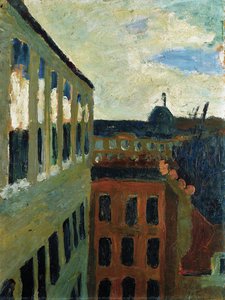 View from the studio window of the artist in Paris1900
 Still life with plant, lemon and orange1906
Esseitä teoksesta Self-portrait
 25 Key Paintings by Paula Modersohn-Becker: A Look at Her Most Important ArtworksExplore 25 key works by Paula Modersohn-Becker. Discover her unique Post-Impressionist style and explore the full collection on OriginalUni…
 German artworks of the 1900sGerman Expressionism through the works of Franz Marc, Ernst Ludwig Kirchner, and August Macke. Find museum-quality reproductions on Origina…
 Beyond Decor: How Custom Historical Portraits Redefine Modern Self-ExpressionDiscover how custom historical portraits transcend decor to become profound expressions of identity. Explore the artistry of bespoke oil re…