

 Esikatselu
 Jaa
Jaa Jaa
Jaa
 Tarkemmat tiedot

 Lataa
Lataa
 Samanlaisia
 Röntgenkuva
 Diaesitys
 Tilastot
Bacchus, Ceres and Cupid
 Acrylic On Canvas
- WallArt
- Northern Mannerism
 163.0 x 113.0 cm
 Kunsthistorisches Museum
 Näytä lisää
Käsinmaalattu öljykopio
Käsinmaalattu öljyväri kankaalle haluamassasi koossa ja kehyksissä, taiteilijoidemme valmistamana tilauksesta. ( Vaihda tulosteeseen Siirry digitaaliseen kuvaan)




P118B $10

P118H $10

P118W $10

P438Z $10

P508JH $12

P508YH $12

P805H $10

P805Z $10

P919BZ $10

P919G $10

P919XJ $10

P959ZH $10

P968JZ $12

W106C $8

W218G $10

W218JH $8

W218Y $10

W307PJ $10

W316G $10

W316PJ $8

W316Y $10

W398PJ $8

W4111J $10

W500HY $15

W500JH $15

W692G $12

W849H $8

W940BG $15

W953PJ $8




Valitse valmiista mitoistamme sellaiset, jotka vastaavat teoksen alkuperäisiä mittasuhteita.

Voit syöttää omat mitat sopimaan tiettyyn kehykseen tai tilaan. Jos valitsemasi koko ei vastaa alkuperäisen kuvan mittasuhteita, rajaamme taideteoksen tai jatkamme maalausta käsin maalatuilla elementeillä. Digitaalinen esikatselu lähetetään hyväksyttäväksi ennen tuotannon aloittamista.
Huomioithan, että näytöllä oleva esikatselu ei vastaa todellista rajausta tai jatkamista. Vain digitaalinen mallikuva näyttää lopullisen sommittelun tarkasti.
Vaikka mittatilaustyöt ovat mahdollisia, suosittelemme valitsemaan mitan ennalta määritetystä listasta alkuperäisten mittasuhteiden säilyttämiseksi.
Tilauksen jälkeen OriginalUniqueArt.com -tiimi lähettää asiakkaalle ohjeet ja esikatselukuvan.
Maailmanlaajuinen toimitus () 3–4 viikossa tavallisen 5 viikon sijaan. (17 syyskuu). Laadusta ei tingitä.

Ilmainen pikatoimitus ympäri maailman

Korkealaatuinen pellavakangas

Kattava kuljetusvakuutus

Tulliveron palautustakuu

Täydellinen värien vastaavuustakuu

100 päivän palautusoikeus (vain valmistusvirheet)

100% rahat takaisin -takuu

Määräalennus tarjous
 Lasivaihtoehto on saatavilla vain alle 110 cm kokoisina teoksina

Bacchus, Ceres and Cupid
Reproduktiotekniikka
Replikaatin koko
-


Kokonaishinta
$ 300
Bacchus, Ceres, and Cupid: A Baroque Dance of Divine Excess
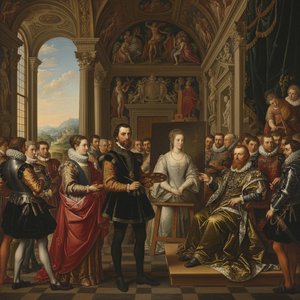
Hans von Aachen’s “Bacchus, Ceres, and Cupid,” painted likely in the late 16th century, is more than just a depiction of mythological figures; it's a vibrant distillation of the Northern Mannerist style – a period characterized by its dramatic contrasts, elongated forms, and an intense exploration of psychological depth. The painting, now residing within the Kunsthistorisches Museum in Vienna, offers a glimpse into the artistic currents flowing between Italy, Germany, and beyond during this transformative era. Von Aachen’s work stands out not merely for its technical skill but also for its ability to imbue classical subjects with a palpable sense of energy and sensuality, reflecting the tastes of powerful patrons like Emperor Rudolf II of Prague.
The composition immediately draws the eye into a dynamic interplay of figures. Dominating the left side is Bacchus, the god of wine, rendered in robust musculature and adorned with a leafy crown – symbols of his intoxicating domain. His expression is one of unrestrained joy, a boisterous celebration that spills outwards, inviting the viewer to partake in his revelry. To his right sits Ceres, the goddess of agriculture, embodying abundance and fertility. She’s depicted with serene grace, holding a basket overflowing with fruits – a visual testament to her role as provider and sustainer. Finally, Cupid, the mischievous god of love, darts across the scene, an arrow poised in his hand, representing desire and passion. The positioning of these three deities isn't merely decorative; it’s carefully orchestrated to suggest a narrative arc—a dance between indulgence, sustenance, and the driving force of romantic longing.
A Mannerist Masterpiece: Technique and Style
Von Aachen’s mastery lies in his skillful manipulation of light and shadow, a hallmark of the Baroque style that was beginning to emerge during this period. The painting is bathed in dramatic chiaroscuro – stark contrasts between light and dark – which sculpts the figures and creates a sense of theatricality. Notice how the musculature of Bacchus is highlighted against the darker background, emphasizing his power and vitality. The elongated forms characteristic of Mannerism are evident throughout, lending an air of elegance and sophistication to the scene. Von Aachen’s brushwork is remarkably detailed, particularly in the rendering of drapery and the intricate patterns on the figures' attire. This meticulous attention to detail speaks to both his technical proficiency and his desire to capture the textures and nuances of the world around him.
The color palette is rich and vibrant, dominated by deep reds, golds, and blues – colors associated with royalty, wealth, and divine power. These hues are juxtaposed against earthy tones, creating a visual tension that mirrors the painting’s thematic complexity. The background landscape, rendered in muted greens and browns, serves as a grounding element, anchoring the figures within a believable, albeit stylized, setting.
Symbolism and Historical Context
“Bacchus, Ceres, and Cupid” is steeped in classical mythology, but it also carries layers of symbolic meaning. The arrangement of the three deities alludes to the Roman proverb “Sine Cerere et Bacchus friget Venus,” or "Without Ceres and Bacchus, Venus would freeze"—a reminder that pleasure, abundance, and love are essential components of a fulfilling life. The painting reflects the artistic tastes of Emperor Rudolf II, who was known for his patronage of both art and science, and whose court in Prague became a hub for cultural exchange between Northern and Southern Europe.
Von Aachen’s work is deeply intertwined with the broader context of the Renaissance and Mannerism. He drew inspiration from Italian masters like Raphael and Michelangelo, but he also incorporated elements of Netherlandish realism – particularly in his attention to detail and his use of light and shadow. His paintings were highly sought after by European nobility, who commissioned them as symbols of wealth, power, and sophistication.
A Timeless Appeal: Reproduction and Interpretation
Today, “Bacchus, Ceres, and Cupid” continues to captivate viewers with its dramatic composition, vibrant colors, and profound symbolism. Reproductions offer a wonderful opportunity to bring this masterpiece into your home or office, allowing you to appreciate its beauty and complexity on a daily basis. When selecting a reproduction, consider the quality of materials used – a high-quality print on archival paper will ensure that the colors remain true for years to come. Whether displayed as a statement piece in a grand salon or as a subtle accent in a smaller room, this painting’s enduring appeal is sure to spark conversation and inspire contemplation.
Taiteilijan elämäkerta
nuoruus ja taiteellinen koulutus
hans von aachen, saksalainen mestari, syntyi vuonna 1552 Kölnin kaupungissa. Hänen varhaisista vuosistaan tiedetään vain vähän, mutta uskotaan, että hän sai taiteellisen koulutuksensa paikallisen maalarin, leonardus sievenhovenin, työpajassa.taiteellinen tyyli ja vaikutteet
von aachenin teokset tunnetaan eloisista väreistä ja dramaattisista sommitelmistä, jotka ovat tyypillisiä manieristiselle tyylille. Hänen maalauksissaan esiintyy usein pitkänomaisia hahmoja, monimutkaisia yksityiskohtia ja jännitteistä tunnelmaa, johon vaikutti voimakkaasti el greco (domenikos theotokopoulos). Hänen merkittävimpiin teoksiinsa kuuluvat muun muassa:- ristisaatuna (1585), maalaus, joka ilmentää hänen taitoaan käyttää rohkeita värejä ja dramaattista valoa.
- viimeinen tuomio (1590), teos, joka osoittaa hänen kykynsä tasapainottaa useita hahmoja yhdessä sommitelmassa.
- tuntemattoman naisen muotokuva (1595), joka korostaa hänen kykyään vangita inhimillisen ilmeen hienovaraisuudet.
merkittävät kokoelmat ja näyttelyt
von aachenin teoksia on esillä useissa museoissa, kuten:- Gemäldegalerie Alte Meister, Dresden, Saksa – museo, jossa on laaja kokoelma eurooppalaisia maalauksia 1400-luvulta 1700-luvulle.
- Museum Ostdeutsche Galerie, Regensburg, Saksa – joka esittelee ainutlaatuisen kokoelman itäsaksalaista taidetta.
perintö
hans von aachen kuoli vuonna 1615 jättäen jälkeensä perinnön monimutkaisista ja tunteikkaista maalauksista. Hänen työnsä jatkaa inspiroimista taiteilijoita ja taiteen ystäviä, tarjoten ainutlaatuisen näkymän manieristisen taiteen maailmaan. löydä lisää tietoa hans von aachenin elämästä ja teoksista OriginalUniqueArt.com-sivustolla: [https://OriginalUniqueArt.com/@@/a@d3aquv](https://OriginalUniqueArt.com/@@/a@d3aquv) | tutustuminen Museum Ostdeutsche Galerie -museoon (Saksa)
Hans Von Aachen
1552 - 1615 , Saksa
Pikatiedot
- Artistic Movement Or Style: Manneristinen maalaus
- Artists Or Movements Influenced By This Artist: ['Renessanssitaide']
- Artists Who Influenced This Artist: ['El Greco']
- Date Of Birth: 1552 Köln, Saksa
- Date Of Death: 1615
- Full Name: Hans von Aachen
- Nationality: Saksalainen
- Notable Artworks:
- Ristiinnaulitseminen
- Viimeinen tuomio
- Tuntemattoman naisen muotokuva
- Place Of Birth: Köln
Liittyvät artikkelit

Baroque Classicism: The Grandeur of Order and Drama in 17th-Century Art History
Explore the profound elegance of Baroque Classicism. Discover how 17th-century masters synthesized dramatic emotion with classical order through the lens of the Counter-Reformation and the works of legends like Carlo Maratta and Andrea Sacchi.
Hans von Aachen: Mannerism's Courtly Visionary & Imperial Portraiture
Explore the captivating world of Hans von Aachen, a leading Mannerist painter renowned for his exquisite imperial portraits & mythological scenes. Discover his legacy and influence on 16th-century European art.

The Dramatic Flourish: Exploring the Baroque Movement's Enduring Legacy in Art History
Explore the dramatic world of Baroque art! Discover iconic artists like Caravaggio & Rubens, defining techniques, and its lasting impact on art history. Expert insights for collectors & enthusiasts at OriginalUniqueArt.

Echoes of Olympus: Mythological Narratives in Western Art Through the Ages
Explore the captivating history of mythological narratives in Western art! From ancient Greece to modern masterpieces, discover iconic artworks & symbolism. Expert analysis and high-quality reproductions at OriginalUniqueArt.

Barokin loisto: Kuinka tuoda ylellisyyttä ja tunnetta nykyaikaiseen sisustukseen
Tutustu barokki sisustuksen loistoon! Opi luomaan ylellistä ja tunnelmallista kotia historiallisen tyylin inspiroimana. Vinkkejä, esimerkkejä ja in apua.