Valikko

() ·

A painting made for you, by hand

Reed-Stacks

Käsinmaalattu öljyvärinen jäljennös

Käsinmaalattu öljyväri kankaalle haluamassasi koossa ja kehyksissä, taiteilijoidemme valmistamana tilauksesta. ( Vaihda tulosteeseen Siirry digitaaliseen kuvaan)

Keräilykohteen kuvaus

Taiteilijan elämäkerta

Franz Marc (1880-1916) oli saksalainen ekspressionisti, jonka eläinpaintauksissa yhdistyvät voimakkaat värit ja syvä henkisyys. Tutustu Der Blaue Reiterin visionääriin ja hänen ainutlaatuiseen taiteeseensa!

from ·

Chapter 1

How large should it be?

Slide to change the size; the picture on the left shows the frame at its real width. The proportions of the original are kept.

Vakiokoko
räätälöity
CM
INCH

Valitse valmiista mitoistamme sellaiset, jotka vastaavat teoksen alkuperäisiä mittasuhteita.

leveys
korkeus

Kirjoita tarvitsemasi leveys ja korkeus, jotta teos sopii kehyksiisi tai seinällesi. Koska kyseessä on käsinmaalattu teos, taiteilija voi maalata hieman enemmän kuvan ympärille tai rajata sitä hieman, jos haluat eri muotoisen koon — valinta on sinun. Lähetämme sinulle digitaalisen mallikuvan hyväksyttäväksi ennen kuin maalaus alkaa. Tällä sivulla näkyvä kuva ei vastaa lopullista tulosta — vain mallikuva näyttää sen.

Chapter 2

How should it arrive?

Choose the edges of the stretched canvas

Choose your frame

Corner sample of the WhiteWrap canvas edge finish, stretched on massiivipuu bars
White €1
Corner sample of the BlurSideWrap canvas edge finish, stretched on massiivipuu bars
Blurside €1
Corner sample of the ExtendedWrap canvas edge finish, stretched on massiivipuu bars
Extended €1
Corner sample of the P118B picture frame: valettu polystyreeni, 5 cm wide and 3 cm thick
P118B €10
Corner sample of the P118H picture frame: valettu polystyreeni, 5 cm wide and 3 cm thick
P118H €10
Corner sample of the P118W picture frame: valettu polystyreeni, 5 cm wide and 3 cm thick
P118W €10
Corner sample of the P438Z picture frame: valettu polystyreeni, 5.5 cm wide and 3.5 cm thick
P438Z €10
Corner sample of the P508JH picture frame: valettu polystyreeni, 7 cm wide and 3.5 cm thick
P508JH €12
Corner sample of the P508YH picture frame: valettu polystyreeni, 7 cm wide and 3.5 cm thick
P508YH €12
Corner sample of the P805H picture frame: valettu polystyreeni, 5 cm wide and 3.5 cm thick
P805H €10
Corner sample of the P805Z picture frame: valettu polystyreeni, 5 cm wide and 3.5 cm thick
P805Z €10
Corner sample of the P919BZ picture frame: valettu polystyreeni, 7 cm wide and 3.5 cm thick
P919BZ €10
Corner sample of the P919G picture frame: valettu polystyreeni, 7 cm wide and 3.5 cm thick
P919G €10
Corner sample of the P919XJ picture frame: valettu polystyreeni, 7 cm wide and 3.5 cm thick
P919XJ €10
Corner sample of the P959ZH picture frame: valettu polystyreeni, 5 cm wide and 3 cm thick
P959ZH €10
Corner sample of the P968JZ picture frame: valettu polystyreeni, 6 cm wide and 4 cm thick
P968JZ €12
Corner sample of the W106C picture frame: massiivipuu, 5 cm wide and 3 cm thick
W106C €8
Corner sample of the W218G picture frame: massiivipuu, 5 cm wide and 3 cm thick
W218G €10
Corner sample of the W218JH picture frame: massiivipuu, 5 cm wide and 3 cm thick
W218JH €8
Corner sample of the W218Y picture frame: massiivipuu, 5 cm wide and 3 cm thick
W218Y €10
Corner sample of the W307PJ picture frame: massiivipuu, 6 cm wide and 3 cm thick
W307PJ €10
Corner sample of the W316G picture frame: massiivipuu, 6 cm wide and 3 cm thick
W316G €10
Corner sample of the W316PJ picture frame: massiivipuu, 6 cm wide and 3 cm thick
W316PJ €8
Corner sample of the W316Y picture frame: massiivipuu, 6 cm wide and 3 cm thick
W316Y €10
Corner sample of the W398PJ picture frame: massiivipuu, 5 cm wide and 3 cm thick
W398PJ €8
Corner sample of the W4111J picture frame: massiivipuu, 6.5 cm wide and 3.5 cm thick
W4111J €10
Corner sample of the W500HY picture frame: massiivipuu, 7 cm wide and 5 cm thick
W500HY €15
Corner sample of the W500JH picture frame: massiivipuu, 7 cm wide and 5 cm thick
W500JH €15
Corner sample of the W692G picture frame: massiivipuu, 8 cm wide and 4 cm thick
W692G €12
Corner sample of the W849H picture frame: massiivipuu, 5 cm wide and 3 cm thick
W849H €8
Corner sample of the W940BG picture frame: massiivipuu, 7.5 cm wide and 4.5 cm thick
W940BG €15
Corner sample of the W953PJ picture frame: massiivipuu, 6 cm wide and 3.5 cm thick
W953PJ €8
Corner sample of the H24-GOLD picture frame: kaiverrettua puuta ja gessoa, 10 cm wide and 6 cm thick
H24-GOLD €30
Corner sample of the H24-SILVER picture frame: kaiverrettua puuta ja gessoa, 10 cm wide and 6 cm thick
H24-SILVER €30
Corner sample of the H36-GOLD picture frame: kaiverrettua puuta ja gessoa, 15 cm wide and 6.5 cm thick
H36-GOLD €45
Corner sample of the H36-SILVER picture frame: kaiverrettua puuta ja gessoa, 15 cm wide and 6.5 cm thick
H36-SILVER €45
Kehyksen esikatselu
Kehystetty

Moulding: . Overall size with the frame: .

Chapter 3

Who paints it, and should anything change?

Examples of what can be changed: Replace face with customer photo; Add pet (e.g., replace cat with dog); Include hidden message in background; Change background landscape or elements.
After order, OriginalUniqueArt.com team will email client for instructions and provide a mockup preview

Maailmanlaajuinen toimitus () 3–4 viikossa tavallisen 5 viikon sijaan. (30 lokakuu). Laadusta ei tingitä.

Chapter 4

The finishing touches

A nameplate, as in a museum?

Kaiverretun pronssilaatan tiedot

This elegant plaque features the artist's name and the title of the artwork, finely engraved for a timeless presentation.

It is made from bronze with a refined, elegant finish. The text is precisely laser-engraved for a sharp and permanent result. Measuring 9x2 cm, the plaque is compact yet easy to read. It's built to be durable and scratch-resistant, offering a professional, museum-quality look. Mounting is simple thanks to the included adhesive backing.

Läpinäkyvän akryylilaatan tiedot

The plaque includes essential engraved details such as the artist's name, the title of the artwork, the date it was created, the type of media used-like oil on canvas or watercolor-a brief description of the piece, and a QR code that links to the complete artwork information.

It is crafted from clear acrylic, offering a sleek, modern appearance. The text is UV-engraved in black to ensure strong visual contrast. With a size of 10x15 cm, it ensures optimal readability. It comes equipped with two metal hooks for secure wall mounting. The plaque is designed to be weather-resistant, making it suitable for various environments, and it includes interactive features that work seamlessly with smartphone scanning.

Mustan akryylilaatan tiedot

This elegant plaque includes engraved information such as the artist's name, the title of the artwork, the date it was created, the type of media used (like oil on canvas or watercolor), a short description of the artwork, and a QR code for quick access to more information.

The plaque itself is made from refined black acrylic with a premium finish. The text is laser-engraved in white for high contrast and readability. Its size is 10x15 cm, designed to be easy to read. It comes with two metal hooks for professional mounting. The design is sleek and fits any interior style. It is also weather-resistant and durable, with built-in digital integration for mobile compatibility.

A protective varnish?

When do you need it?

Chapter 5

Your painting, as you ordered it

Reed-Stacks

Reproduktiotekniikka

Replikaatin koko

-

Kokenut huipputaiteilija

Lisää yksityiskohtia, hienostuneisuutta ja enemmän aikaa tuotantoon

-

Reproduktion kehystysvaihtoehdot

-

-

Teoksille tai reproduktioille, joiden mikä tahansa sivu on suurempi kuin 105 cm (noin 41 tuumaa), kehys toimitetaan osina purettuna sarjana. Tämä menetelmä varmistaa turvallisen toimituksen ja ehkäisee vaurioita kuljetuksen aikana.

Vaatii ammattimaista kokoamista – kyseessä ei ole tee-se-itse-tuote.
Sarja on koottava ja kangas kiristettävä kokeneen kehystysammattilaisen toimesta käyttäen puuliimaa (ei sisälly pakkaukseen), kangaspinnetteitä ja puristimia, jotta kehyksen kulmat pysyvät suorina liiman kuivuessa. Virheellinen kokoaminen tai epätasainen kankaan kiristys voi vaurioittaa teosta pysyvästi, eikä tällaiset vauriot ala takuun piiriin.

  • Kaikki massiivipuupalat sisältyvät, tarkasti mittojen mukaan leikattuina.

  • Kootaan mukana tulevilla ruuveilla sekä kulmaliitoksia varten tarvittavalla puuliimalla, jota ei toimiteta, joten se on hankittava kehystäjältä.

  • Vaatii ammattilaisvälineitä, jotka eivät sisälly pakkaukseen: kankaan venytyspihdit (kiristin) ja puristimet, joilla pidetään kehyksen puut suorassa liiman kuivuessa.

Tärkeää:
Kulmaliitoksissa tarvitaan puuliimaa, kehyksien osat on pidettävä puristimilla, kunnes liima on täysin kuivunut, ja koottuun kehykseen jännitettävän kankaan kiristämiseen tarvitaan kangaspenssipihti. Mikään näistä ei sisälly pakkaukseen. Suosittelemme varmistamaan kokeneen kehystäjän saatavuuden ennen tämän kokoisen kehyksen tilaamista.

Nimilaatta

-

-

Suojalakkaus

Kiiltävä lakka (syventää värejä, suojaa valolta ja kosteudelta)

-

Mukauta taideteokseni

Esimerkkejä muokattavista asioista: Vaihda kasvot asiakkaan omaan valokuvaan; Lisää lemmikki (esim. vaihda kissa koiraan); Lisää taustalle piilotettu viesti; Muuta taustan maisemaa tai elementtejä.

-

Pikatoimitus

Maailmanlaajuinen toimitus () 3–4 viikossa tavallisen 5 viikon sijaan. (30 lokakuu). Laadusta ei tingitä.

-

Pikatoimitus

Maailmanlaajuinen toimitus () 5 viikon kuluessa. (6 marraskuu).

Sisältyy hintaan

Kokonaishinta

€ 266

Kokonaishinta € 266

Lasivaihtoehto on saatavilla vain alle 110 cm kokoisille teoksille

Included with every order

  • Ilmainen pikatoimitus ympäri maailman
  • Korkealaatuinen pellavakangas
  • Kattava kuljetusvakuutus
  • Tulliveron palautustakuu
  • Takuu täydellisestä värien vastaavuudesta
  • 100 päivän palautusoikeus (vain valmistusvirheet)
  • 100% rahat takaisin -takuu
  • Määräalennus tarjolla

A Symphony of Color and Rural Reverie: Exploring Franz Marc’s *Reed-Stacks*

Franz Marc's 1909 painting, *Reed-Stacks*, isn’t merely a depiction of agricultural labor; it’s a profound meditation on the interconnectedness between humanity and nature. This work, rendered in Marc’s signature vibrant palette and deeply felt symbolism, captures a fleeting moment in the German countryside – a scene imbued with an almost palpable spiritual resonance. The painting presents five substantial stacks of reeds or straw, meticulously arranged to create a sense of spatial depth and inviting the viewer into their shadowed recesses. These aren't simply piles of harvested material; they become monumental forms, suggesting both the bounty of the land and the quiet industry that sustains it.

Marc’s artistic journey was profoundly shaped by his early interest in theology, a pursuit that instilled within him a belief in art’s capacity to transcend the purely representational. This conviction is powerfully evident in *Reed-Stacks*. The artist deliberately eschews photographic realism, instead prioritizing emotional and spiritual truth. The muted earth tones – ochres, browns, and deep greens – are punctuated by bursts of intense color: a vibrant blue that seems to emanate from within the reeds themselves, and touches of crimson hinting at the lifeblood of the land. This chromatic intensity isn’t arbitrary; it reflects Marc's belief in the inherent spiritual qualities residing within natural forms.

The Language of Color and Animal Spirit

Marc’s distinctive style, firmly rooted in the burgeoning Expressionist movement, is immediately recognizable. He employed a simplified, almost childlike approach to form, prioritizing color and emotional impact over meticulous detail. This simplification allows the viewer to connect with the essence of the scene – the feeling of warmth, the quiet dignity of rural life, and perhaps even a sense of ancient wisdom. The use of bold, non-naturalistic colors is particularly significant. Marc wasn’t aiming for literal representation; he was translating his *felt* experience of the landscape into visual terms. He frequently drew inspiration from animals, believing they possessed a deeper understanding of the world's spiritual truths. This influence can be seen in the way the reeds are rendered – their forms subtly reminiscent of animal bodies, suggesting a kinship between humankind and the natural kingdom.

  • Color Theory: Marc’s masterful use of complementary colors—particularly blue and red—creates visual excitement and dynamism within the composition.
  • Simplified Forms: The reduction of forms to their essential shapes contributes to the painting's emotional intensity.
  • Symbolic Representation: The reeds themselves become symbols of fertility, abundance, and the cyclical rhythms of nature.

Historical Context and Artistic Influences

Created in 1909, *Reed-Stacks* sits within a pivotal moment in Marc’s artistic development. Following his initial exposure to Vincent van Gogh's expressive brushwork and vibrant color palette – an encounter that profoundly impacted his own approach to painting – Marc continued to explore themes of spirituality and the natural world. The late 1900s saw Expressionism gaining momentum, challenging traditional academic conventions and prioritizing subjective experience. *Reed-Stacks* exemplifies this shift, moving beyond mere representation to convey a deeply felt emotional response to the landscape.

Furthermore, Marc’s interest in folklore and mythology informed his work. The image of the reed stacks evokes ancient agricultural rituals and beliefs surrounding fertility and prosperity. It's not surprising that Marc was drawn to this subject matter; it resonated with his broader exploration of the spiritual dimensions of rural life.

A Timeless Reflection: Reproduction and Interior Design

OriginalUniqueArt offers exceptional, hand-painted reproductions of *Reed-Stacks*, meticulously crafted to capture the essence of Marc’s original vision. These reproductions faithfully recreate the painting's vibrant colors, expressive brushwork, and profound emotional depth. Whether adorning a contemporary living room or a study dedicated to art history, this iconic work will undoubtedly serve as a captivating focal point. The scale and color palette lend themselves beautifully to a variety of interior design styles, from rustic farmhouse chic to modern minimalist spaces. A OriginalUniqueArt reproduction allows you to bring the spirit of rural Germany – and Marc’s profound spiritual insights – into your home.

Kysymykset ja vastaukset

Kuinka vanha Franz Marc oli tehdessään "Reed-Stacks"?

Franz Marc oli 29 vuotias luodessaan teoksen "Reed-Stacks" vuonna 1909. Ikä on laskettu taiteilijan syntymävuodesta 1880.

Mikä on teoksen Franz Marc:n "Reed-Stacks" luminanssi?

Teoksen "Reed-Stacks" värit heijastavat Bright Balance luminanssia.

Mikä väri hallitsee teoksen Franz Marc:n "Reed-Stacks" sommittelua?

Teoksen Franz Marc:n "Reed-Stacks" hallitseva väri on Rosy Brown (#9f9294).

More about this painting

Esikatselu Esikatsele AR-tilassa Vaihda tulosteeseen Siirry digitaaliseen kuvaan Jaa teos
Tiedot Opas Lisää suosikkeihin Lataa kuva Samanlaisia kohteita Röntgenkuvaus Diaesitys Q&A Tilastot

In numbers

  • 1909the year it was painted
  • 29frames to choose from
  • standard sizes, in its own proportions
  • 5weeks to paint and deliver it
Franz Marc

Franz Marc

1880 - 1916, Saksa

Quick facts about Franz Marc

  • Artistic Movement Or Style: Saksa ekspressionismi
  • Artists Or Movements Influenced By This Artist: ['Der Blaue Reiter']
  • Artists Who Influenced This Artist:
    • Van Gogh
    • Delaunay
  • Date Of Birth: 8. helmikuuta 1880
  • Date Of Death: 4. maaliskuuta 1916
  • Full Name: Franz Moritz Wilhelm Marc
  • Nationality: Saksalainen
  • Notable Artworks:
    • Unelmahevonen
    • Lehmä
    • Puro
  • Place Of Birth: München, Saksa

Taiteilijan elämäkerta

A Life Immersed in Color and Spirit

Franz Moritz Wilhelm Marc, syntynyt Münchenissä vuonna 1880, oli taidemaalari, jonka lyhyt mutta intensiivinen ura mullisti merkittävästi Saksan ekspressionismin. Hänen tarinansa on syvän hengellisen etsinnän ja elämän voimakkaan värimaailman yhdistelmä, pyrkimys ymmärtää elämän olemusta luonnon puhtauden kautta – erityisesti eläinten maailmassa. Alkujaan hänen taiteellisensa polkunsa ei aluksi ollut varma. Hän harkitsi lyhyesti teologiaa, pohdiskelevan uskon ja olemisen kysymyksiä ennen kuin lopullisesti omisti itsensä taiteelle Münchenin Taideakatemian kautta. Nämä varhaiset pohdinnat uskonnollisesta ajattelusta olivat syvällä hänen työssään, muotoillen hänen uskoaan taiteen kykyyn toimia hengellisenä kokemuksen kanavana. Akateeminen koulutuksensa tarjosi hänelle teknisiä perustuksia, mutta kohtaamiset Vincent van Goghin teosten kanssa Pariisissa sytyttivät todella hänen taiteellisen näkemyksensä. Van Gogh’n tunteellinen värien käyttö ja raaka ilmaisu resonoi Marcilla voimakkaasti, vapauttaen hänet perinteisistä tekniikoista ja asettaen hänet polulle, joka johtaisi subjektiivisempaan ja tunteikkaampaan tyyliin.

Der Blaue Reiter ja Uusi Taiteellinen Visio

Marcin taiteellinen kehitys ei ollut yksinäistä; se kukoisti varhaisen 2000-luvun Münchenin dynaamisessa kontekstissa. Hän kokeili erilaisia taiteilijaryhmiä, mukaan lukien Neue Künstlervereinigung München, ennen kuin perusti *Der Blaue Reiter* (The Blue Rider) -ryhmän vuonna 1911 yhdessä Wassily Kandinskin kanssa. Tämä ei ollut pelkästään ryhmä tai näyttelysarja; se oli filosofinen ja taiteellinen vallankumous. *Der Blaue Reiter* pyrki menemään pidemmälle kuin pelkkien esitysten ohi, tavoitteenaan ilmaista sisäisiä hengellisiä totuuksia abstraktin ja symbolisen värin kautta. Ryhmän aikakauden almanakka oli alusta asti alkaa levittää näitä ideoita, esitellen ei ainoastaan heidän omaa työtään vaan myös muiden taiteilijoiden teoksia. Tämä ryhmä pyrki luomaan uudenlaista taiteellista ilmaisua, joka ylitti perinteiset rajoitukset ja keskittyi syvällisempään merkitykseen. *Der Blaue Reiter* oli enemmän kuin pelkkä taiteilijaryhmä; se oli liikkeen keskeinen osa, joka edisti uusia ideoita ja tekniikoita. Ryhmän jäsenet olivat kiinnostuneita monista eri taiteellisista suuntauksista, kuten impressionismista, symbolistisesta taidosta ja primitivisistä taiteen muodoista. Marcin tärkein panos *Der Blaue Reiter* -ryhmässä oli hänen pyrkimyksensä yhdistää taide ja hengellisyys. Hän uskoi, että taiteella voitiin luoda silta ihmisen ja jumalallisen maailman välille, ja hän yritti ilmaista tätä uskomustaan teoksissaan. Hän myös kannusti muita taiteilijoita tutkimaan taiteen mahdollisuuksia syvällisempänä kokemuksena. Ryhmän jäsenet olivat kiinnostuneita monista eri taiteellisista suuntauksista, kuten impressionismista, symbolistisesta taidosta ja primitivisistä taiteen muodoista.

Symbolismi, Väri ja Olemisen Ydin

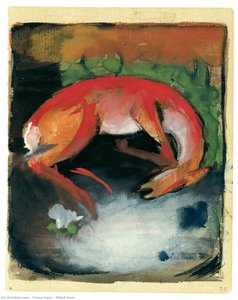
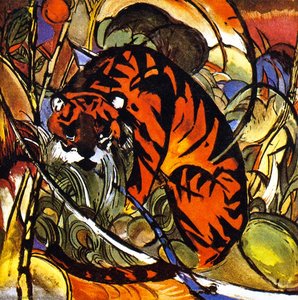
Marcin taiteellinen tyyli on heti tunnistettavissa sen ainutlaatuisen käytön kautta värejä ja muotoja. Hän ei käyttänyt värejä kuvauksellisesti; hän sisällytti niihin symbolista merkitystä. Sininen edusti hengellisyyttä ja maskuliinisuutta, keltainen iloa ja feminiinisyyttä, ja punainen materiaa ja voimaa. Nämä eivät olleet satunnaisia valintoja vaan huolellisesti suunniteltu järjestelmä, jonka tarkoituksena oli välittää tiettyjä tunteita ja filosofisia ideoita. Hänen eläimensä eivät ole pelkästään aiheita; ne ovat näiden käsitteiden ilmentymiä. Muotojen yksinkertaistaminen – hahmojen vähentäminen niiden olennaisiin muotoihin – korosti entisestään syvällistä hengellistä ydintä, johon hän pyrki vangitsemaan. *The Tiger* (1912) ja *Red Deer* (1912) ovat esimerkkejä tästä lähestymistavasta, jotka esittävät voimakkaita värien valintoja ja kasvavaa keskitystä aiheiden omiin ominaisuuksiin eikä realistiseen esittämiseen.

Eläimet, Symboliikka ja Ihmiskunnan Kohtalo

Marcin taiteellinen näkemys ei ollut yksinäistä; se kukoisti varhaisen 2000-luvun Münchenin dynaamisessa kontekstissa. Hän kokeili erilaisia taiteilijaryhmiä, mukaan lukien Neue Künstlervereinigung München, ennen kuin perusti *Der Blaue Reiter* -ryhmän vuonna 1911 yhdessä Wassily Kandinskin kanssa. Ryhmässä he tutkivat abstraktin taiteen mahdollisuuksia ja pyrkivät luomaan uudenlaisen taiteellisen ilmaisun, joka ylitti perinteiset rajoitukset ja keskittyi syvällisempään merkitykseen. Marc oli erityisen kiinnostunut eläimistä, jotka hän näki heijastavan luonnon puhtautta ja viattomuutta sekä ihmiskunnan menettämää yhteyttä luontoon. Hän uskoi, että eläimet olivat symbolisia edustajia, jotka voivat välittää syvällisiä hengellisiä totuuksia. Eläinten kuvaaminen oli Marcille tapa tutkia ihmisen olemassaolon kysymyksiä ja pyrkiä löytämään vastauksia niihin taiteen kautta. Marcin työ ei ollut pelkästään eläinten kuvaamista; se oli myös tunteiden, uskonnon ja luonnon yhteyden tutkimista. Hän pyrki välittämään näitä teemoja värien, muotojen ja symbolien avulla. Hänen taiteensa on täynnä syvällistä merkitystä ja heijastaa hänen henkilökohtaista hengellistä etsintäänsä.

Traginen Loppu ja Jälleenmuistuttava Perintö

Ensimmäisen maailmansodan puhkeaminen vuonna 1914 muutti Marcin elämää ja taiteellista uraa dramaattisesti. Vaikka hän pyrki hankkimaan armahduksen aseman sotilaana, hänet kuitenkin värvättiin Saksan armeijaan, missä hän palveli ratsuväessä. Sodan kauhut vaikuttivat syvästi häneen, mutta jopa kaaoksen keskellä hän jatkoi taiteellista toimintaansa löytääkseen lohtua ja merkitystä taiteestaan. Valitettavasti Franz Marc kuoli Verdunissa 4. maaliskuuta 1916, mikä oli katastrofaalinen menetys taideyhteisölle. Hänen lyhyt elämänsä päättyi kuitenkin ennenaikaisesti, mutta se vahvisti hänen paikkansa modernin taiteen keskeisenä hahmona. Hänen työnsä resonoivat edelleen tänään, vaikuttamalla sukupolvien taiteilijoita ja lumoamalla katsojia syvällisellä tunteellisuudellaan ja hengellisellä resonanssillaan. Marc’n maalauksia esitetään nykyisin suurissa museoissa ympäri maailmaa, mukaan lukien Lenbachhaus Münchenissä, jossa on laaja kokoelma hänen teoksiaan. Hänet muistetaan ei ainoastaan modernismin varhaisena edistäjänä vaan myös visionäärisenä taiteilijana, joka uskalsi tutkia syvällistä yhteyttä taiteen, hengellisyyden ja luonnon välillä – perintö, joka inspiroi edelleen ihailua ja pohdintaa.

Pikaista tietoa

  • Artist: Franz Marc
  • Subject or theme: Rural life
  • Movement: Expressionism
  • Title: Reed-Stacks

Taidevisat

Jokaisessa kysymyksessä on vain yksi oikea vastaus.

Kysymys 1:
Franz Marc’s ‘Reed-Stacks’ primarily reflects which artistic movement?
Kysymys 2:
The presence of the reed stacks in ‘Reed-Stacks’ is most likely intended to symbolize:
Kysymys 3:
Considering Franz Marc’s biography, what influenced his artistic focus on the natural world?
Kysymys 4:
The composition of ‘Reed-Stacks’ utilizes elements that create an impression of depth. Which technique is MOST evident in this portrayal?
Kysymys 5:
What year was ‘Reed-Stacks’ painted, providing context for its artistic style and themes?