Eelvaade
 Saada
Saada Jaga
Jaga
 Teave teose kohta

 Laadi alla
 Sarnased teosed
 Röntgenuuring
 Slaidietendus
 Statistika
Self-portrait


 Loe lähemalt
Giclée / Kunstiprint
Muuseumikvaliteediga giclée- või kangasprint kiire tootmisega ja paindlikud viimistlusvõimalused. ( Osta käsitsi maalitud maal Ülemineks digitaalse pildiga müügi kanalisse)




P118B $10

P118H $10

P118W $10

P438Z $10

P508JH $12

P508YH $12

P805H $10

P805Z $10

P919BZ $10

P919G $10

P919XJ $10

P959ZH $10

P968JZ $12

W106C $8

W218G $10

W218JH $8

W218Y $10

W307PJ $10

W316G $10

W316PJ $8

W316Y $10

W398PJ $8

W4111J $10

W500HY $15

W500JH $15

W692G $12

W849H $8

W940BG $15

W953PJ $8




Vali meie eelmääratud suurused, mis vastavad teose algupärastele proportsioonidele.

Saate sisestada oma mõõdud, et need sobiks konkreetse raami või ruumi sisse. Kui valitud suurus ei vasta originaalteose proportsioonidele, lõigame teose ära või laiendame pilti peegeldatud või ühtlase servaga. Enne tootmisprotsessi algust saadetakse Teie kinnitamiseks digitaalne näidis.
Palun märka, et ekraanil kuvatav eelvaade ei kajasta tegelikku lõigamist või laiendamist. Ainult näidis kujutab täpselt lõplikku kompositsiooni.
Kuigi erimõõdu on saadaval, soovitame originaaproportsioonide säilitamiseks valida mõõt ette määratud nimekirjast.
Ülemaailmne tarne () 2 nädala jooksul, tavalise 4/5 nädala asemel. (11 september)

Tasuta ekspresssaatmine üle maailma

Kõrgekvaliteediline linakangas

Täielik transpordikindlustus

Tollimaksude tagastamise garantii

Värvitoime täpsuse garantii

100 päeva tagastusõigus (ainult tootmisdefektide korral)

100% raha tagasi garantii

Hulgusoodustus
 Klaasivalik on saadaval ainult suuruses kuni 110 cm

Self-portrait
Giclée / Kunstiprint
Reproduktsiooni suurus
-


Kogusumma
$ 80
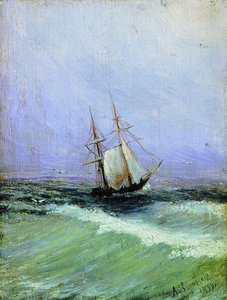
A Moment of Oceanic Reverie: Aivazovsky's Self-Portrait
This evocative black and white sketch, attributed to the renowned 19th-century Russian painter Ivan Aivazovsky, offers a rare glimpse into the mind of a master. More than just a portrait, it’s a deeply personal meditation on creativity, dedication, and the profound connection between an artist and his subject – in this case, the boundless, turbulent beauty of the sea. Executed around 1880, during the height of Aivazovsky's career, the work embodies the artist’s signature style: a raw, expressive approach that prioritized capturing the *feeling* of the ocean over meticulous realism.
- Subject Matter: The central figure is Ivan Aivazovsky himself, depicted in the act of playing the violin. His closed eyes suggest an intense focus, a complete immersion within the music and, undoubtedly, within the very essence of his artistic vision.
- Style & Technique: This isn’t a polished finished piece; it's a preparatory study, a “sketches” brimming with energy. The loose lines, visible pencil strokes, and expressive hatching create a sense of immediacy and spontaneity – as if the artist were frozen in a moment of passionate creation.
The Language of Line: Technique and Texture
Aivazovsky’s mastery lies not just in his subject matter but also in his extraordinary command of line. The sketch is built entirely through variations in pencil pressure, creating a remarkable range of tonal values from the darkest shadows to the lightest highlights. Hatching and cross-hatching are employed with deliberate precision, layering lines to build up texture and suggest the movement of water – the swell of waves, the shimmer of sunlight on the surface. The roughness of the paper itself is subtly emphasized, adding to the overall sense of immediacy and authenticity.
The absence of color amplifies the impact of this technique. The monochromatic palette forces the viewer to focus entirely on the play of light and shadow, further enhancing the sketch’s dramatic effect. It's a testament to Aivazovsky's ability to convey depth and volume purely through line.
A Symbol of Maritime Passion
Born in Feodosia, Crimea, in 1817 (Hovhannes Aivazian), Ivan Konstantinovich Aivazovsky’s life was inextricably linked to the sea. His upbringing amidst the Black Sea's dramatic landscapes profoundly shaped his artistic sensibility. This self-portrait isn’t simply a depiction of an artist; it’s a symbolic representation of that deep, almost spiritual connection. The violin itself – a traditional instrument often associated with romanticism and introspection – further reinforces this theme.
- Symbolic Elements: The closed eyes represent not just concentration but also a state of transcendence, a merging with the power and beauty of nature.
- Historical Context: Aivazovsky’s work reflects the Romantic era's fascination with the sublime – the awe-inspiring power of nature that could both inspire and terrify. His seascapes were hugely influential, shaping the course of landscape painting for generations to come.
Collecting a Masterpiece: Reproduction Considerations
OriginalUniqueArt offers meticulously crafted hand-painted reproductions of this captivating sketch, allowing you to bring Aivazovsky’s vision into your home or office. Our skilled artisans employ the same techniques – careful line work, nuanced tonal shading – to faithfully recreate the original's emotional impact and textural richness. Each reproduction is a unique artwork, capturing not just an image but also the spirit of a master artist at his most passionate.
Kunstniku elulugu
Ivan Konstantinovich Aivazovsky – Hovhannes Aivazian
Ivan Konstantinovich Aivazovsky, born Hovhannes Aivazian in 1817, was more than just a painter of seascapes; he embodied the Romantic spirit—a conduit to the ocean’s soul. His very existence seemed inextricably linked to the Black Sea—that vast, unpredictable expanse that would forever dominate his artistic vision and fuel an extraordinary career spanning nearly six decades. Born in Feodosia, Crimea, Russia – a city steeped in maritime history – Aivazovsky didn't merely observe the sea; he felt it – its raw energy, sublime beauty, and inherent danger becoming the very essence of his art. From a young age, this connection was nurtured by Jacob Koch, an architect who recognized the boy’s innate talent, then blossoming within the rigorous academic environment of Saint Petersburg’s Imperial Academy of Arts. Yet, formal training alone couldn't account for the depth of Aivazovsky’s understanding; it was the constant presence of salt-laced air and the cries of gulls that truly shaped his artistic sensibility. His Armenian heritage – he was baptized at St. Sargis Armenian Church in Feodosia – instilled a profound appreciation for cultural traditions, occasionally informing his expansive body of work with motifs reflecting Armenian landscapes and folklore.Early Influences and Artistic Formation
Aivazovsky’s formative years were marked by exposure to influential artistic currents. Like many aspiring artists of his time, he studied at the Imperial Academy of Arts in Saint Petersburg, absorbing the stylistic conventions of Academic painting—characterized by idealized forms and meticulous detail. However, Aivazovsky possessed a rebellious streak that would soon propel him beyond these established boundaries. He found inspiration in the works of Claude Lorrain and Salvator Rosa – artists who championed dramatic landscapes infused with emotion—artists who captured the sublime grandeur of nature. These influences instilled in him a desire to depict not merely what was seen, but what was felt—a conviction that resonated deeply throughout his artistic career. His early paintings demonstrated remarkable technical skill, reflecting meticulous observation and careful rendering of light and color.The Rise of a Marine Master: Patronage and Naval Service
A pivotal moment arrived when Aivazovsky secured the patronage of Czar Nicholas I – a relationship that profoundly shaped his artistic trajectory. Recognizing his talent and unwavering dedication to his craft, the Tsar appointed him the main painter of the Russian Navy—a position that granted him unparalleled access to naval life, battleships, and firsthand observation of maritime expeditions. This wasn’t merely a prestigious title; it was transformative – providing him with invaluable material for artistic inspiration and fostering an intimate understanding of the challenges faced by sailors at sea. He became acutely aware of the psychological impact of confronting turbulent waters and perilous storms—themes that would permeate his paintings throughout his life. The patronage afforded him by the Tsar allowed him to pursue his artistic ambitions without constraint, securing funding for ambitious projects and enabling him to travel extensively – documenting naval voyages and capturing breathtaking vistas across Europe.A Style Defined by Drama and Luminosity
Aivazovsky’s distinctive style—characterized by dramatic compositions and masterful use of color—became synonymous with Romantic marine art. He eschewed the polished surfaces of Academic painting, favoring looser brushstrokes and vibrant hues that conveyed a palpable sense of movement and emotion. Like Turner – whom he admired greatly – Aivazovsky sought to capture not just the visual spectacle of the sea but its very soul—its moods, its power, and its mystery. His technique involved applying paint in thin layers, creating luminous textures that seemed to emanate from within the canvas itself. He meticulously studied atmospheric perspective, skillfully rendering distant landscapes with hazy blues and greys – techniques that heightened the dramatic impact of his paintings. Works such as *Chaos (The Creation)* and *Ship in a Stormy Sea* exemplify this approach—capturing the terror and majesty of nature with breathtaking precision.Legacy and Enduring Influence
Ivan Konstantinovich Aivazovsky’s contribution to Russian art is undeniable – securing him a place among the most celebrated marine artists of his era. His paintings continue to inspire awe and admiration, demonstrating an unparalleled ability to convey emotion and capture the essence of the sea. He profoundly influenced subsequent generations of painters—establishing a precedent for Romantic landscape painting that prioritized expressive power over strict adherence to academic conventions. The saying “worthy of Aivazovsky’s brush” – popularized by Anton Chekhov – encapsulates the enduring legacy of this artistic genius—a testament to his unwavering commitment to capturing the sublime beauty and dramatic intensity of the natural world. His paintings remain exhibited in museums worldwide, ensuring that his vision continues to resonate with audiences across cultures and generations.
Ivan Konstantinovitš Айвазовский
1817 - 1900 , Россия
Lühikesed faktid
- Artistic Movement Or Style: Romanticism, Marine art
- Artists Who Influenced This Artist:
- Claude Lorrain
- Salvator Rosa
- Date Of Birth: 1817
- Date Of Death: 1900
- Full Name: Ivan Konstantinovich Aivazovsky
- Nationality: Russian-Armenian
- Notable Artworks:
- The Ninth Wave
- Ship in a Stormy Sea
- Seascape with Full Moon
- Place Of Birth: Feodosia, Russia
Seotud artiklid

Mustvalge Elegantsus: Fotost Klassik Kunsti – Isikupärane Esteetika Koduks
OriginalUniqueArt loob mustvalge fotokunsti meistreid reproduktsioonid ja isikupärased portreed. Käsipainatud maalide kvaliteet, usaldusväärne teenus ja ekspertide nõuanded – kaunistage oma kodu ajatu kunstiga!

Monochrome Visions: Exploring the Aesthetic & Historical Significance of Black & White Photography
Explore the rich history & artistic power of black and white photography. From early techniques to iconic masters like Ansel Adams, discover why monochrome continues to captivate art lovers today. Expert insights for collectors.

Dark Masterpieces: 10 Iconic Paintings Dominated by Black Tones |
Explore 10 iconic paintings dominated by black tones, from Rembrandt’s chiaroscuro to Goya's dark expressions. Discover the stories behind these masterpieces & find museum-quality art reproductions for your home at .

White on Canvas: 10 Masterpieces & Timeless Elegance for Your Home Decor
Explore 10 iconic white paintings by Monet, Whistler & Rothko! Discover the stories behind these serene masterpieces and their impact on art history. Find museum-quality reproductions for your home decor at .

Monochrome Edge: The Ultimate Design Flex—Level Up Your Space with Bold Black & White Art
Master the monochrome aesthetic with high-impact Black & White art from OriginalUniqueArt.com. From custom hand-painted oils to iconic pop culture remixes, discover the ultimate design flex for your urban space. Elevate your decor with bold, premium, and timeless monochrome masterpieces.