
 Eelvaade
 Saada
Saada Jaga
Jaga
 Teave teose kohta
 Juhend

 Laadi alla
 Sarnased teosed
 Röntgenuuring
 Slaidietendus
 KÜSIMUSED JA VASTUSID
 Statistika
Maastik Tuulelehtede Vaatel

- 40.0 x 63.0 cm


 Loe lähemalt
Giclée / Kunstiprint
Muuseumikvaliteediga giclée- või kangasprint kiire tootmisega ja paindlikud viimistlusvõimalused. ( Osta käsitsi maalatud teos Lülita digitaalse pildi juurde)




P118B €10

P118H €10

P118W €10

P438Z €10

P508JH €12

P508YH €12

P805H €10

P805Z €10

P919BZ €10

P919G €10

P919XJ €10

P959ZH €10

P968JZ €12

W106C €8

W218G €10

W218JH €8

W218Y €10

W307PJ €10

W316G €10

W316PJ €8

W316Y €10

W398PJ €8

W4111J €10

W500HY €15

W500JH €15

W692G €12

W849H €8

W940BG €15

W953PJ €8




Vali meie eelmääratud suurused, mis vastavad teose algupärastele proportsioonidele.

Sisestage vajalik laius ja kõrgus, et see sobiks teie raamile või seinale. Trükki saab ainult lõigata, seda ei saa kunagi pildist suuremaks teha, seega ka erineva mustega suurus kaotab osa pildist. Enne trükkimist saadame teile kinnitamiseks digitaalse näidisprojektsiooni. Sellel lehel näidatud pilt ei kujuta reaalset lõiget — seda näitab ainult näidisprojektsioon.
Ülemaailmne tarne () 2 nädala jooksul, tavalise 4/5 nädala asemel. (4 november)

Tasuta ekspresssaatmine üle maailma

Kõrgekvaliteediline lina-kangas

Täielik transpordikindlustus

Tollimaksude tagastamise garantii

Värvitoime täpsuse garantii

100 päeva tagastusõigus (ainult valmistusdefektide korral)

100% raha tagasi garantii

Hulgusoodustus
 Klaasivalik on saadaval ainult kuni 110 cm suuruses teostes

Maastik Tuulelehtede Vaatel
Giclée / Kunstiprint
Reproduktsiooni suurus
-


Koguhind
€ 72
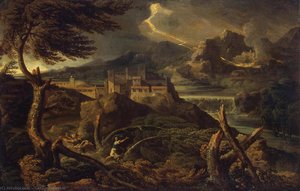
Landscape with Lightning – A Roman Vision Captured in Detail
Gaspard Dughet’s “Landscape with Lightning” stands as a cornerstone of Baroque landscape painting, embodying the grandeur and dramatic intensity characteristic of the era. Painted in 1667, this monumental canvas transports viewers to the serene yet turbulent campagna surrounding Rome—a region favored by artists seeking inspiration for capturing sublime beauty alongside moments of unsettling power. The artwork’s enduring appeal lies not only in its visual splendor but also in its profound exploration of humanist ideals and artistic innovation.Subject Matter and Composition
The painting depicts a vast expanse of rolling hills punctuated by towering cypress trees, dominated by a formidable mountain range crowned with a castle—a motif frequently employed by Dughet to convey notions of majesty and spiritual contemplation. Scattered across the landscape are figures representing humanity’s relationship with nature: three men stand attentively observing the scene, perhaps pondering its significance. Adding to the dynamism is a lone horse positioned on the left side, symbolizing strength and nobility, while birds soar gracefully overhead—a deliberate inclusion intended to elevate the composition beyond mere topographical representation.Style and Technique – Dughet’s Pioneering Approach
Dughet distinguished himself from his contemporaries through his unwavering commitment to disegno—the Italian term for drawing—which served as the foundation of his artistic practice. Unlike many painters who relied heavily on color, Dughet prioritized meticulous line work, achieving remarkable tonal gradation through subtle shading and hatching techniques. This approach allowed him to convey atmospheric perspective with unparalleled accuracy, creating a palpable sense of depth and realism that was revolutionary for its time. The artist’s masterful handling of light—particularly the dramatic depiction of lightning illuminating the mountain peaks—further underscores his ambition to capture not just what is seen but also what is felt.Historical Context – Baroque Ideals Embodied
“Landscape with Lightning” emerged during a period marked by significant intellectual and artistic ferment, fueled by the rediscovery of classical antiquity and underpinned by humanist philosophy. Dughet’s work reflects these influences, aligning with the Baroque aesthetic's preoccupation with conveying emotion and grandeur—a deliberate contrast to the Mannerist style that preceded it. The castle atop the mountain symbolizes Christian faith and divine providence, mirroring the broader artistic agenda of portraying idealized visions of humanity’s place within God’s creation.Symbolism – Beyond Representation
The inclusion of birds represents freedom and aspiration, while the horse embodies nobility and courage—symbols resonating with humanist values that championed virtue and moral fortitude. The overall composition serves as a meditation on the sublime—the experience of awe inspired by confronting overwhelming beauty or terror—a concept central to Enlightenment thought and reflecting Dughet’s profound understanding of human psychology.Emotional Impact – A Moment Frozen in Time
“Landscape with Lightning” transcends mere visual depiction, inviting contemplation about humanity's connection to the natural world and its capacity for spiritual reflection. The painting’s subdued palette—dominated by earthy tones—contrasts powerfully with the brilliant flashes of lightning, creating an emotional tension that captures the essence of Baroque art: a desire to inspire wonder and provoke profound thought. It remains a testament to Dughet's artistic genius and his enduring contribution to the history of landscape painting.Korduvad küsimused
Kas "Maastik Tuulelehtede Vaatel" on üks Gaspard Dughet populaarsemaid teoseid?
Teose „Maastik Tuulelehtede Vaatel“, autor Gaspard Dughet populaarsusaste on Tunnustatud. See klassifikatsioon peegeldab teose tuntust ja tunnustust.
Mis tüüpi teos on "Maastik Tuulelehtede Vaatel"?
„Maastik Tuulelehtede Vaatel“, autor Gaspard Dughet on klassifitseeritud kui Seinakunst. See kategooria kirjeldab originaalteose kunstivormi.
Kui palju valgust tundub teose "Maastik Tuulelehtede Vaatel" värvid peegeldavat?
Teose "Maastik Tuulelehtede Vaatel" värvid näitavad Kõige tumedam luminantsi.
Kunstniku elulugu
The Soul of the Roman Campagna
In the heart of the seventeenth century, amidst the sweeping vistas and ancient ruins of Rome, emerged a painter whose brush captured the very breath of the Italian countryside. Gaspard Dughet, often whispered in art circles as Gaspard Poussin, was a man of dual identity—a French soul born into the warmth of an Italian landscape. Though he never set foot in his ancestral France, his work remains a cornerstone of the French school, deeply rooted in the fertile soil of the Roman Campagna.
His journey began under the tutelage of his brother-in-law, the great Nicolas Poussin, a connection that would forever link his name to the classical tradition. Yet, Dughet was never merely a shadow of his mentor. While he inherited a sense of structured grandeur, he infused his landscapes with a vitality and a rhythmic movement that were uniquely his own. He specialized in the topography of the Roman outskirts, transforming dusty paths and verdant hills into stages for silent, eternal dramas.
The Drama of Light and Tempest
As Dughet’s artistry matured, his canvases began to pulse with a more fluid and atmospheric energy. He became a master of the elements, particularly known for his ability to depict the sudden, breathtaking arrival of a storm. Out of his vast repertoire, many of his works are dedicated to these turbulent skies, where heavy clouds collide with shafts of breaking light. This fascination with the ephemeral nature of weather placed him alongside his contemporary, Salvator Rosa, as one of the preeminent landscape painters of his era.
His technique often involved a delicate collaboration; he frequently worked with Guillaume Courtois, who would breathe life into the scenes by painting the staffage—the small, human figures that wander through the vastness. This synergy allowed Dughet to focus on the monumental scale of nature while maintaining an intimate connection to the human experience. From the grand frescoes of the Palazzo Colonna to the more weathered cycles in San Martino ai Monti, his work reflects a profound mastery over both light and texture.
A Legacy Carved in Stone and Garden
The influence of Dughet’s vision did not fade with his death in 1675; rather, it migrated north, finding a profound resonance in the British Isles. During the eighteenth century, his name became synonymous with the ideal classical landscape. His style was so evocative that collectors often attributed any beautiful, pastoral scene to him, a testament to the enduring power of his aesthetic.
His impact can be seen across several disciplines:
- The evolution of British landscape painting, providing a blueprint for masters like Thomas Gainsborough and John Constable.
- The design of English landscape gardens, which sought to replicate the serene, structured wildness found in his oil paintings.
- The preservation of classical ideals within the National Gallery in London, where works like his Sacrifice of Abraham continue to inspire awe.
Gaspard Dughet
1613 - 1675 , Italy
Lühikest infot
- Full Name: Gaspard Dughet
- Nationality: French
- Date Of Birth: 1613
- Date Of Death: 1675
- Place Of Birth: Rome, Italy
- Notable Artworks:
- Landscape with Cross
- View of the Hermitage of Camaldoli near Frascati
- Artistic Movement Or Style: Baroque Landscape
- Artists Who Influenced This Artist: Nicolas poussin
- Artists Or Movements Influenced By This Artist: British landscape painting
Sarnased artiklid
Cornelis van Poelenburch: Bridging Mannerism & the Dutch Baroque Landscape
Discover Cornelis van Poelenburch, a pivotal Dutch Baroque landscape painter bridging Mannerism & Italianate styles. Explore his life, key works, and lasting influence on 17th-century art with OriginalUniqueArt.

Romantilise Maastikukunsti 10 Meisterteost: Kunstiteosed Koduks OriginalUniqueArt.com'ist
Avastage 10 romantilise maastikukunsti meistriteost! Tutvuge Caspar David Friedrichi, J.M.W. Turneri ja teiste suurte kunstnike loominguga OriginalUniqueArt.com-is. Leidke täiuslik õlimaal või reproduktsioon koduks – inspireeriv kollektsioon ootab!

Evocations of Place: A Historical Journey Through Landscape Art
Explore the rich history of landscape art with OriginalUniqueArt. Discover renowned artists, movements like Impressionism & Romanticism, and expert guidance for collecting timeless pieces. Find your perfect serene escape today!

Claude Lorrain: Master of Light & Landscape in the Golden Age
Explore the luminous landscapes of Claude Lorrain, a Baroque master renowned for his masterful use of light & atmosphere. Discover his life, techniques, key works & enduring influence on art history.

Evoking Atmosphere & Identity: A Journey Through Landscape Painting's History
Explore the rich history of landscape painting! Discover renowned artists, movements like Romanticism, & techniques such as atmospheric perspective. Find inspiration and quality reproductions at OriginalUniqueArt.