Lülita trükkitoodetele
 Loe lähemalt







































 Kunstiteoste või reproduktsioonide puhul, mille üks külg on üle 105 cm (umbikmolt 41 tolli), saadetakse raam kirjal asendis, la Dismantlitud komplektina. See meetod tagab ohutuse kohaletoimetamisel ja väldib transpordil tekkivaid kahjustusi.


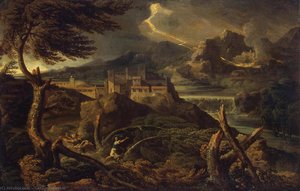
Landscape with Lightning – A Roman Vision Captured in Detail
Gaspard Dughet’s “Landscape with Lightning” stands as a cornerstone of Baroque landscape painting, embodying the grandeur and dramatic intensity characteristic of the era. Painted in 1667, this monumental canvas transports viewers to the serene yet turbulent campagna surrounding Rome—a region favored by artists seeking inspiration for capturing sublime beauty alongside moments of unsettling power. The artwork’s enduring appeal lies not only in its visual splendor but also in its profound exploration of humanist ideals and artistic innovation.Subject Matter and Composition
The painting depicts a vast expanse of rolling hills punctuated by towering cypress trees, dominated by a formidable mountain range crowned with a castle—a motif frequently employed by Dughet to convey notions of majesty and spiritual contemplation. Scattered across the landscape are figures representing humanity’s relationship with nature: three men stand attentively observing the scene, perhaps pondering its significance. Adding to the dynamism is a lone horse positioned on the left side, symbolizing strength and nobility, while birds soar gracefully overhead—a deliberate inclusion intended to elevate the composition beyond mere topographical representation.Style and Technique – Dughet’s Pioneering Approach
Dughet distinguished himself from his contemporaries through his unwavering commitment to disegno—the Italian term for drawing—which served as the foundation of his artistic practice. Unlike many painters who relied heavily on color, Dughet prioritized meticulous line work, achieving remarkable tonal gradation through subtle shading and hatching techniques. This approach allowed him to convey atmospheric perspective with unparalleled accuracy, creating a palpable sense of depth and realism that was revolutionary for its time. The artist’s masterful handling of light—particularly the dramatic depiction of lightning illuminating the mountain peaks—further underscores his ambition to capture not just what is seen but also what is felt.Historical Context – Baroque Ideals Embodied
“Landscape with Lightning” emerged during a period marked by significant intellectual and artistic ferment, fueled by the rediscovery of classical antiquity and underpinned by humanist philosophy. Dughet’s work reflects these influences, aligning with the Baroque aesthetic's preoccupation with conveying emotion and grandeur—a deliberate contrast to the Mannerist style that preceded it. The castle atop the mountain symbolizes Christian faith and divine providence, mirroring the broader artistic agenda of portraying idealized visions of humanity’s place within God’s creation.Symbolism – Beyond Representation
The inclusion of birds represents freedom and aspiration, while the horse embodies nobility and courage—symbols resonating with humanist values that championed virtue and moral fortitude. The overall composition serves as a meditation on the sublime—the experience of awe inspired by confronting overwhelming beauty or terror—a concept central to Enlightenment thought and reflecting Dughet’s profound understanding of human psychology.Emotional Impact – A Moment Frozen in Time
“Landscape with Lightning” transcends mere visual depiction, inviting contemplation about humanity's connection to the natural world and its capacity for spiritual reflection. The painting’s subdued palette—dominated by earthy tones—contrasts powerfully with the brilliant flashes of lightning, creating an emotional tension that captures the essence of Baroque art: a desire to inspire wonder and provoke profound thought. It remains a testament to Dughet's artistic genius and his enduring contribution to the history of landscape painting.Korduvad küsimused
Kas "Maastik Tuulelehtede Vaatel" on üks Gaspard Dughet populaarsemaid teoseid?
Teose „Maastik Tuulelehtede Vaatel“, autor Gaspard Dughet populaarsusaste on Tunnustatud. See klassifikatsioon peegeldab teose tuntust ja tunnustust.
Mis tüüpi teos on "Maastik Tuulelehtede Vaatel"?
„Maastik Tuulelehtede Vaatel“, autor Gaspard Dughet on klassifitseeritud kui Seinakunst. See kategooria kirjeldab originaalteose kunstivormi.
Kui palju valgust tundub teose "Maastik Tuulelehtede Vaatel" värvid peegeldavat?
Teose "Maastik Tuulelehtede Vaatel" värvid näitavad Kõige tumedam luminantsi.
 Eelvaade
 Saada
Saada Jaga
Jaga
 Teave teose kohta
 Juhend

 Laadi alla
 Sarnased teosed
 Röntgenuuring
 Slaidietendus
 KÜSIMUSED JA VASTUSID
 Statistika