Cambiar a impresiones
 Ver más







































 Para obras de arte o reproducciones que midan más de 105 cm (aproximadamente 41 pulgadas) en cualquiera de sus lados, el marco se enviará como un kit desmontado. Este método garantiza una entrega segura y evita daños durante el transporte.


A Symphony of Serenity: The Soul of A Pastoral Landscape
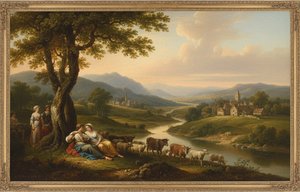
In the vast tapestry of American art history, few moments capture the quiet breath of nature as poignantly as Thomas Moran’s A Pastoral Landscape. Painted in 1889, this exquisite oil on canvas serves as a profound departure from the rugged, awe-inspiring vistas of the American West for which Moran is most famous. Instead of the dramatic canyons and sun-scorched peaks, we are invited into a sanctuary of peace—a lush, verdant corner of the Long Island marshlands. The painting presents an idyllic countryside where time seems to suspend itself; a gentle river meanders through the heart of the composition, its surface reflecting the soft, diffused light of an overcast sky. Here, the artist captures not just a place, but a feeling of profound tranquility, inviting the viewer to step away from the clamor of modernity and into a world of rhythmic, natural grace.
The mastery of Moran’s technique is on full display through his delicate handling of light and atmosphere. Utilizing the principles of Romanticism, he moves beyond mere topographical accuracy to evoke an emotional response. The composition is built upon receding planes that guide the eye with effortless fluidity: from the textured, rocky outcrops in the foreground to the soft, grassy meadows where cattle graze in quiet companionship, and finally toward the dense, mysterious forests that loom in the distance. His brushwork is both purposeful and subtle, layering colors to create a sense of palpable depth. The palette, dominated by rich greens, earthy browns, and the muted blues of a cloudy sky, creates a harmonious atmosphere where every element—from the swaying trees to the shimmering water—feels interconnected within a single, breathing ecosystem.
Symbolism and the Sublime in the Everyday
While many associate the concept of the sublime with terrifying storms or monumental mountains, Moran finds it here in the quiet persistence of life. The painting functions as a symbolic bridge between the wildness of nature and the comfort of the pastoral ideal. The presence of grazing cows introduces a sense of domestic harmony, suggesting a world where humanity and nature exist in a state of gentle equilibrium. The meandering river acts as a metaphor for the passage of time—constant, flowing, and life-giving. Even the sky, with its blend of white and grey clouds, suggests the potential for change, reminding us that even in moments of absolute stillness, the natural world is in a state of perpetual motion.
For the discerning collector or interior designer, A Pastoral Landscape offers more than just visual beauty; it provides an emotional anchor for a space. The painting’s muted tones and soft lighting make it an incredibly versatile piece for sophisticated decor, capable of bringing a sense of calm to a modern study, a classic library, or a bright, airy living room. It serves as a window into a lost era of American innocence, making it an ideal centerpiece for those looking to infuse their surroundings with a sense of history, prestige, and enduring peace. To possess a high-quality reproduction of this work is to hold a fragment of the Romantic spirit, ensuring that the serene beauty of Moran’s vision continues to inspire generations to come.
Preguntas y respuestas
¿Cómo se combinan la técnica y el movimiento en "A Pastoral Landscape"?
En "A Pastoral Landscape", la técnica de Oil On Canvas se funde con el movimiento Romanticism.
¿Es "A Pastoral Landscape" más bien clara o más bien oscura en su conjunto?
"A Pastoral Landscape" presenta un brillo general de deep_shadow y una luminancia de Soft Shadow.
¿Qué color predomina en "A Pastoral Landscape"?
El color dominante de "A Pastoral Landscape" de Thomas Moran es Espresso (#444b29).




 Ver en contexto
 Enviar
 Compartir
 Detalles
 Guía
Guía

 Descargar
 Similares
 Radiografía
 Presentación de diapositivas
 Q&A
Q&A Estadísticas