Cambiar a impresiones
 Ver más







































 Para obras de arte o reproducciones que midan más de 105 cm (aproximadamente 41 pulgadas) en cualquiera de sus lados, el marco se enviará como un kit desmontado. Este método garantiza una entrega segura y evita daños durante el transporte.


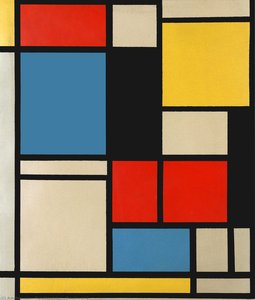
Composition with Grid No. 1
Piet Mondrian’s Composition with Grid No. 1 is not merely a painting; it's a visual manifesto, distilled from the core tenets of Neoplasticism—a style Mondrian fervently believed could express universal harmony through pure abstraction. Emerging from the turbulent currents of early 20th-century art, this work embodies precisely that conviction. To gaze upon its stark arrangement of black lines and rectangular planes is to encounter a world stripped bare of representational clutter, leaving only the essential elements of form and color.
A Journey Towards Abstraction
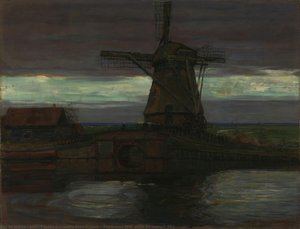
Mondrian’s path to this radical simplicity wasn't direct. Born Pieter Cornelis Mondriaan in Amersfoort, Netherlands, he initially trained as a teacher while simultaneously pursuing his artistic passions. His early works reveal a fascination with naturalistic landscapes—pieces like *The Red Mill* echo the traditions of the Hague School and Dutch Impressionism—demonstrating a careful study of observation before embarking on his transformative quest for an authentic visual language. However, a restless spirit drove him to experiment—Pointillism, Fauvism—always searching for a way to convey emotion without resorting to illusion.
De Stijl and the Pursuit of Universal Beauty
Composition with Grid No. 1 is deeply rooted in the principles of De Stijl (The Style), a Dutch artistic movement co-founded by Mondrian and Theo van Doesburg. This group envisioned art as a vehicle for social and spiritual renewal, believing that abstract forms could embody universal values—a bold assertion against the prevailing sentiment of the time. The painting’s limited palette—primarily black, white, and shades of gray—wasn't arbitrary; it represented a deliberate rejection of emotional expression in favor of clarity and objectivity. Each hue was chosen with meticulous consideration, reflecting Mondrian’s philosophical commitment to reducing visual experience to its most fundamental components.
The Geometry of Harmony
At the heart of this aesthetic endeavor lies Mondrian's unwavering belief in geometric abstraction as a means of achieving spiritual enlightenment. He meticulously sketched an underlying grid pattern onto the canvas—a technique he would repeat throughout his oeuvre—employing the golden ratio to ensure optimal balance and proportion. This deliberate simplification wasn’t merely stylistic; it was a profound reflection of Mondrian’s conviction that visual art could transcend subjective perception and reveal an underlying order.
A Lasting Legacy
The impact of Composition with Grid No. 1 extends far beyond the confines of painting itself. It profoundly influenced graphic design, architecture, and fashion throughout the 20th century—a testament to Mondrian’s enduring vision for a harmonious aesthetic language. As Stephen Bayley aptly noted, “Mondrian has come to mean Modernism. His name and his work sum up the High Modernist ideal.” Owning a reproduction of this iconic piece is not simply acquiring an artwork; it's embracing a legacy of artistic innovation—a celebration of pure form and color as expressions of universal beauty.
Preguntas y respuestas
¿En qué tamaño se recomienda imprimir "Composition con Rojo, Amarillo y Azul"?
El tamaño de impresión recomendado para "Composition con Rojo, Amarillo y Azul" de Piet Mondrian es Gran formato.
¿Qué tan armoniosos son los colores de "Composition con Rojo, Amarillo y Azul" de Piet Mondrian?
Los colores de "Composition con Rojo, Amarillo y Azul" de Piet Mondrian presentan una armonía Gran unidad cromática. La armonía describe la relación entre los colores.
¿Qué tamaño de impresión de "Composition con Rojo, Amarillo y Azul" de Piet Mondrian se adapta mejor a la habitación recomendada?
La combinación recomendada para "Composition con Rojo, Amarillo y Azul" de Piet Mondrian: una impresión de Gran formato en un/a Salón principal.
 Ver en contexto
 Enviar
 Compartir
 Detalles
 Guía
Guía

 Descargar
 Similares
 Radiografía
 Presentación de diapositivas
 Q&A
Q&A Estadísticas