
 Ver en contexto
 Enviar
 Compartir
 Detalles

 Descargar
 Similares
 Radiografía
 Presentación de diapositivas
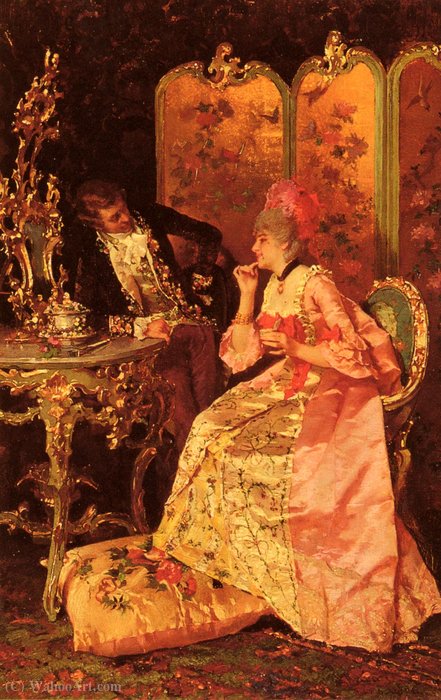
The flirtation
 Ver más
Reproducción al óleo hecha a mano
Óleo sobre lienzo pintado a mano en el tamaño y marco de su elección, realizado por encargo por nuestros artistas. ( Comprar impresión Comprar imagen)




































Elija entre nuestros tamaños predefinidos que respetan las proporciones originales de la obra.

Puede ingresar sus propias dimensiones para adaptarse a un marco o espacio específico. Si el tamaño seleccionado no coincide con las proporciones de la imagen original, recortaremos la obra o extenderemos la pintura con elementos adicionales pintados a mano. Se le enviará una maqueta digital para su aprobación antes de comenzar la producción.
Tenga en cuenta que la vista previa en pantalla no refleja el recorte o la extensión reales. Solo la maqueta mostrará con precisión la composición final.
Si bien existen tamaños personalizados, recomendamos seleccionar una dimensión de la lista predefinida para preservar las proporciones originales.
Tras realizar el pedido, el equipo de OriginalUniqueArt.com enviará un correo electrónico al cliente para solicitar instrucciones y proporcionarle una vista previa del boceto.
Envío a todo el mundo () en 3-4 semanas en lugar de las 5 semanas estándar. (29 agosto). Sin comprometer la calidad.

Envío exprés gratuito a todo el mundo

Lienzo de lino de alta calidad

Seguro de envío total

Garantía de reembolso de impuestos aduaneros

Garantía de fidelidad cromática exacta

Política de devolución de 60 días (solo por defectos)

Garantía de devolución del 100% del dinero

Descuento por cantidad
 La opción de vidrio solo está disponible en tamaños inferiores a 110 cm.

The flirtation
Técnica de reproducción
Dimensiones de la reproducción
-


Precio total final
$ 300
Biografía del artista
A Painter of Northern Spain’s Soul
Luis Álvarez Catalá, a name etched into the golden era of nineteenth-century Spanish art, possessed a rare ability to capture the very essence of his heritage. Born on January 22, 1836, to an Asturian family, his early years were shaped by the rugged beauty and cultural richness of Northern Spain. Though he is believed to have been born in Madrid, the summers spent in Cangas de Narcea left an indelible mark on his artistic psyche. These formative landscapes, filled with the traditions of Asturias and León, would later serve as the emotional wellspring for much of his most poignant work. His journey from a student in Oviedo to a master of the academic tradition is a testament to a life dedicated to the pursuit of visual truth.
Catalá’s formal education was marked by rigorous discipline and the guidance of masters. After studying at the Escuela Especial de Pintura, Escultura y Grabado, he entered the prestigious Real Academia de Bellas Artes de San Fernando in Madrid. Under the influential tutelage of Federico de Madrazo, Catalá refined his technique, absorbing the elegance and precision of the academic style. However, it was his departure for Rome in 1857 that truly ignited his creative spirit. Supported by a generous scholarship alongside contemporaries like Eduardo Rosales, he immersed himself in the vibrant Roman artistic milieu. This period of international exposure allowed him to blend Spanish sentiment with European sophistication, leading to his first major triumph: winning a gold medal at the First National Exposition of Florence for Calpurnia’s Dream.
Mastery of Genre and Historical Grandeur
The evolution of Catalá’s oeuvre is a fascinating study in the balance between historical narrative and the intimate charm of costumbrismo. In his early career, he gained immense prestige through large-scale historical scenes that commanded attention in the great salons of Europe. The success of Calpurity's Dream was so profound that it caught the eye of Queen Isabel II, who purchased the work, further elevating his status within the Spanish court. His ability to breathe life into antiquity and legend demonstrated a technical mastery over light, shadow, and human emotion that resonated with the romantic sensibilities of his age.
As his career matured, Catalá turned his gaze toward the everyday—the quiet, unvarnished moments of Spanish life. This shift toward costumbrista painting allowed him to explore the textures of rural existence and the subtle nuances of social interaction. Works such as The Flirtation and The Suitor showcase a delicate touch, where the warmth of the palette and the meticulous detail of costume and setting invite the viewer into a private, domestic world. Whether depicting an opulent studio scene in Admiring the Picture or the rustic simplicity of his youth, Catalá maintained a profound respect for the dignity of his subjects, ensuring that even the most mundane moment felt monumental.
Legacy and the Stewardship of Art
Beyond the canvas, Luis Álvarez Catalá played a monumental role in the preservation of Spanish artistic heritage. His appointment as Director of the Museo del Prado from 1898 to 1901 was not merely a professional milestone but a period of significant cultural stewardship. During his tenure, he worked tirelessly to enhance the museum's collection, most notably through the acquisition of several works by Francisco de Goya. His scholarly dedication even led him to produce an illustrated catalog of the Velázquez collection, a contribution that remains vital to the study of Spanish masters. He was a man who understood that the greatness of the past must be carefully curated to inspire the future.
In his final years, Catalá returned to his roots, finding inspiration once more in the landscapes and people of Northern Spain. This nostalgic period produced works that are now cherished within the Museum of Fine Arts of Asturias, completing a beautiful artistic circle that began in those same verdant hills. When he passed away in Madrid on October 4, 1901, he left behind a legacy defined by both grandeur and intimacy. His life remains a bridge between the rigid traditions of the academy and the soulful, lived experience of the Spanish people, ensuring his place as a pivotal figure in the history of European painting.

luis alvarez catala
1836 - 1901
Datos clave
- Artistic Movement Or Style: Costumbrista
- Artists Or Movements Influenced By This Artist: ['Diego Velázquez']
- Artists Who Influenced This Artist: ['Federico de Madrazo']
- Date Of Birth: January 22, 1836
- Date Of Death: October 4, 1901
- Full Name: Luis Álvarez Catalá
- Nationality: Spanish
- Notable Artworks:
- The Filandón
- The Suitor
- Calpurnia's Dream
- Place Of Birth: Madrid, Spain

