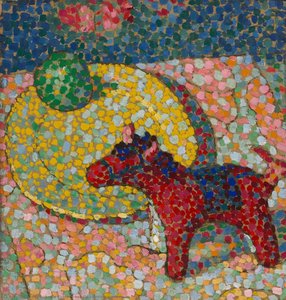
Ver en contexto
 Enviar
 Compartir
 Detalles
 Guía
Guía

 Descargar
 Similares
 Radiografía
 Presentación de diapositivas
 Estadísticas
Head with Broken Pot


 Ver más
La obra de arte que se muestra en esta página está protegida por las leyes de propiedad intelectual, lo que significa que no podemos crear ni vender legalmente una reproducción idéntica. Esta protección se hace cumplir en virtud de acuerdos internacionales como el Convenio de Berna y por las leyes nacionales, incluidas aquellas establecidas por el Ley de derechos de autor de los EE. UU. - Título 17.
Este método cumple plenamente con las normativas de derechos de autor, ya que no implica la copia ni la duplicación de la obra protegida. En su lugar, se trata de una reinterpretación creativa: una nueva pintura influenciada por la original, pero que no es idéntica a ella.
Giclée / Impresión de arte
Impresiones giclée o en lienzo de calidad de museo con producción rápida y opciones de acabado flexibles. ( Comprar pintura hecha a mano Cambiar a imagen digital)




P118B €10

P118H €10

P118W €10

P438Z €10

P508JH €12

P508YH €12

P805H €10

P805Z €10

P919BZ €10

P919G €10

P919XJ €10

P959ZH €10

P968JZ €12

W106C €8

W218G €10

W218JH €8

W218Y €10

W307PJ €10

W316G €10

W316PJ €8

W316Y €10

W398PJ €8

W4111J €10

W500HY €15

W500JH €15

W692G €12

W849H €8

W940BG €15

W953PJ €8




Elija entre nuestros tamaños predefinidos que respetan las proporciones originales de la obra.

Introduzca el ancho y el alto que necesite para adaptarse a su marco o pared. Una impresión solo puede recortarse, nunca hacerse más grande que la imagen original, por lo que un tamaño con una forma distinta perderá parte de la obra. Le enviaremos una maqueta digital para su aprobación antes de realizar cualquier impresión. La imagen que se muestra en esta página no refleja el recorte real; solo la maqueta lo hace.
Envío a todo el mundo () en 2 semanas en lugar de las 4/5 semanas estándar. (25 octubre)

Envío exprés gratuito a todo el mundo

Lienzo de lino de alta calidad

Seguro de envío total

Garantía de reembolso de aranceles aduaneros

Garantía de fidelidad cromática exacta

Política de devolución de 100 días (solo por defectos)

Garantía de devolución del 100% del dinero

Descuento por cantidad
 La opción de vidrio solo está disponible en tamaños inferiores a 110 cm.

Head with Broken Pot
Giclée / Impresión de arte
Dimensiones de la reproducción
-


Precio total final
€ 70
A Silent Still Life: Deconstructing Mortality and the Female Form
Georgia O’Keeffe’s “Head with Broken Pot,” painted in 1943, isn’t merely a depiction of an inanimate object; it's a profound meditation on mortality, femininity, and the quiet dignity of decay. The stark simplicity of the composition—a weathered skull resting atop a shattered ceramic pot—immediately commands attention, drawing the viewer into a space where the boundaries between life and death, beauty and ruin, become exquisitely blurred. O’Keeffe, already a master of distilling form to its essential elements, here elevates the commonplace to the realm of symbolic significance, inviting us to contemplate the fragility of existence and the enduring power of the human spirit.

The Desert’s Echoes: New Mexico and O'Keeffe’s Vision
Painted during a period of intense personal reflection and artistic exploration, “Head with Broken Pot” is inextricably linked to O’Keeffe’s relocation to the high desert landscapes of New Mexico in 1949. The muted palette—ochre browns, dusty blues, and stark whites—mirrors the arid beauty of the region, while the rough texture of the skull and pot evokes the weathered surfaces of ancient ruins. This setting profoundly influenced her work, providing a backdrop for her explorations of form, scale, and the relationship between nature and human perception. The New Mexico landscape became a constant source of inspiration, informing her unique visual language and allowing her to capture the essence of the Southwest’s stark beauty.
Deconstructing Symbolism: Skull, Pot, and the Feminine Archetype
The symbolism within “Head with Broken Pot” is layered and open to interpretation. The skull, a universal emblem of mortality, anchors the composition, reminding us of our own inevitable fate. However, O’Keeffe doesn't present it as a morbid image; instead, she imbues it with a sense of quiet strength and resilience. The broken pot, positioned above the skull, adds another layer of complexity. It could represent shattered dreams, lost innocence, or the fragility of beauty—a poignant reminder that even the most enduring things can be irrevocably damaged. Some scholars have suggested the pot alludes to female genitalia, a recurring motif in O’Keeffe's work, further emphasizing the painting’s exploration of feminine power and vulnerability. The deliberate ambiguity invites viewers to project their own interpretations onto the scene.
A Masterclass in Minimalism: Technique and Composition
O’Keeffe’s masterful technique is evident in the painting's precise execution and careful attention to detail. She employed a limited palette of earthy tones, applying thin layers of oil paint to create a textured surface that captures the rough quality of the materials. The composition is remarkably simple—a tight crop focusing solely on the skull and pot—yet it’s incredibly dynamic. The stark contrast between the smooth curves of the skull and the jagged edges of the broken pot creates a visual tension that draws the eye across the canvas. O'Keeffe’s use of scale further enhances this effect, making the skull appear monumental against the backdrop of the desert landscape. The painting is a testament to her ability to convey profound meaning through deceptively simple forms and techniques.
Legacy and Reproduction: Bringing O’Keeffe’s Vision Home
“Head with Broken Pot” remains one of Georgia O'Keeffe’s most iconic works, celebrated for its haunting beauty and enduring symbolism. High-quality reproductions capture the painting’s rich textures and subtle nuances, allowing viewers to experience O’Keeffe’s vision in their own homes. Whether displayed as a statement piece or incorporated into a minimalist interior design scheme, this artwork continues to resonate with audiences today, prompting reflection on life, death, and the enduring power of art.
Preguntas y respuestas
¿Se puede ver "Head with Broken Pot" de Georgia O'Keeffe en una presentación de diapositivas?
Disponible una presentación de diapositivas: la página Galería de imágenes de "Head with Broken Pot" de Georgia O'Keeffe.
¿Cómo puedo conseguir una lámina de "Head with Broken Pot" de Georgia O'Keeffe?
Para obtener una impresión de "Head with Broken Pot" de Georgia O'Keeffe, simplemente pídala en su página de Impresión de arte de bellas artes: una impresión de bellas artes sobre lienzo de algodón o papel de lienzo de archivo.
¿Cómo puedo descargar la imagen de "Head with Broken Pot" de Georgia O'Keeffe?
Puede descargar "Head with Broken Pot" de Georgia O'Keeffe desde la página de Descargar imagen digital de la obra, como descarga de una imagen digital en alta resolución.
Biografía del artista
Primeros años y formación (1887–1916)
Georgia Totto O’Keeffe, una figura fundamental del modernismo americano, nació el 15 de noviembre de 1887 en Sun Prairie, Wisconsin. Sus padres, Francis Calyxtus O'Keeffe e Ida (Totto) O'Keeffe, eran agricultores dedicados a la producción lechera de ascendencia irlandesa y húngara, respectivamente. A los diez años, Georgia ya había decidido convertirse en artista. Recibió instrucción artística de la acuarelista local Sara Mann y posteriormente asistió al Instituto de Arte de Chicago desde 1905 hasta 1906, donde estudió bajo John Vanderpoel. Su estilo único comenzó a desarrollarse durante sus estudios en la Universidad de Virginia.Carrera Artística (1917–1986)
En 1917, Alfred Stieglitz, un marchante de arte y fotógrafo, expuso las obras de O’Keeffe. Esto marcó el inicio de su carrera profesional. Se mudó a Nueva York en 1918 a petición de Stieglitz y comenzó a trabajar seriamente como artista. Su relación profesional floreció en una personal, lo que llevó a su matrimonio el 11 de diciembre de 1924. El arte abstracto de O’Keeffe, incluyendo los primeros planos de flores como Red Canna, fue frecuentemente interpretado como representaciones de vulvas, aunque ella negó consistentemente esta intención. Su trabajo también estuvo influenciado por su tiempo en el suroeste americano, lo que inspiró pinturas como Cow's Skull: Red, White, and Blue (1931) y Summer Days (1936).Influencias y Estilo
- Arthur Wesley Dow: O’Keeffe estudió con Arthur Wesley Dow, quien enfatizaba la importancia del diseño y la interpretación personal sobre la mera copia de la naturaleza. Este enfoque influyó profundamente en su estilo abstracto.
- Alfred Stieglitz: El apoyo y la promoción de Alfred Stieglitz fueron cruciales para el desarrollo y reconocimiento de O’Keeffe como artista.
- Impresionismo y Precisionismo: Aunque O'Keeffe se distanció de los movimientos artísticos tradicionales, su trabajo muestra influencias tanto del impresionismo en su uso del color como del precisionismo en su enfoque detallado y geométrico de las formas naturales.
Legado e Importancia Histórica
Tras la muerte de Stieglitz en 1946, O’Keeffe vivió en Nuevo México durante los siguientes 40 años. Su obra ha sido fundamental para definir el modernismo americano y su enfoque innovador de la abstracción y la representación de la naturaleza ha inspirado a generaciones de artistas. En 2014, su pintura Jimson Weed/White Flower No. 1 se vendió por $44,405,000, estableciendo un récord para el precio más alto pagado por una obra de arte de una artista femenina. Su legado continúa siendo celebrado en todo el mundo a través del Museo Georgia O’Keeffe y numerosas exposiciones.Obras Destacadas
- Red Canna (1924): Una vibrante representación abstracta de una flor, que generó controversia por su posible interpretación erótica.
- Cow's Skull: Red, White, and Blue (1931): Un ejemplo icónico de su trabajo inspirado en el paisaje del suroeste americano.
- Summer Days (1936): Una pintura que captura la atmósfera y los colores del verano en Nuevo México.
- Jimson Weed/White Flower No. 1 (1932): Una obra maestra que muestra una flor con un fondo abstracto, destacando su habilidad para combinar formas naturales y abstracción.

Georgia O'Keeffe
1887 - 1986 , Estados Unidos de América
Datos clave
- Artistas Que Influyeron: ['Alfred Stieglitz']
- Fecha De Fallecimiento: 6 de marzo de 1986
- Fecha De Nacimiento: 15 de noviembre de 1887
- Lugar De Nacimiento: Sun Prairie, Estados Unidos
- Movimiento Artístico: Modernismo americano
- Nacionalidad: Estadounidense
- Nombre Completo: Georgia O’Keeffe
- Obras Notables:
- Luz de Iris
- Orquídeas Orientales
- Azul y Verde Música
- Sol Pálido
- Cráneo de Vaca Roja
- Música, Rosa y Azul No. 2
- Abstracción azul
- La Cabeza de Toro
- Onda azul maine
Artículos relacionados

Georgia O'Keeffe: Redefining Modernism Through Symbolism & the American Landscape
Explore the captivating world of Georgia O'Keeffe! Discover her groundbreaking flower paintings, New Mexico landscapes & lasting impact on American Modernism. Expert analysis and insights.
Clyfford Still's Abstract Expressionism: A Study of Color, Form & the Existential Landscape
Explore the profound world of Clyfford Still's Abstract Expressionism with OriginalUniqueArt. Discover his unique style, existential themes & investment potential. Expert analysis for discerning collectors.
De la Naturaleza Muerta Clásica a la Abstracción Contemporánea: Elevando los Espacios de Entretenimiento en Villas a Través de Reproducciones Artísticas
Descubre la evolución del bodegón y cómo integrar reproducciones artísticas de alta calidad en tu villa. Expertos en arte, selección exclusiva y asesoramiento personalizado.
The Enduring Appeal of Still Life: A Historical & Contemporary Exploration
Explore the rich history & symbolism of still life painting with OriginalUniqueArt. Discover masterpieces from the Dutch Golden Age, learn about vanitas art, and find expert guidance for collecting timeless artworks.

Silent Narratives: Exploring the Enduring Appeal of Still Life Painting Across Centuries
Explore the rich history of still life painting with OriginalUniqueArt. Discover Dutch Masters, decode vanitas symbolism & learn about collecting timeless art. Expert insights and museum-quality reproductions.