Cambiar a impresiones
 Ver más







































 Para obras de arte o reproducciones que midan más de 105 cm (aproximadamente 41 pulgadas) en cualquiera de sus lados, el marco se enviará como un kit desmontado. Este método garantiza una entrega segura y evita daños durante el transporte.


La Riboteuse de Gabriel Metsu: Un Reflejo de la Dignidad Cotidiana
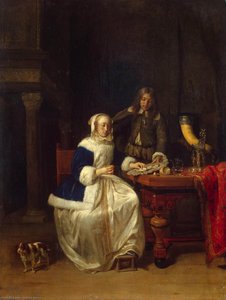
“La Riboteuse” (The Washerwoman) by Gabriel Metsu, painted around 1665, is more than just a portrait; it’s a poignant window into the heart of 17th-century Dutch life. This intimate scene, rendered with an almost unsettling realism, captures a moment of quiet contemplation within a domestic setting – a world both familiar and subtly imbued with symbolic weight. Metsu, a remarkably eclectic artist whose career spanned diverse genres, here masterfully employs the techniques characteristic of the Dutch Golden Age to create an image that resonates deeply with viewers centuries later.
The painting immediately draws us in through its masterful use of light and shadow, a hallmark of chiaroscuro. A single, unseen source illuminates the woman’s face and hands, highlighting the intricate details of her worn clothing and the delicate wrinkles etched by time. These shadows, deep and velvety, create a sense of depth and volume, lending an almost sculptural quality to the figure. The muted earth tones – browns, ochres, creams, and subtle hints of red – dominate the palette, reflecting the practicality and simplicity of everyday life in Holland at that period. The artist’s meticulous attention to texture is equally remarkable; you can practically feel the roughness of the fabric, the smoothness of her skin, and the cool solidity of the jugs resting on the table.
El Contexto Histórico y la Eclecticidad de Metsu
To understand “La Riboteuse,” it’s crucial to consider Gabriel Metsu's place within the broader artistic landscape of the Dutch Golden Age. This era, marked by unprecedented prosperity and a burgeoning merchant class, witnessed an explosion of artistic creativity. Artists like Metsu were tasked with documenting the realities of daily life – not in grand historical narratives, but in intimate portraits of ordinary people. Metsu’s career was defined by his refusal to adhere strictly to any single style; he seamlessly blended elements from history painting, still life, portraiture, and genre scenes, earning him a reputation for remarkable versatility. This eclectic approach is vividly displayed here, combining the meticulous detail of a portrait with the symbolic richness often found in still lifes.
Born into a family connected to tapestry production – his father was a painter originally from Hainault – Metsu’s early exposure to diverse artistic traditions undoubtedly shaped his unique style. Leiden, where he spent much of his life, served as a vibrant hub for artistic exchange and innovation during this period. His relatively short but intensely productive career (1629-1667) produced only around 133 works, making each one exceptionally valuable and offering a rare glimpse into the mind of an artist grappling with form, light, and human experience.
Simbolismo y la Dignidad de una Mujer Común
Beyond its technical brilliance, “La Riboteuse” is rich in subtle symbolism. The jugs on the table are not merely decorative elements; they represent domestic labor, the essential work of women in 17th-century Holland. They speak to the rhythms of daily life and the quiet dignity of those who sustained the household. The woman’s expression – a mixture of thoughtfulness and perhaps a touch of melancholy – invites us to contemplate her story, her struggles, and her resilience. She is not idealized or romanticized; she is simply presented as an ordinary woman, worthy of our attention and respect.
Metsu's ability to capture such profound emotion with such understated grace is what elevates “La Riboteuse” beyond a mere depiction of a washerwoman. It’s a testament to his artistic skill and his deep understanding of the human condition. The painting serves as a powerful reminder that beauty can be found in the most unexpected places – in the everyday lives of ordinary people, rendered with exquisite detail and imbued with a quiet dignity.
Reproducciones de Alta Calidad para tu Espacio
OriginalUniqueArt offers meticulously crafted reproductions of Gabriel Metsu’s “La Riboteuse,” allowing you to bring this remarkable artwork into your home or office. Our hand-painted reproductions faithfully capture the original's nuances, from the subtle variations in color and texture to the evocative lighting and emotional depth. Whether you are an art collector, a design enthusiast, or simply someone seeking a piece of history to enrich your surroundings, our reproductions provide an authentic and stunning representation of this iconic Dutch masterpiece. Explore our collection today and discover the timeless beauty of “La Riboteuse.”
Preguntas y respuestas
¿Dónde puedo encontrar estadísticas sobre "La Riboteuse" de Gabriel Metsu?
Las estadísticas sobre "La Riboteuse" de Gabriel Metsu se encuentran en la página de Estadísticas de la obra: visitas mensuales de la pieza, visitas a las obras del artista y desgloses por país e idioma de los visitantes recientes.
¿Qué nivel de luminosidad transmite "La Riboteuse" de Gabriel Metsu?
En términos generales, "La Riboteuse" presenta una luminosidad de sombras profundas. La luminosidad percibida describe qué tan clara u oscura parece la obra.
¿Qué tema y atmósfera combina "La Riboteuse" de Gabriel Metsu?
"La Riboteuse" muestra elderly woman, domesticity, dutch art, chiaroscuro, realism, jugs, reflection, y su atmósfera es Serenidad.
 Ver en contexto
 Enviar
 Compartir
 Detalles
 Guía
Guía

 Descargar
 Similares
 Radiografía
 Presentación de diapositivas
 Q&A
Q&A Estadísticas