Portrait of William McTaggart

The 100 Most Famous William McTaggart Paintings, a Gallery Selection

Updated November 2026 · ranked by our popularity score (searches, visits and orders for each work) · 117 works by William McTaggart in our catalogue

In short

Of all the originals William McTaggart left, the most famous is Storm Cloud. Close behind it come A Study of Two Female Nude Models (1858) and A Ground Swell, Carradale, Argyll (1886). Our catalog holds 117 works by William McTaggart; the gallery has kept the 100 the world admires most, each shown with its date, its museum and its story.

1835 – 1910, Argyll and Bute Impressionism Most works: Scottish National Gallery

William McTaggart's top 10 paintings: the gallery's choice

1
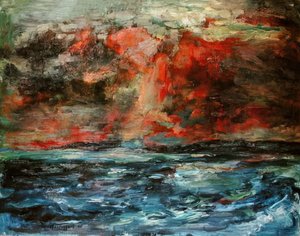
Storm Cloud by William McTaggart

Storm Cloud

Oil On Canvas

William McTaggart's “Storm Cloud” is a captivating exploration of nature’s raw energy and emotional intensity. This work isn’t a literal depiction of a storm, but rather an abstract expressionist interpretation that prioritizes feeling over precise representation. It invites viewers to connect with the primal forces at play in the natural world and within themselves.

2
A Study of Two Female Nude Models (1858) by William McTaggart

A Study of Two Female Nude Models

1858 · Oil On Canvas · Scottish National Gallery, Edinburgh

In the soft, amber-hued light of a mid-nineteenth-century studio, two women exist in a moment of stillness. One figure stands tall on the left, her back turned to us in a three-quarter view, her form defined by the gentle play of light against skin. To her right, a second woman rests, seated and leaning against a large, terracotta vessel that anchors the composition. The air feels heavy with the scent…

3
A Ground Swell, Carradale, Argyll (1886) by William McTaggart

A Ground Swell, Carradale, Argyll

1886 · Oil

In this 1886 work, we find ourselves looking out over the waters near Carradale, Argyll. The scene is defined by a sense of movement, specifically the restless energy of a ground swell moving through the sea. Several boats are scattered across the composition, some drifting near the shoreline while others appear smaller and more distant as they navigate the expanse. A single figure stands near the center, a small presence…

4
A Study of Oak Leaves in Autumn (Self-portrait) (1892) by William McTaggart

A Study of Oak Leaves in Autumn (Self-portrait)

1892 · Oil On Canvas · Scottish National Gallery, Edinburgh

The oil on canvas work titled A Study of Oak Leaves in Autumn (Self-portrait) was executed by the Scottish artist William McTaggart. Dated 1892, this painting presents a self-portrait of the artist. The subject is depicted as a man with a prominent, well-groomed beard and mustache, wearing a dark hat and a heavy, textured coat. He is positioned in a bust-length composition, looking toward the viewer from a slightly off-center…

5
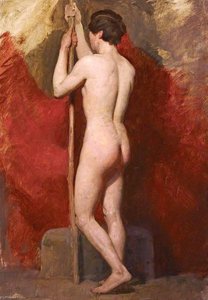
Life Study of a Standing Nude Male Model (1859) by William McTaggart

Life Study of a Standing Nude Male Model

1859 · Oil On Canvas · Scottish National Gallery, Edinburgh

The painting depicts a naked man standing in front of a red curtain. The man has his back turned towards the viewer and appears to be looking at something behind him. He is positioned as if holding onto a pole or rod, which may be used for support while posing. The red curtain serves as the background for the scene, providing depth and color.

7
Life Study of a Seated Male Nude Holding a Staff (1850) by William McTaggart

Life Study of a Seated Male Nude Holding a Staff

1850 · Oil On Canvas · Scottish National Gallery, Edinburgh

In "Life Study of a Seated Male Nude Holding a Staff" by William McTaggart, a single nude male subject occupies the center of the frame. He is positioned in a three-quarter profile, facing toward the right. A long, diagonal staff cuts across the composition, providing a sharp structural element that breaks the stillness of the figure. This wooden line anchors the subject within a shallow space. The background is a…

9
The Past and the Present (1860) by William McTaggart

The Past and the Present

1860 · Oil · Scottish National Gallery, Edinburgh

The oil painting titled The Past and the Present was executed by the artist William McTaggart. Created in 1860, this work represents an early period in the artist's career. The piece demonstrates McTaggart's developing skill in capturing light and color through a delicate touch.

10
The Old Net (1869) by William McTaggart

The Old Net

1869 · Oil On Canvas

The Old Net is a painting by William McTaggart, created about 1869. This work emerged during a period when the artist was refining his ability to translate the atmospheric qualities of the Scottish coast onto canvas. It captures a quiet, grounded moment on a shoreline, focusing on the interaction between figures and their environment.

The William McTaggart selection continues, 11 to 100

11Halfway Home (1869) by William McTaggartHalfway Home1869 · Scottish National Gallery 12The Young Fishers (1876) by William McTaggartThe Young Fishers1876 · Scottish National Gallery 13Through Wind and Rain (1875) by William McTaggartThrough Wind and Rain1875 14The Bait Gatherers (1879) by William McTaggartThe Bait Gatherers1879 · Scottish National Gallery 15By Summer Seas (1890) by William McTaggartBy Summer Seas1890 · Scottish National Gallery 16Mist Clearing off Mull of Kintyre (1890) by William McTaggartMist Clearing off Mull of Kintyre1890 17Spring (1864) by William McTaggartSpring1864 · Scottish National Gallery 18'The Belle' (The Artist's Daughter, Jean Isobel McTaggart, 1880 - 1955) (1885) by William McTaggart'The Belle' (The Artist's Daughter, Jean Isobel McTaggart, 1880 - 1955)1885 · Scottish National Gallery 19Life Study of a Female Nude Model with her Left Arm Raised (1859) by William McTaggartLife Study of a Female Nude Model with her Left Arm Raised1859 · Scottish National Gallery 20The Artist's Mother (Barbara Brodie or Brolochan, Mrs Dugald McTaggart, died 1884) by William McTaggartThe Artist's Mother (Barbara Brodie or Brolochan, Mrs Dugald McTaggart, died 1884)Scottish National Gallery 21A Sprig Of Heather - by William McTaggartA Sprig Of Heather - 22The Past And Present by William McTaggartThe Past And Present 23Molly, Mary Gavin (1874) by William McTaggartMolly, Mary Gavin1874 · Scottish National Gallery 24When Summer Is In The Prime by William McTaggartWhen Summer Is In The Prime 25The Sailing of the Emigrant Ship (1895) by William McTaggartThe Sailing of the Emigrant Ship1895 · Scottish National Gallery 26Life Study of a Female Nude Model Seated on White Drapery (1854) by William McTaggartLife Study of a Female Nude Model Seated on White Drapery1854 · Scottish National Gallery 27Life Study Reclining Female Nude (1855) by William McTaggartLife Study Reclining Female Nude1855 · Scottish National Gallery 28Sketch of a church door (1860) by William McTaggartSketch of a church door1860 · Scottish National Gallery 29My Boy Tammie (1861) by William McTaggartMy Boy Tammie1861 30Life Study of a Seated Nude Male Model (1859) by William McTaggartLife Study of a Seated Nude Male Model1859 · Scottish National Gallery 31Helping Granny (1863) by William McTaggartHelping Granny1863 32Fish from the Boat (1868) by William McTaggartFish from the Boat1868 · Mcmanus: Dundee's Art Galleries And Museums 33Dora (1869) by William McTaggartDora1869 34Grandmother's Pet (1864) by William McTaggartGrandmother's Pet1864 35Do Doggies Gang tae Heaven (1867) by William McTaggartDo Doggies Gang tae Heaven1867 36Lucy's Flitting (1873) by William McTaggartLucy's Flitting1873 37A Fresh Breeze (1876) by William McTaggartA Fresh Breeze1876 · Mcmanus: Dundee's Art Galleries And Museums 38Jeannie (Miss Jean Halley) (1873) by William McTaggartJeannie (Miss Jean Halley)1873 · Mcmanus: Dundee's Art Galleries And Museums 39Mrs Leiper (1872) by William McTaggartMrs Leiper1872 · Scottish National Gallery 40Summer Sundown - Tir-nan-og (1880) by William McTaggartSummer Sundown - Tir-nan-og1880 41A Message from the Sea (1883) by William McTaggartA Message from the Sea1883 · Dundee Art Gallery And Museum 42Flotsam and Jetsam (1883) by William McTaggartFlotsam and Jetsam1883 · City Art Centre 43In a Ground Swell (1883) by William McTaggartIn a Ground Swell1883 44Mrs William Lawrie (1881) by William McTaggartMrs William Lawrie1881 · Scottish National Gallery 45Snow in April (1892) by William McTaggartSnow in April1892 · Scottish National Gallery 46Cornfield, Sandy Dean (1891) by William McTaggartCornfield, Sandy Dean1891 · Scottish National Gallery 47A Breezy Day off Campbeltown (1886) by William McTaggartA Breezy Day off Campbeltown1886 · The Hunterian Museum and Art Gallery 48In the Rock Pools (1887) by William McTaggartIn the Rock Pools1887 49The Harvest Moon (1889) by William McTaggartThe Harvest Moon1889 50Fisher's Landing (1887) by William McTaggartFisher's Landing1887 51Hayfield, Broomieknowe (1889) by William McTaggartHayfield, Broomieknowe1889 52The Emigrants (1889) by William McTaggartThe Emigrants1889 53Mrs (James Guthrie) Orchar (1886) by William McTaggartMrs (James Guthrie) Orchar1886 · Mcmanus: Dundee's Art Galleries And Museums 54Happy Days (1886) by William McTaggartHappy Days1886 55Father is at the Helm (1889) by William McTaggartFather is at the Helm1889 56Jeannie (1887) by William McTaggartJeannie1887 · Mcmanus: Dundee's Art Galleries And Museums 57The Coming of Saint Columba (1895) by William McTaggartThe Coming of Saint Columba1895 · Scottish National Gallery 58Autumn Day, Midlothian (1898) by William McTaggartAutumn Day, Midlothian1898 59Sound of Jura (1894) by William McTaggartSound of Jura1894 · The Hunterian Museum and Art Gallery 60End of the Links (1893) by William McTaggartEnd of the Links1893 61The Lilies (1896) by William McTaggartThe Lilies1896 62Landscape Sketch, Howgate (1895) by William McTaggartLandscape Sketch, Howgate1895 63Joseph Henderson (1894) by William McTaggartJoseph Henderson1894 64Harvest at Broomieknowe (1896) by William McTaggartHarvest at Broomieknowe1896 · Scottish National Gallery 65Emigrants Leaving the Hebrides (1898) by William McTaggartEmigrants Leaving the Hebrides1898 66Golden Grain (also known as Harvester) (1894) by William McTaggartGolden Grain (also known as Harvester)1894 67Kinloch Rannoch (1893) by William McTaggartKinloch Rannoch1893 68Autumn Evening, Broomieknowe (1905) by William McTaggartAutumn Evening, Broomieknowe1905 · Scottish National Gallery 69The White Calm - Ailsa Craig from Port an Righ (1901) by William McTaggartThe White Calm - Ailsa Craig from Port an Righ1901 70A June Day Crab Catching (1903) by William McTaggartA June Day Crab Catching1903 71Left in Charge (1902) by William McTaggartLeft in Charge1902 72Harvest Moon (1899) by William McTaggartHarvest Moon1899 · Scottish National Gallery 73Lobster Fishers, Machrihanish Bay (1901) by William McTaggartLobster Fishers, Machrihanish Bay1901 · University of Dundee 74Portrait Study of a Lady by William McTaggartPortrait Study of a LadyScottish National Gallery 75The Silver Sea (1907) by William McTaggartThe Silver Sea1907 · The Hunterian Museum and Art Gallery 76Glenramskill (1908) by William McTaggartGlenramskill1908 77Snow in April by William McTaggartSnow in April 78Running For Shelter by William McTaggartRunning For Shelter 79Father is at the Helm by William McTaggartFather is at the Helm 80Mist and Rain, Macrihanish (1907) by William McTaggartMist and Rain, Macrihanish1907 81Machrihanish Bay (1878) by William McTaggartMachrihanish Bay1878 · Scottish National Gallery 82The Sailor's Yarn by William McTaggartThe Sailor's YarnScottish National Gallery 83Quiet Sunset, Machrihanish by William McTaggartQuiet Sunset, MachrihanishScottish National Gallery 84Winter Wheat by William McTaggartWinter Wheat 85A Deserted Rocky Shore by William McTaggartA Deserted Rocky Shore 86And All The Choral Waters Sang by William McTaggartAnd All The Choral Waters Sang 87On loch fyne by William McTaggartOn loch fyne 88Preaching Of St. Columba by William McTaggartPreaching Of St. Columba 89Flotsam And Jetsam by William McTaggartFlotsam And Jetsam 90Noontide, Jovie's Neuk by William McTaggartNoontide, Jovie's Neuk 91And All The Choral Waters Sang - by William McTaggartAnd All The Choral Waters Sang - 92Flotsam And Jetsam - by William McTaggartFlotsam And Jetsam - 93Cauldron Rocks by William McTaggartCauldron Rocks 94The Fisher Boy by William McTaggartThe Fisher Boy 95The Adventure by William McTaggartThe Adventure 96Fisher Children by William McTaggartFisher Children 97Storm Cloud by William McTaggartStorm Cloud 98Sweet william by William McTaggartSweet william 99Jeanni Deans by William McTaggartJeanni Deans 100The Old Pump Well by William McTaggartThe Old Pump Well

William McTaggart's famous paintings, period by period

The subjects that held William McTaggart's eye

The four subjects that come back most often in these originals, each with its finest example.

The museums that keep William McTaggart's originals

The 7 museums that hold the most of the paintings on this page.

Museum City Works by William McTaggart Paintings from this list
Scottish National Gallery, EdinburghScottish National Gallery Edinburgh 32 A Study of Two Female Nude Models, A Study of Oak Leaves in Autumn (Self-portrait), Life Study of a Standing Nude Male Model
Mcmanus: Dundee's Art Galleries And Museums, DundeeMcmanus: Dundee's Art Galleries And Museums Dundee 5 Fish from the Boat, A Fresh Breeze, Jeannie (Miss Jean Halley)
The Hunterian Museum and Art Gallery, GlasgowThe Hunterian Museum and Art Gallery Glasgow 3 A Breezy Day off Campbeltown, Sound of Jura, The Silver Sea
Polesden LaceyPolesden Lacey 1 The Pleasures of Hope
Dundee Art Gallery And Museum, DundeeDundee Art Gallery And Museum Dundee 1 A Message from the Sea
City Art Centre, EdinburghCity Art Centre Edinburgh 1 Flotsam and Jetsam
University of Dundee, DundeeUniversity of Dundee Dundee 1 Lobster Fishers, Machrihanish Bay

William McTaggart decade by decade: the original that defines each

Works per decade

Pick a decade to see the original that defines it.

Collectors' questions about William McTaggart's paintings

Which work is William McTaggart most famous for?Reveal the answer

Storm Cloud. A Study of Two Female Nude Models (1858) and A Ground Swell, Carradale, Argyll (1886) come next.

What are the ten most famous William McTaggart paintings?Reveal the answer

Storm Cloud, A Study of Two Female Nude Models, A Ground Swell, Carradale, Argyll, A Study of Oak Leaves in Autumn (Self-portrait), Life Study of a Standing Nude Male Model, A Life Study of a Standing Female Nude, Life Study of a Seated Male Nude Holding a Staff, The Pleasures of Hope, The Past and the Present and The Old Net. The ranking above gives each one's year and museum.

How many paintings did William McTaggart leave?Reveal the answer

Our catalog holds 117 works by William McTaggart, dated from 1850 to 1908.

In which museums do William McTaggart's masterpieces hang?Reveal the answer

Mostly in Scottish National Gallery (Edinburgh), Mcmanus: Dundee's Art Galleries And Museums (Dundee) and The Hunterian Museum and Art Gallery (Glasgow). The museum table above lists them all.

In which years did William McTaggart paint the most famous works?Reveal the answer

In 1890s: 18 of the 100 works on this page were made then, A Study of Oak Leaves in Autumn (Self-portrait) among them.

What are the first and the last famous originals of William McTaggart?Reveal the answer

On this page, the earliest is A Life Study of a Standing Female Nude (1850) and the latest Glenramskill (1908).

Which subjects did William McTaggart choose most often?Reveal the answer

Sea (8), Sky (8) and Children (7), across the 100 works on this page.

Which technique did William McTaggart use most?Reveal the answer

Oil On Canvas, for 18 of the 100 works on this page.

To which art movement does William McTaggart belong?Reveal the answer

Impressionism, judging by the originals on this page.

Which William McTaggart works hang at the Scottish National Gallery?Reveal the answer

A Study of Two Female Nude Models, A Study of Oak Leaves in Autumn (Self-portrait) and Life Study of a Standing Nude Male Model: the Scottish National Gallery, Edinburgh holds 32 of the works on this page.

William McTaggart: life and work

William McTaggart: Bridging the Divide Between Landscape and Soul

William McTaggart (1835-1910) stands as a pivotal figure in late 19th and early 20th century Scottish art, a painter who masterfully navigated the evolving currents of Impressionism while retaining a deeply rooted connection to his native landscape. Born on the windswept Kintyre Peninsula in Scotland – a region sculpted by the relentless Atlantic – McTaggart’s work is more than mere depiction; it's an intimate exploration of light, atmosphere, and the profound relationship between humanity and nature. His legacy lies not just in the beauty of his paintings but also in his courageous attempt to synthesize observation with feeling, a pursuit that defined much of his artistic journey.

McTaggart’s early life was shaped by the stark realities of rural existence. He was born into a crofter family – farmers who cultivated small plots of land – and witnessed firsthand the dramatic shifts in weather and light across the rugged coastline. This formative experience instilled within him an acute sensitivity to the natural world, a quality that would later permeate his art. Initially drawn to portraiture, influenced by the guidance of Daniel MacNee in Edinburgh, McTaggart’s focus gradually shifted towards capturing the essence of the Scottish landscape. He moved away from purely representational approaches, embracing the Impressionist technique of *plein air* painting – working directly outdoors to capture fleeting moments of light and color.

His artistic development was inextricably linked to his personal life. The loss of his wife, Marjory, in 1884 profoundly impacted McTaggart’s work, leading him towards a more introspective style. Following her death, he relocated to Lasswade near Edinburgh, where he found solace and inspiration in the rolling hills of the Moorfoot Hills. This period marked a significant shift in his artistic focus, with an increased emphasis on capturing the subtle nuances of light and color across these familiar landscapes. His paintings during this time are characterized by a remarkable sense of atmosphere – a feeling of stillness and contemplation that invites the viewer to lose themselves within the scene.

McTaggart’s technique was both disciplined and intuitively expressive. He meticulously observed the effects of light on water, capturing its shimmering reflections and transient moods with remarkable skill. His brushwork is loose yet controlled, conveying a sense of movement and immediacy. He employed a vibrant palette, often utilizing complementary colors to heighten the intensity of his scenes. While undeniably influenced by Impressionism – particularly the work of Constable and Turner – McTaggart never fully embraced its detached objectivity. Instead, he infused his landscapes with an emotional depth that distinguished him from many of his contemporaries. His paintings aren’t simply representations of places; they are expressions of a deeply felt connection to the natural world.

Beyond his technical mastery, McTaggart's work holds significant historical importance. He was one of the first Scottish artists to fully embrace Impressionism, adapting it to the unique character of the Scottish landscape. His paintings helped to establish a distinctly Scottish voice within the broader European art movement. His dedication to capturing the ephemeral qualities of light and atmosphere paved the way for future generations of Scottish landscape painters. Today, William McTaggart’s work continues to resonate with viewers, offering a poignant reminder of the enduring beauty and power of the natural world.

Key Works & Artistic Style

  • The Past and The Present (1860): This early work exemplifies McTaggart’s interest in depicting childhood innocence, reflecting influences from Pre-Raphaelite painters. It showcases his developing skill in capturing light and color with a delicate touch.
  • Seascape at Campbeltown (c. 1870): A prime example of McTaggart’s mastery of depicting the rugged coastline of Kintyre, demonstrating his ability to capture the drama of the sea and sky with a bold use of color and brushwork.
  • Harvest Field, Carnoustie (c. 1880): This painting exemplifies McTaggart’s later style, characterized by a heightened sense of atmosphere and emotional depth. The muted colors and loose brushstrokes create a feeling of quiet contemplation.
  • End of the Links (1907): A stunning depiction of the coastline near Campbeltown, showcasing McTaggart’s ability to capture the subtle nuances of light and color on water and sand.

Influences & Artistic Connections

McTaggart's artistic journey was shaped by a diverse range of influences. His early exposure to portraiture under Daniel MacNee instilled in him a strong sense of observation and technical skill. The Impressionist painters, particularly Constable and Turner, provided him with a framework for capturing the fleeting effects of light and color. He also drew inspiration from Scottish landscape painters such as George Washington Henderson, whose work explored similar themes of rural life and the natural world.

His connection to the Royal Academy was significant, allowing him access to exhibitions and opportunities for professional development. However, McTaggart’s artistic vision extended beyond the confines of academic tradition. He sought to create a uniquely Scottish style – one that captured the spirit of his homeland with honesty and emotional depth.

Legacy & Historical Significance

William McTaggart's contribution to Scottish art is undeniable. He was a pioneer in adapting Impressionism to the specific characteristics of the Scottish landscape, establishing a distinctively Scottish voice within the broader European art movement. His paintings are celebrated for their atmospheric qualities, emotional depth, and technical mastery.

Beyond his artistic achievements, McTaggart’s work offers valuable insights into the relationship between humanity and nature. His paintings invite viewers to contemplate the beauty of the natural world and our place within it. He remains a beloved figure in Scottish art history, admired for his skill, sensitivity, and unwavering commitment to capturing the essence of the Scottish landscape.