Portrait of Walter Ufer

The 40 Most Famous Walter Ufer Paintings, Each One of a Kind

Updated November 2026 · ranked by our popularity score (searches, visits and orders for each work) · 41 works by Walter Ufer in our catalogue

In short

El Cacique del Pueblo (1916) is the Walter Ufer painting that draws the most eyes. After it, the eye goes to Nude (1915) and Portrait of a Man with a Pumpkin (1920). Among the 41 works of Walter Ufer in our catalog, these 40 are the most famous, each a unique original presented with its year, its museum and the reason it endures.

1876 – 1936, Hückeswagen Impressionism Most works: Museum of Fine Arts

Top 10 paintings by Walter Ufer, through the gallery's eye

1
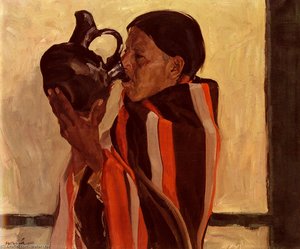
El Cacique del Pueblo (1916) by Walter Ufer

El Cacique del Pueblo

1916 · Oil On Canvas

In El Cacique del Pueblo, Walter Ufer presents an elderly Indigenous man who sits with a quiet, steady presence. Painted about 1916, the portrait captures a moment of stillness. The subject faces slightly to the right, his gaze directed away from the viewer as if lost in thought. There is a profound sense of dignity in his posture. He carries the weight of his years with a calm, contemplative grace…
2
Nude (1915) by Walter Ufer

Nude

1915 · Oil On Canvas

In "Nude" by Walter Ufer, a seated woman occupies the center of the frame, her form reclining slightly toward the viewer in a moment of quiet stillness. The composition focuses entirely on her presence, anchoring the gaze amidst a backdrop of heavy, draped fabrics. Light enters from the upper left, washing over the subject and casting gentle shadows that trace the soft contours of her body. These shadows provide a…

3
Portrait of a Man with a Pumpkin (1920) by Walter Ufer

Portrait of a Man with a Pumpkin

1920 · Oil On Canvas · Museum of Fine Arts, Houston

A seated man occupies the center of the frame, his presence heavy and dignified. He holds a large, orange pumpkin against his lap, the fruit's weight seemingly felt in the way his hands cradle its rounded form. His gaze is solemn, meeting the viewer with a quiet intensity that anchors the entire composition. A pink shirt provides a soft warmth to his torso, while a cool blue necktie offers a…

4
Anna (1920) by Walter Ufer

Anna

1920 · Oil · Museum of Fine Arts, Houston

The air inside the room feels heavy with the scent of woodsmoke and sun-warmed earth. Anna sits in a moment of profound stillness, her presence anchoring the entire composition. She is positioned slightly to the right, her posture upright and steady, creating a balance that feels both intentional and natural. A soft light spills from the left, catching the curve of her cheek and the gentle folds of her pink…

5
Jim (1918) by Walter Ufer

Jim

1918 · Oil On Canvas · National Academy of Design, New York City

The canvas presents Jim, a portrait painted by Walter Ufer. Created about 1918, the work captures a specific presence within the Taos Valley. The subject is a Taos Indian named Jim Mirabal, a man who moves through the frame with a quiet, heavy dignity. Within the artist's circle, he is often recognized by the intimate name "Ufer's Jim."

6
The Listeners (1920) by Walter Ufer

The Listeners

1920 · Oil On Canvas · Philbrook Museum of Art, Tulsa

In this 1920 oil painting, four figures occupy a room filled with objects that suggest a convergence of cultures. On the left, a person wearing a blue garment sits at a dark wooden upright piano, their back turned toward the viewer. In the center, a man is draped in a large green cloak, looking toward the right side of the frame. To the right, two women stand facing one another;…

7
Frank Archuleta (Taos Indian with Rifle) (1925) by Walter Ufer

Frank Archuleta (Taos Indian with Rifle)

1925 · Oil On Canvas · The Owings Gallery, Santa Fe

The gaze of Frank Archuleta meets the viewer in this striking portrait, titled Frank Archuleta (Taos Indian with Rifle). Painted by Walter Ufer, the work captures a specific moment of stillness and presence. The subject, a Native American man identified as Frank Archuleta, sits with a quiet, serious expression that commands immediate attention. He holds a rifle across his lap, a detail that anchors the composition and speaks to the…

8
Bob Abbott and His Assistant (1935) by Walter Ufer

Bob Abbott and His Assistant

1935 · Oil On Canvas · Speed Art Museum, Louisville

Bob Abbott and His Assistant is an oil on canvas by Walter Ufer. Created about 1935, the work captures a specific intersection of labor and stillness. It presents a scene where two men pause beside a vintage automobile, their presence anchored against a rugged landscape.

9
The Solemn Pledge, Taos Indians by Walter Ufer

The Solemn Pledge, Taos Indians

Oil On Canvas · Art Institute of Chicago, Chicago

A group of five individuals is gathered in an open field, framed by the rugged silhouettes of distant mountains. The composition places two figures in the center, flanked by one person on the left and two on the right, all engaged in a quiet, communal exchange. Scattered trees punctuate the landscape, grounding the scene within the natural topography of the Taos Valley. The atmosphere is heavy with the weight of…

10
Cornfield In Taos by Walter Ufer

Cornfield In Taos

Oil On Canvas

A group of five figures moves through a field of tall grass and corn, their presence integrated into the landscape of the New Mexico high desert. One individual stands near the left periphery, while others occupy the center and right, some positioned slightly behind their companions. In the distance, the silhouette of mountains provides a rugged backdrop to the agricultural scene. A single handbag rests in the middle of the…

Walter Ufer's famous paintings, numbers 11 to 40

The subjects that held Walter Ufer's eye

The four subjects that come back most often in these originals, each with its finest example.

The museums that keep Walter Ufer's originals

The 8 museums that hold the most of the paintings on this page.

Museum City Works by Walter Ufer Paintings from this list
Museum of Fine Arts, HoustonMuseum of Fine Arts Houston 3 Portrait of a Man with a Pumpkin, Anna, Taos in the Snow
National Academy of Design, New York CityNational Academy of Design New York City 2 Jim, Self-Portrait
Art Institute of Chicago, ChicagoArt Institute of Chicago Chicago 2 The Solemn Pledge, Taos Indians, Jim And His Daughter
Smithsonian American Art Museum, Washington, D.C.Smithsonian American Art Museum Washington, D.C. 2 After Them, Callers
National Cowboy - Western Heritage Museum, Оклахома-СитиNational Cowboy - Western Heritage Museum Оклахома-Сити 2 Sleep, At Rest
Philbrook Museum of Art, TulsaPhilbrook Museum of Art Tulsa 1 The Listeners
The Owings Gallery Santa Fe 1 Frank Archuleta (Taos Indian with Rifle)
Speed Art Museum, LouisvilleSpeed Art Museum Louisville 1 Bob Abbott and His Assistant

Walter Ufer across the decades: one unique original for each

Works per decade

Pick a decade to see the original that defines it.

Walter Ufer's paintings: questions for the gallery

What is the single most famous work of Walter Ufer?Reveal the answer

El Cacique del Pueblo (1916). Nude (1915) and Portrait of a Man with a Pumpkin (1920) come next.

At what age did Walter Ufer create El Cacique del Pueblo?Reveal the answer

40 years old: El Cacique del Pueblo dates from 1916, and Walter Ufer was born in 1876.

Which ten paintings by Walter Ufer are the most famous?Reveal the answer

El Cacique del Pueblo, Nude, Portrait of a Man with a Pumpkin, Anna, Jim, The Listeners, Frank Archuleta (Taos Indian with Rifle), Bob Abbott and His Assistant, The Solemn Pledge, Taos Indians and Cornfield In Taos. The ranking above gives each one's year and museum.

How many works by Walter Ufer are known?Reveal the answer

Our catalog holds 41 works by Walter Ufer, dated from 1915 to 1935.

Where can the most famous Walter Ufer originals be seen?Reveal the answer

Mostly in Museum of Fine Arts (Houston), National Academy of Design (New York City) and Art Institute of Chicago (Chicago). The museum table above lists them all.

During which period did Walter Ufer create the best-known paintings?Reveal the answer

In 1920s: 7 of the 40 works on this page were made then, Portrait of a Man with a Pumpkin among them.

Which famous Walter Ufer painting is the earliest, and which the latest?Reveal the answer

On this page, the earliest is Nude (1915) and the latest Bob Abbott and His Assistant (1935).

What subjects did Walter Ufer favour?Reveal the answer

Man (5), Mountains (5) and Landscape (5), across the 40 works on this page.

What materials did Walter Ufer paint with most?Reveal the answer

Oil On Canvas, for 12 of the 40 works on this page.

Which movement does the work of Walter Ufer belong to?Reveal the answer

Impressionism and Contemporary realism, judging by the originals on this page.

What Walter Ufer originals can I see at the Museum of Fine Arts?Reveal the answer

Portrait of a Man with a Pumpkin, Anna and Taos in the Snow: the Museum of Fine Arts, Houston holds 3 of the works on this page.

Walter Ufer: a portrait of the artist

The Soul of the Southwest: The Life and Legacy of Walter Ufer

Walter Ufer stands as a pivotal figure in American Impressionism, a painter whose brushstrokes did more than merely capture light; they captured the very heartbeat of a culture. Born in 1876 in Hückeswagen, Germany, Ufer’s journey to the high deserts of New Mexico was paved with rigorous European training and a deep-seated curiosity about the human condition. His early years were shaped by the German-American diaspora in Louisville, Kentucky, where he first began to absorb the rich textures of his heritage. This foundational period, marked by studies in lithography and printmaking, gifted him with a technical precision that would later allow him to navigate the complexities of light and shadow with unparalleled mastery.

His pursuit of artistic excellence led him on a transformative odyssey across Europe. As a traveling journeyman, Ufer immersed himself in the diverse artistic traditions of the continent, refining his technique at the prestigious academies of Hamburg and Dresden. This period of intense intellectual and creative expansion culminated in his time in Munich, where he dedicated himself to an intensive studio practice. When he finally returned to the United and States in 1911, he carried with him a sophisticated European sensibility that was poised for a profound encounter with the rugged, sun-drenched landscapes of the American West.

A Visionary of the Taos Ten

The year 1914 marked a definitive turning point in Ufer’s life and the trajectory of American art. Upon venturing into Taos Pueblo, New Mexico, he found himself part of an extraordinary artistic revolution. Joining the influential group known as the "Taos Ten," Ufer became a central figure in a collective that sought to move beyond mere landscape painting toward a more authentic, visceral portrayal of Native American life. Unlike many of his contemporaries who viewed the Southwest through a romanticized or colonial lens, Ufer approached his subjects with a profound respect and an eye for the dignity of daily existence.

His work became a bridge between European Impressionist techniques and the raw, spiritual energy of the Pueblo people. He was not merely an observer but a chronicler of rituals, landscapes, and the quiet rhythms of community life. Central to this creative evolution was his relationship with Jim Mirabal, a Taos Indian who served as both Ufer’s muse and collaborator. Through this connection, Ufer gained an intimate understanding of the cultural nuances that define the region, allowing him to infuse his canvases with a sense of lived truth that resonated far beyond the borders of New Mexico.

Technique, Symbolism, and Historical Significance

Ufer’s oeuvre is characterized by a masterful command of color and a bold, expressive application of paint. His style, while rooted in the principles of American Impressionism, often leaned toward a more robust and textured approach that captured the heat of the desert sun and the weight of the earth. He utilized light not just to illuminate form, but to evoke emotion—creating scenes where the atmosphere feels heavy with history and tradition.

The historical significance of Walter Ufer lies in his ability to elevate genre painting into a profound social and cultural statement. His achievements include:

  • Authentic Representation: Breaking away from the "picturesque" stereotypes of Native American life to present a more nuanced and humanized portrait of the Taos people.
  • Artistic Synthesis: Successfully merging the formal academic training of Germany with the vibrant, unbridled spirit of the American Southwest.
  • Legacy of the Taos Ten: Playing a crucial role in establishing Taos as a premier destination for American modernism and a vital center for indigenous-focused art.

Today, Ufer’s paintings remain enduring testaments to a period of intense cultural intersection. His ability to weave together the technical rigor of his European education with the spiritual depth of the Pueblo culture ensures that his work continues to captivate, inviting modern viewers to witness the timeless spirit of the Taos Valley through his evocative and masterful eyes.