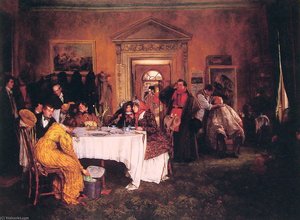
The Elegance of a Victorian Visionary
Born in the picturesque surroundings of Dorking, Surrey, in 1854, Walter Dendy Sadler emerged as a defining voice in the golden age of British genre painting. His life and work serve as a luminous window into the heart of the Victorian era, capturing not merely the faces of his contemporaries, but the very soul of their social fabric. As he navigated the burgeoning artistic landscape of London, Sadler found himself surrounded by the profound influences of luminaries such as Frederic Leighton and William Holman Hunt. From these masters, he inherited a deep appreciation for idealized beauty and the pursuit of moral virtue, yet he infused these classical inspirations with a uniquely observational charm that celebrated the nuances of everyday existence.
Sadler’s artistic development was marked by an extraordinary ability to marry meticulous detail with a profound sense of atmosphere. He possessed a rare gift for manipulating light, using it to breathe life into domestic interiors and sun-drenched landscapes alike. His brushwork, characterized by its precision, allowed him to document the subtle textures of silk, the delicate patterns of embroidery, and the soft glow of candlelight. This technical mastery was never an end in itself; rather, it served his greater purpose of exploring the social customs and quiet aspirations of a society caught between tradition and the dawn of a new age.
Narratives of Domesticity and Desire
The true magic of Sadler’s oeuvre lies in his ability to transform ordinary moments into extraordinary narratives. He became particularly renowned for his depictions of women, portraying them within the serene confines of domestic life. In these scenes, one finds a profound exploration of Victorian femininity—portraying women engaged in quiet contemplation, needlework, or the graceful reception of guests. These were not merely portraits of leisure, but carefully orchestrated studies of grace, decorum, and the tranquil beauty found within the home.
Beyond the domestic sphere, Sadler’s work often ventured into the romantic and the grand, utilizing composition to evoke deep emotional responses:
- The Grandeur of Society: In works such as “London to York Times Up Gentlemen,” Sadler demonstrates a masterful command of perspective. This sweeping panorama of a lavish social gathering uses opulent décor and dramatic illumination to invite the viewer into the ritualistic splendor of high-society life.
- The Romance of the Countryside: Conversely, paintings like "The Suitor"* reveal his talent for pastoral storytelling. Here, the artist captures an idyllic rural setting brimming with romantic promise, where the landscape itself seems to participate in the unspoken emotions of the characters.
- Human Connection: Through pieces such as “The Village Postman,” Sadler highlights the poignant beauty of simple human interactions, documenting the tender moments of courtship and community that define the human experience.
A Lasting Legacy in British Art
As the Victorian era transitioned into the Edwardian period, Sadler’s work remained a steadfast pillar of genre painting. His significance lies in his role as a visual historian; he did not merely paint scenes, but archived the values, aesthetics, and social hierarchies of his time. Through his evocative color palettes and rhythmic compositions, he created a world that felt both intimately familiar and aspirationally beautiful to his audience.
Though he passed away in 1923, the legacy of Walter Dendy Sadler continues to resonate with art lovers worldwide. His ability to find the extraordinary within the ordinary ensures that his paintings remain much more than historical artifacts. They are living, breathing windows into a vanished world, offering a sense of nostalgia and a profound appreciation for the artistry of human connection and the enduring beauty of the everyday.