Portrait of Samuel Scott

The 58 Most Famous Samuel Scott Paintings, a Gallery Selection

Updated November 2026 · ranked by our popularity score (searches, visits and orders for each work) · 69 works by Samuel Scott in our catalogue

In short

Of all the originals Samuel Scott left, the most famous is View on the Thames with Westminster Bridge (1743), in the collection of the Yale Center for British Art, New Haven. Close behind it come The Building of Westminster Bridge and Table Bay, c. 1730. (1730). Our catalog holds 69 works by Samuel Scott; the gallery has kept the 58 the world admires most, each shown with its date, its museum and its story.

1702 – 1772, London Most works: National Maritime Museum

Samuel Scott's top 10 paintings: the gallery's choice

1
View on the Thames with Westminster Bridge (1743) by Samuel Scott

View on the Thames with Westminster Bridge

1743 · Oil On Canvas · Yale Center for British Art, New Haven

The oil on canvas painting titled View on the Thames with Westminster Bridge was executed by the English painter Samuel Scott. This work depicts a maritime scene on the River Thames, featuring a large sailing vessel in the foreground and the stone arches of Westminster Bridge in the middle ground. The composition captures the urban landscape and river commerce of 18th-century London.

2
The Building of Westminster Bridge by Samuel Scott

The Building of Westminster Bridge

Oil On Canvas · Metropolitan Museum of Art, New York

The Building of Westminster Bridge is an oil on canvas riverscape painting. Created in 1742, the work captures a specific moment of transformation within the city of London. The English artist Samuel Scott rendered this scene, documenting the heavy labor required to span the River Thames. He focused his attention on the skeletal progress of the bridge as it rose from the water.

3
Table Bay, c. 1730. (1730) by Samuel Scott

Table Bay, c. 1730.

1730 · Oil On Canvas

Table Bay, c. 1730. is an 18th-century maritime oil painting by Samuel Scott. The work captures a naval scene situated within Table Bay, presenting a view of the coastline and its surrounding waters.

4
Departure from England of Francis, Duke of Lorraine, 1731 (1732) by Samuel Scott

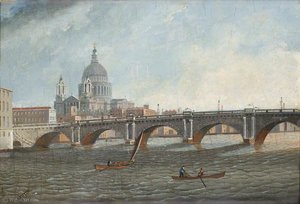
Departure from England of Francis, Duke of Lorraine, 1731

1732 · Oil

The waters churn with the quiet energy of a significant moment in 1731. In Departure from England of Francis, Duke of Lorraine, 1731 by Samuel Scott, the viewer finds themselves amidst a bustling maritime scene. The air feels heavy with the weight of a departure, as ships navigate the shifting currents under a vast, cloudy sky. This work, created about 1732, captures the movement of vessels as they prepare to…

5
Taking and destruction of the port of Paita in 1741 by the squadron of George Anson. (1741) by Samuel Scott

Taking and destruction of the port of Paita in 1741 by the squadron of George Anson.

1741 · Oil On Canvas

In this work, titled Taking and destruction of the port of Paita in 1741 by the squadron of George Anson., the artist Samuel Scott captures a moment of intense naval aggression. The scene depicts a coordinated attack on a port, focusing on the violent intersection of maritime power and coastal settlement. It is a depiction of a specific historical engagement that took place about 1741.

7
Shipping off Dover (1738) by Samuel Scott

Shipping off Dover

1738 · Oil · Yale Center for British Art, New Haven

In this expansive oil painting from 1738, we find ourselves observing a wide, panoramic view of the sea as it meets the iconic white cliffs of Dover. The scene captures a moment of significant naval activity, where the calm, shimmering surface of the water is populated by a variety of vessels. Larger warships navigate the coastal waters alongside smaller transport boats, all appearing to move away from the shoreline under…

8
Shipping on the Thames off Rotherhithe (1740) by Samuel Scott

Shipping on the Thames off Rotherhithe

1740 · Oil On Canvas

The oil on canvas painting titled Shipping on the Thames off Rotherhithe was executed by the English painter Samuel Scott. This work is dated 1740. The artist, who was born in London, United Kingdom, around 1702, specialized in landscape painting and marine art. His career involved detailed observations of the Thames and the architectural developments of the city during the 18th century.

9
An Arch of Westminster Bridge, London (1750) by Samuel Scott

An Arch of Westminster Bridge, London

1750 · Oil On Canvas · National Gallery of Ireland, Dublin City

An Arch of Westminster Bridge, London is an oil on canvas landscape painting by the English artist Samuel Scott. Created about 1750, the work captures a specific perspective of the River Thames. The view looks toward the northern bank, directed toward the City of London. It is a moment of architectural permanence fixed in oil.

10
Old London Bridge (1753) by Samuel Scott

Old London Bridge

1753 · Oil On Canvas · Felbrigg Hall, Norwich

Old London Bridge is an oil painting by the English artist Samuel Scott. Created in 1753, this work offers a panoramic upstream view of the River Thames, captured from the south bank. It provides a rare glimpse of the historic structure during a period of significant urban transition. The scene depicts the bridge in its medieval form, crowded with multi-story houses and shops, just years before the era of its…

The Samuel Scott selection continues, 11 to 58

11Beginning of Knowles' action off Havana, 1 October 1748 (1750) by Samuel ScottBeginning of Knowles' action off Havana, 1 October 17481750 · National Maritime Museum 12The Bombardment of Bastia, 6 November 1745 (1750) by Samuel ScottThe Bombardment of Bastia, 6 November 17451750 · National Maritime Museum 13French fireships attacking the English fleet off Quebec, 28 June 1759 (1750) by Samuel ScottFrench fireships attacking the English fleet off Quebec, 28 June 17591750 · National Maritime Museum 14The Capture of the 'Nuestra Señora de Cavadonga' by the 'Centurion', 20 June 1743 (1745) by Samuel ScottThe Capture of the 'Nuestra Señora de Cavadonga' by the 'Centurion', 20 June 17431745 · National Maritime Museum 15A Sunset, with a View of Nine Elms (1755) by Samuel ScottA Sunset, with a View of Nine Elms1755 16A Morning, with a View of Cuckold’s Point (1755) by Samuel ScottA Morning, with a View of Cuckold’s Point1755 17plan of St. Marco in Venice 1740 (1749) by Samuel Scottplan of St. Marco in Venice 17401749 18Arches of Westminster Bridge (1750) by Samuel ScottArches of Westminster Bridge1750 · Yale Center for British Art 19Westminster from Lambeth, with the Ceremonial Barge of the Ironmongers' Company (1745) by Samuel ScottWestminster from Lambeth, with the Ceremonial Barge of the Ironmongers' Company1745 · Yale Center for British Art 20Shipping in a Choppy Sea (1753) by Samuel ScottShipping in a Choppy Sea1753 · Yale Center for British Art 21The Building of Westminster Bridge (1750) by Samuel ScottThe Building of Westminster Bridge1750 22The Thames at Westminster Bridge with Barges (1746) by Samuel ScottThe Thames at Westminster Bridge with Barges1746 23The Thames by the Tower of London (1759) by Samuel ScottThe Thames by the Tower of London1759 · Felbrigg Hall 24View of the Thames with Blackfriars Bridge and St Paul's Cathedral (1761) by Samuel ScottView of the Thames with Blackfriars Bridge and St Paul's Cathedral1761 · Blickling Hall 25An English Man-of-War Firing a Salute (1765) by Samuel ScottAn English Man-of-War Firing a Salute1765 · National Maritime Museum 26A View of Westminster Bridge and Parts Adjacent (1758) by Samuel ScottA View of Westminster Bridge and Parts Adjacent1758 27A View of London Bridge before the Late Alterations (1758) by Samuel ScottA View of London Bridge before the Late Alterations1758 28Ludlow Castle with Dinham Weir, from the South-West (1765) by Samuel ScottLudlow Castle with Dinham Weir, from the South-West1765 · Yale Center for British Art 29The Thames at Twickenham (1760) by Samuel ScottThe Thames at Twickenham1760 · Yale Center for British Art 30Action off the Cape of Good Hope (1757) by Samuel ScottAction off the Cape of Good Hope1757 · Yale Center for British Art 31Action off the Cape of Good Hope (1757) by Samuel ScottAction off the Cape of Good Hope1757 · Yale Center for British Art 32Pope's Villa, Twickenham (1759) by Samuel ScottPope's Villa, Twickenham1759 · Yale Center for British Art 33Lambeth palace by Samuel ScottLambeth palace 34Bombarding of Bastia in 1745 by Samuel ScottBombarding of Bastia in 1745 35Action between HMS Nottingham and the Mars, 11 October 1746 by Samuel ScottAction between HMS Nottingham and the Mars, 11 October 1746National Maritime Museum 36End of Knowles' action off Havana, 1 October 1748 by Samuel ScottEnd of Knowles' action off Havana, 1 October 1748National Maritime Museum 37An English privateer engaging a French privateer by Samuel ScottAn English privateer engaging a French privateerNational Maritime Museum 38The Capture of Fort Chagres, March 1740 by Samuel ScottThe Capture of Fort Chagres, March 1740National Maritime Museum 39The Battle of Porto Bello by Samuel ScottThe Battle of Porto Bello 40Southwark bridge by Samuel ScottSouthwark bridge 41The Thames at London Bridge by Samuel ScottThe Thames at London Bridge 42Somerset House and St Paul's by Samuel ScottSomerset House and St Paul's 43Old london bridge by Samuel ScottOld london bridge 44The Tower of London from the River by Samuel ScottThe Tower of London from the River 45Blackfriars Bridge and St Paul's from the Bridge by Samuel ScottBlackfriars Bridge and St Paul's from the Bridge 46Lambeth Palace from Millbank, London by Samuel ScottLambeth Palace from Millbank, London 47A View of the Thames at Westminster, Seen through an Arch of the Bridge by Samuel ScottA View of the Thames at Westminster, Seen through an Arch of the Bridge 48View of Somerset House Looking Downstream from the York Water-Tower by Samuel ScottView of Somerset House Looking Downstream from the York Water-Tower 49A Danish Timber Bark Getting Under Way (1736) by Samuel ScottA Danish Timber Bark Getting Under Way1736 · National Maritime Museum 50Wager's Action off Cartagena, 28 May 1708 (1772) by Samuel ScottWager's Action off Cartagena, 28 May 17081772 · National Maritime Museum 51French Firerafts Attacking the British Fleet off Quebec, 28 June 1759 (1767) by Samuel ScottFrench Firerafts Attacking the British Fleet off Quebec, 28 June 17591767 · National Maritime Museum 52The Capture of Puerto Bello, 21 November 1739 (1740) by Samuel ScottThe Capture of Puerto Bello, 21 November 17391740 · National Maritime Museum 53An Arch of Westminster Bridge (1750) by Samuel ScottAn Arch of Westminster Bridge1750 54A View of the Tower of London, Supposed on his Majesty's Birthday (1771) by Samuel ScottA View of the Tower of London, Supposed on his Majesty's Birthday1771 · Yale Center for British Art 55The Building of Westminster Bridge (1742) by Samuel ScottThe Building of Westminster Bridge1742 · Yale Center for British Art 56Vice Admiral Sir George Anson's Victory off Cape Finisterre (1749) by Samuel ScottVice Admiral Sir George Anson's Victory off Cape Finisterre1749 · Yale Center for British Art 57Part of Old Westminster Bridge (1750) by Samuel ScottPart of Old Westminster Bridge1750 · Tate Gallery 58A Thames Wharf (1757) by Samuel ScottA Thames Wharf1757 · Victoria and Albert Museum

Samuel Scott's famous paintings, period by period

The subjects that held Samuel Scott's eye

The four subjects that come back most often in these originals, each with its finest example.

The museums that keep Samuel Scott's originals

The 8 museums that hold the most of the paintings on this page.

Museum City Works by Samuel Scott Paintings from this list
National Maritime Museum, LondonNational Maritime Museum London 14 A First-Rate Shortening Sail, Beginning of Knowles' action off Havana, 1 October 1748, The Bombardment of Bastia, 6 November 1745
Yale Center for British Art, New HavenYale Center for British Art New Haven 13 View on the Thames with Westminster Bridge, Shipping off Dover, Arches of Westminster Bridge
Felbrigg Hall, NorwichFelbrigg Hall Norwich 2 Old London Bridge, The Thames by the Tower of London
Metropolitan Museum of Art, New YorkMetropolitan Museum of Art New York 1 The Building of Westminster Bridge
National Gallery of Ireland, Dublin CityNational Gallery of Ireland Dublin City 1 An Arch of Westminster Bridge, London
Blickling HallBlickling Hall 1 View of the Thames with Blackfriars Bridge and St Paul's Cathedral
Tate Gallery, LondonTate Gallery London 1 Part of Old Westminster Bridge
Victoria and Albert Museum, LondonVictoria and Albert Museum London 1 A Thames Wharf

Samuel Scott decade by decade: the original that defines each

Works per decade

Pick a decade to see the original that defines it.

Collectors' questions about Samuel Scott's paintings

Which work is Samuel Scott most famous for?Reveal the answer

View on the Thames with Westminster Bridge (1743), Yale Center for British Art, New Haven. The Building of Westminster Bridge and Table Bay, c. 1730. (1730) come next.

What age was Samuel Scott when View on the Thames with Westminster Bridge was made?Reveal the answer

41 years old: View on the Thames with Westminster Bridge dates from 1743, and Samuel Scott was born in 1702.

What are the ten most famous Samuel Scott paintings?Reveal the answer

View on the Thames with Westminster Bridge, The Building of Westminster Bridge, Table Bay, c. 1730., Departure from England of Francis, Duke of Lorraine, 1731, Taking and destruction of the port of Paita in 1741 by the squadron of George Anson., A First-Rate Shortening Sail, Shipping off Dover, Shipping on the Thames off Rotherhithe, An Arch of Westminster Bridge, London and Old London Bridge. The ranking above gives each one's year and museum.

How many paintings did Samuel Scott leave?Reveal the answer

Our catalog holds 69 works by Samuel Scott, dated from 1730 to 1772.

In which museums do Samuel Scott's masterpieces hang?Reveal the answer

Mostly in National Maritime Museum (London), Yale Center for British Art (New Haven) and Felbrigg Hall (Norwich). The museum table above lists them all.

In which years did Samuel Scott paint the most famous works?Reveal the answer

In 1750s: 19 of the 58 works on this page were made then, An Arch of Westminster Bridge, London among them.

What are the first and the last famous originals of Samuel Scott?Reveal the answer

On this page, the earliest is Table Bay, c. 1730. (1730) and the latest Wager's Action off Cartagena, 28 May 1708 (1772).

Which subjects did Samuel Scott choose most often?Reveal the answer

Sky (25), Water (23) and River (16), across the 58 works on this page.

Which technique did Samuel Scott use most?Reveal the answer

Oil On Canvas, for 25 of the 58 works on this page.

Which Samuel Scott works hang at the National Maritime Museum?Reveal the answer

A First-Rate Shortening Sail, Beginning of Knowles' action off Havana, 1 October 1748 and The Bombardment of Bastia, 6 November 1745: the National Maritime Museum, London holds 14 of the works on this page.

Samuel Scott: life and work

The Father of English Watercolour: The Legacy of Samuel Scott

Samuel Scott, born in London around 1702, remains a figure shrouded in artistic mystery—a testament to the challenges faced by documenting artists of his era. Despite scarce biographical details regarding his formative years and training, Scott emerged as one of Britain’s most prominent landscape painters during the mid-18th century, establishing himself as a pioneer in watercolour technique and profoundly influencing subsequent generations of British artists. His distinctive style—characterized by serene riverside scenes and dramatic seascapes imbued with atmospheric perspective—captured the spirit of his time and cemented his legacy as “the father of English watercolour.”

Scott’s artistic journey commenced in approximately 1720, initially focusing on maritime art. Like many artists of his generation, he was deeply impacted by the works of Willem van de Velde the Younger, owning numerous copies and absorbing a masterful handling of light and texture. This influence is palpable in his early works depicting warships engaged in naval battles, demonstrating a meticulous attention to detail and an understanding of compositional principles rooted in Dutch marine painting traditions. His ability to translate the raw power of the sea into delicate, evocative imagery allowed him to bridge the gap between rigid maritime documentation and fine art.

A Vision of London and the Thames

As his career matured, Scott turned his gaze toward the heart of the British Empire, finding profound inspiration in the bustling waterways of the River Thames. His works serve as a vivid window into 18th-century London, capturing the rhythmic pulse of maritime trade and the daily life of the riverside. In masterpieces such as A Thames Wharf (1757), he presents a bustling depiction of commerce, where the movement of boats and the structure of the wharves tell a story of a city in constant motion. His talent lay in his ability to blend topographical accuracy with a romanticized atmosphere, making the industrial and commercial aspects of London appear both grand and intimate.

Beyond the busy docks, Scott possessed a remarkable gift for capturing the architectural majesty of London’s landmarks. His depictions of the city often utilized an oil on canvas medium to achieve a sense of permanence and grandeur, as seen in The Thames at Westminster Bridge with Barges (1746). In this work, he showcases London’s architectural detail through a Romantic lens, using light and shadow to create a captivating historical atmosphere. Similarly, his View of Somerset House Looking Downstream from the York Water-Tower demonstrates his skill in topographical painting, offering a serene look at the cityscape and the nearby Tower of London, rendered with a precision that honors the structural elegance of the era.

Artistic Collaborations and Historical Significance

The development of Scott's style was also shaped by significant professional partnerships. His collaborative project with George Lambert on six paintings portraying East India Company settlements showcased his versatility and ability to synthesize disparate artistic elements—architecture alongside landscape—reflecting the intellectual currents of the period. This partnership resulted in images that conveyed both grandeur and intimacy, capturing the essence of colonial enterprise while simultaneously celebrating the beauty of natural surroundings. Such works were not merely aesthetic pursuits but served as important historical records of Britain's expanding global reach.

The enduring significance of Samuel Scott lies in his role as a transitional figure who helped elevate watercolour from a medium of mere sketching to a respected form of fine art. His contributions can be summarized through several key artistic pillars:

  • Pioneering Technique: He introduced a level of atmospheric depth and light manipulation that would define the English watercolour tradition for decades.
  • Maritime Mastery: By blending Dutch marine influences with British subject matter, he created a unique genre of naval and riverine art.
  • Topographical Documentation: His detailed renderings of London landmarks provided an invaluable visual archive of 18th-century urban life and architecture.
  • Cultural Synthesis: Through his collaborations, he successfully merged the documentation of colonial expansion with the aesthetic beauty of landscape painting.

Through his dedicated observation of the Thames and the sea, Samuel Scott did more than just paint landscapes; he captured the very soul of a maritime nation during a period of immense growth and transformation.