Portrait of Ruskin Spear

The 53 Most Famous Ruskin Spear Paintings, Each One of a Kind

Updated November 2026 · ranked by our popularity score (searches, visits and orders for each work) · 55 works by Ruskin Spear in our catalogue

In short

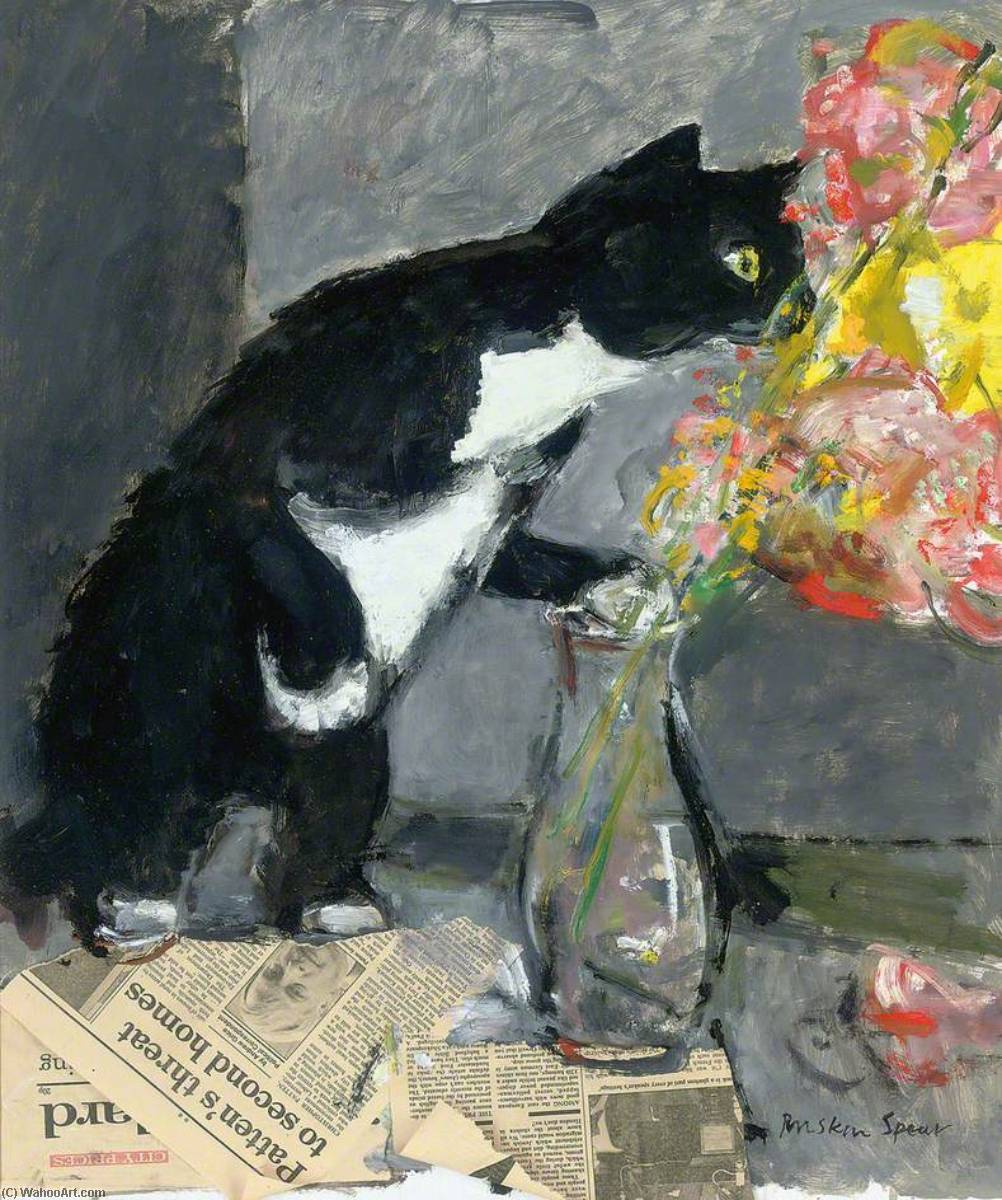
The Curious Cat is the Ruskin Spear painting that draws the most eyes; the original belongs to the The Ingram Collection of Modern British And Contemporary Art, London. After it, the eye goes to In the Dope Shop of an RAF Mosquito Aircraft Factory (1943) and Director General Portrait – Sir Hugh Carlton Greene. Among the 55 works of Ruskin Spear in our catalog, these 53 are the most famous, each a unique original presented with its year, its museum and the reason it endures.

1911 – 1990, Hammersmith Contemporary realism Most works: Government Art Collection

Top 10 paintings by Ruskin Spear, through the gallery's eye

3
Director General Portrait – Sir Hugh Carlton Greene by Ruskin Spear

Director General Portrait – Sir Hugh Carlton Greene

Acrylic On Canvas · Bbc England, London

Director General Portrait – Sir Hugh Carlton Greene Sir Hugh Carlton Greene’s “Director General Portrait” stands as a testament to Ruskin Spear’s masterful ability to capture not just likeness but also the very essence of his subject—a portrait that transcends mere representation and delves into psychological nuance. Executed in oil on canvas around 1968, this artwork exemplifies Spear's signature style: meticulous observation blended with theatrical flair, reflecting a fascination with…

7
Siesta (1938) by Ruskin Spear

Siesta

1938 · Arts Council Collection, London

In the gentle stillness of Siesta, we are invited into a sanctuary of profound repose. Painted in 1938, this evocative work by Ruskin Spear transcends a mere depiction of sleep, offering instead a window into the very essence of domestic tranquility. The composition centers on a woman lost in the soft embrace of slumber, her form draped in a blanket that suggests both warmth and a protective cocoon from the…

Ruskin Spear's famous paintings, numbers 11 to 53

11China Clay Pits, St Austell (1939) by Ruskin SpearChina Clay Pits, St Austell1939 12In the Dope Shop of a Mosquito Aircraft Factory (1939) by Ruskin SpearIn the Dope Shop of a Mosquito Aircraft Factory1939 13Portrait of Ida (1940) by Ruskin SpearPortrait of Ida1940 · Jerwood Gallery 14Mackerel (1943) by Ruskin SpearMackerel1943 15A Royal Ordnance Factory Explosion, Hereford (1945) by Ruskin SpearA Royal Ordnance Factory Explosion, Hereford1945 16A London Street (1945) by Ruskin SpearA London Street1945 17Snow Scene (1946) by Ruskin SpearSnow Scene1946 18Woman in a Red Jumper (1948) by Ruskin SpearWoman in a Red Jumper1948 · Arts Council Collection 19Still Life with Fish (1948) by Ruskin SpearStill Life with Fish1948 · Laing Art Gallery 20Spring Morning (1947) by Ruskin SpearSpring Morning1947 · Government Art Collection 21Mr Hollingbery's Canary (1950) by Ruskin SpearMr Hollingbery's Canary1950 22Park Scene (1950) by Ruskin SpearPark Scene1950 · Bristol Museum - Art Gallery 23Ernest Marsh (1954) by Ruskin SpearErnest Marsh1954 24Hollingberry's Canary by Ruskin SpearHollingberry's Canary 25Cherries and Pear by Ruskin SpearCherries and Pear 26The Saloon Bar by Ruskin SpearThe Saloon BarReading Museum - Town Hall 27Airgraphs on Drying Drums in the Dark Room by Ruskin SpearAirgraphs on Drying Drums in the Dark Room 28Winter Evening by Ruskin SpearWinter Evening 29Spring at Rottingdean, East Sussex by Ruskin SpearSpring at Rottingdean, East Sussex 30Sleeping Cat by Ruskin SpearSleeping Cat 31Low Tide by Ruskin SpearLow TideGovernment Art Collection 32Flowers on a Piano by Ruskin SpearFlowers on a PianoBritish Council Collection 33Edward 'Teddy' Crisp Bullard (1907–1980) by Ruskin SpearEdward 'Teddy' Crisp Bullard (1907–1980)Department of Earth Sciences 34Bernard Fergusson (1911–1980), Lord Ballantrae by Ruskin SpearBernard Fergusson (1911–1980), Lord BallantraeThe Black Watch Castle - Museum 35Approach to Hammersmith Bridge by Ruskin SpearApproach to Hammersmith Bridge 36Spring in Hammersmith by Ruskin SpearSpring in HammersmithTowner 37Hammersmith Bridge by Ruskin SpearHammersmith BridgeGovernment Art Collection 38Director General Portrait – Charles Curran by Ruskin SpearDirector General Portrait – Charles CurranBbc England 39Paul Cairn Vellacott, Master (1939–1954) by Ruskin SpearPaul Cairn Vellacott, Master (1939–1954)Peterhouse 40Tremodrett, Cornwall by Ruskin SpearTremodrett, CornwallGovernment Art Collection 41John Moon, OBE by Ruskin SpearJohn Moon, OBERoyal College of Art 42Denis Richards (1910–2004), Principal of Morley College by Ruskin SpearDenis Richards (1910–2004), Principal of Morley CollegeMorley College 43Modigliani Reproductions with Paper Flowers by Ruskin SpearModigliani Reproductions with Paper FlowersGovernment Art Collection 44Sir Harold Wilson, Prime Minister (1964–1970 1974–1976) by Ruskin SpearSir Harold Wilson, Prime Minister (1964–1970 1974–1976)Jesus College 45Joseph Forsyth Gimson (1896–1985), CBE, Managing Director of the Worcester Royal Porcelain Company by Ruskin SpearJoseph Forsyth Gimson (1896–1985), CBE, Managing Director of the Worcester Royal Porcelain Company 46Sir Harold Wilson (1916–1995), Prime Minister by Ruskin SpearSir Harold Wilson (1916–1995), Prime MinisterGovernment Art Collection 47Dr Charles Ian Carr Bosanquet, Rector, King's College (1952–1963), Vice Chancellor, University of Newcastle upon Tyne (1963–1968) by Ruskin SpearDr Charles Ian Carr Bosanquet, Rector, King's College (1952–1963), Vice Chancellor, University of Newcastle upon Tyne (1963–1968) 48Chimp and Baby by Ruskin SpearChimp and BabyRoyal College of Obstetricians And Gynaecologists 49Interior with Nude by Ruskin SpearInterior with NudeUsher Gallery 50Sir William Stewart Duke Elder (1898–1978), GCVO, MD, DSc, FACS, FRCS, FRCP, FRS by Ruskin SpearSir William Stewart Duke Elder (1898–1978), GCVO, MD, DSc, FACS, FRCS, FRCP, FRSInstitute of Ophthalmology 51Sir John Dewhurst (1920–2007), President of the Royal College of Obstetricians and Gynaecologists (1976–1978) by Ruskin SpearSir John Dewhurst (1920–2007), President of the Royal College of Obstetricians and Gynaecologists (1976–1978)Royal College of Obstetricians And Gynaecologists 52Mr Hollingberry's Canary (1950) by Ruskin SpearMr Hollingberry's Canary1950 · Herbert Art Gallery - Museum 53Portrait of Mother (1935) by Ruskin SpearPortrait of Mother1935 · Jerwood Gallery

The subjects that held Ruskin Spear's eye

The four subjects that come back most often in these originals, each with its finest example.

The museums that keep Ruskin Spear's originals

The 8 museums that hold the most of the paintings on this page.

Museum City Works by Ruskin Spear Paintings from this list
Government Art Collection, LondonGovernment Art Collection London 6 Spring Morning, Low Tide, Hammersmith Bridge
The Ingram Collection of Modern British And Contemporary Art, LondonThe Ingram Collection of Modern British And Contemporary Art London 3 The Curious Cat, Ecstasy, Cat on a Roof
Bbc England, LondonBbc England London 2 Director General Portrait – Sir Hugh Carlton Greene, Director General Portrait – Charles Curran
Arts Council Collection, LondonArts Council Collection London 2 Siesta, Woman in a Red Jumper
Jerwood Gallery, HastingsJerwood Gallery Hastings 2 Portrait of Ida, Portrait of Mother
Royal College of Obstetricians And Gynaecologists, LondonRoyal College of Obstetricians And Gynaecologists London 2 Chimp and Baby, Sir John Dewhurst (1920–2007), President of the Royal College of Obstetricians and Gynaecologists (1976–1978)
City Lit, LondonCity Lit London 1 Dr James Tait (1912–1998), Principal, Northampton College of Advanced Technology (1957–1966)
Laing Art Gallery, Newcastle upon TyneLaing Art Gallery Newcastle upon Tyne 1 Still Life with Fish

Ruskin Spear across the decades: one unique original for each

Works per decade

Pick a decade to see the original that defines it.

Ruskin Spear's paintings: questions for the gallery

What is the single most famous work of Ruskin Spear?Reveal the answer

The Curious Cat, The Ingram Collection of Modern British And Contemporary Art, London. In the Dope Shop of an RAF Mosquito Aircraft Factory (1943) and Director General Portrait – Sir Hugh Carlton Greene come next.

Which ten paintings by Ruskin Spear are the most famous?Reveal the answer

The Curious Cat, In the Dope Shop of an RAF Mosquito Aircraft Factory, Director General Portrait – Sir Hugh Carlton Greene, Ecstasy, The Blackout, December Afternoon, Siesta, Children in the Snow, Cat on a Roof and Dr James Tait (1912–1998), Principal, Northampton College of Advanced Technology (1957–1966). The ranking above gives each one's year and museum.

How many works by Ruskin Spear are known?Reveal the answer

Our catalog holds 55 works by Ruskin Spear, dated from 1935 to 1954.

Where can the most famous Ruskin Spear originals be seen?Reveal the answer

Mostly in Government Art Collection (London), The Ingram Collection of Modern British And Contemporary Art (London) and Bbc England (London). The museum table above lists them all.

During which period did Ruskin Spear create the best-known paintings?Reveal the answer

In 1940s: 11 of the 53 works on this page were made then, In the Dope Shop of an RAF Mosquito Aircraft Factory among them.

Which famous Ruskin Spear painting is the earliest, and which the latest?Reveal the answer

On this page, the earliest is Portrait of Mother (1935) and the latest Ernest Marsh (1954).

What subjects did Ruskin Spear favour?Reveal the answer

Portrait (5), Darkness (2) and Formal (2), across the 53 works on this page.

Which movement does the work of Ruskin Spear belong to?Reveal the answer

Contemporary realism and Impressionism, judging by the originals on this page.

What Ruskin Spear originals can I see at the Government Art Collection?Reveal the answer

Spring Morning, Low Tide and Hammersmith Bridge: the Government Art Collection, London holds 6 of the works on this page.

Ruskin Spear: a portrait of the artist

Ruskin Spear: A Life Sculpted in Sound and Vision

Roger Ruskin Spear (1943-1990) wasn’t merely an artist; he was a conjurer of experiences, a delightfully eccentric inventor of sound and form. Born into a family steeped in artistic rebellion – his father, Ruskin Spear CBE RA, was a celebrated portrait painter known for his satirical observations of London life – Roger inherited a legacy of playful subversion and a deep fascination with the mechanics of both art and reality. His career, spanning decades and encompassing music, sculpture, performance, and design, defies easy categorization, revealing a restless spirit constantly pushing the boundaries of creative expression.

Spear’s early life was shaped by a physical challenge: contracted polio at the age of two, he navigated the world with a wheelchair. This experience profoundly influenced his artistic vision, imbuing his work with a sense of observation rooted in the everyday, often exploring themes of limitation and adaptation. He attended Brook Green School for the “Physically Defective,” an institution that fostered both creativity and a unique perspective on society. His formal training at the Hammersmith School of Art and later the Royal College of Art provided him with technical skills, but it was his father’s influence – particularly the Camden Town Group's embrace of urban realism and social commentary – that truly ignited his artistic fire.

The Bonzo Dog Doo-Dah Band and Early Musical Explorations

Spear’s career gained significant momentum with his involvement in the Bonzo Dog Doo-Dah Band, a satirical musical collective known for its irreverent humor and theatrical performances. Joining the band in 1964 after dissolving his own jazz ensemble, “New Jungle Orchestra,” he quickly became an integral part of their sound and visual identity. Spear’s contributions extended beyond songwriting; he was responsible for much of the band's distinctive stage presence, including elaborate costumes, robotic creations, and a penchant for theatrical absurdity. Songs like "Shirt," "Tubas in the Moonlight," and “Trouser Press” became iconic examples of the band’s witty and often surreal lyrics.

However, Spear’s artistic ambitions extended far beyond the confines of the Bonzos. He was a prolific inventor, creating bizarre contraptions – most famously the “Theremin Leg,” a robotic appendage controlled by a theremin – that appeared in performances and recordings. This fascination with mechanics and automation permeated his work, leading to projects like "Noises for the Leg," a series of experimental soundscapes designed to be experienced through this unusual instrument. His exploration of robotics wasn’t simply about technological novelty; it was a way of questioning human interaction and exploring alternative forms of expression.

Sculptural Innovations and Performance Art

Following the Bonzos' dissolution, Spear continued to experiment with diverse media. He formed biGGrunt with Vivian Stanshall, a short-lived but influential band known for its dark humor and theatrical performances. He also took on solo projects, including “Roger Ruskin Spear and his Giant Kinetic Wardrobe,” a spectacular stage show featuring elaborate costumes, robotic figures, and orchestral music – a testament to his boundless imagination. This performance piece, often referred to as "Giant Orchestral Wardrobe," became a signature of his work, showcasing his ability to blend art, technology, and spectacle.

In the 1980s, Spear collaborated with Dave Glasson on “The Slightly Dangerous Brothers,” producing a single, “Let’s Talk Basic,” accompanied by a music video featuring his robot creations. He also participated in The Cut Price Comedy Show, a television program known for its corny sketches and ironic humor, demonstrating his versatility as a performer and collaborator.

Legacy and Artistic Significance

Ruskin Spear's artistic legacy is one of playful innovation and unconventional vision. He wasn’t confined by traditional categories; he seamlessly blended music, sculpture, performance art, and design into a singular, often bewilderingly delightful, body of work. His exploration of robotics, his satirical wit, and his unique perspective on the human condition continue to resonate with audiences today. His influence can be seen in contemporary artists who embrace experimentation, challenge conventions, and seek to create immersive and thought-provoking experiences.

Spear’s paintings, particularly works like “Portrait of Mother” and “Mr Hollingberry's Canary,” reveal a subtle yet powerful narrative sensibility. His early training with Walter Sickert and the Camden Town Group informed his approach to portraiture, but he infused his work with a distinctive sense of humor and social commentary. His official war artist commission during World War II further solidified his place in British art history, documenting the everyday lives of Londoners amidst wartime austerity.

Ruskin Spear’s life and work stand as a testament to the power of creative freedom and the enduring appeal of artistic eccentricity. He remains a singular figure – a sculptor of sound, a conjurer of visions, and a champion of delightfully strange ideas.