The Poetic Vision of Robert Smirke
In the grand tapestry of British art history, where many sought glory through sweeping battle scenes or monumental portraits, Robert Smirke carved a delicate and profoundly intimate niche. Born in 1753 in the quiet town of Wigton, near Carlisle, Smirke was a man whose brush was guided more by the rhythm of verse than by the drama of history. As the son of a travelling artist, his childhood was steeped in the very essence of observation, learning to see the world through a lens of movement and light long before he ever held a formal apprenticeship. This early exposure to the itinerant life instilled in him a lifelong reverence for the subtle details of the natural world, a quality that would later define his unique approach to the literary landscape.
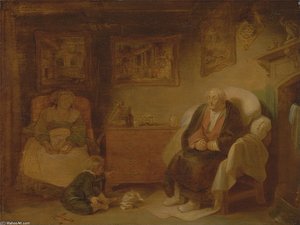
Smir andke's artistic journey was one of steady, meticulous refinement. After honing his technical skills under a London heraldic painter, he began to emerge into the professional sphere through the Incorporated Society of Artists in 1775. While his early exhibitions were modest, they revealed a burgeoning talent for capturing the quiet elegance of a scene. He did not merely paint landscapes; he painted stories. His true mastery lay in his ability to translate the written word into visual poetry, specifically focusing on the works of English poets such as James Thomson. By choosing monochrome palettes and intricate compositions, Smirke created a sense of timelessness, allowing the viewer to step directly into the stanzas of classic literature.
A Legacy Within the Royal Academy
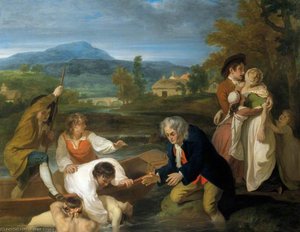
The ascent of Robert Smirke within the prestigious halls of the Royal Academy serves as a testament to his technical prowess and his ability to captivate the era's most discerning critics. His election as an Associate Academician in 1791, followed by full academician status in 1793, marked his transition from a promising illustrator to a cornerstone of the British art establishment. It was during this period that his most celebrated works began to resonate with the public imagination. Pieces such as Narcissus and the Lady and Sabrina—subjects drawn from Milton’s Comus—demonstrated a profound sensitivity to the atmospheric qualities of myth and legend.
Smirke's work is characterized by several defining elements that set him apart from his contemporaries:
- Literary Symbiosis: An unparalleled ability to bridge the gap between English poetry and visual art, making the abstract beauty of verse tangible.
- Monochrome Mastery: A sophisticated use of limited color palettes to evoke mood, depth, and a sense of historical nostalgia.
- Meticulous Draughtsmanship: A foundation in heraldic precision that allowed for exquisite detail in every leaf, ripple, and drapery.
- Intimate Scale: A preference for compositions that invite close inspection, rewarding the viewer with hidden nuances and delicate textures.
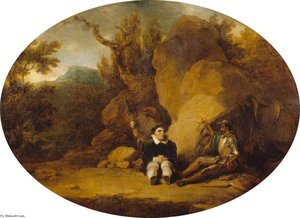
Even his diploma work, Don Quixote and Sancho, reflected his dedication to character and narrative depth. Though he may not have sought the fame of those who painted the epic scale of empire, Smirke’s historical significance lies in his role as a visual custodian of English literary heritage. He transformed the canvas into a page of a book, ensuring that the romanticism of the 18th-century poets would endure through the enduring power of his imagery. His life, spanning from the late 18th century to 1845, remains a beautiful chapter in the story of British art—a story told not in loud proclamations, but in the soft, evocative whispers of a master storyteller.