

1

Updated November 2026 · ranked by our popularity score (searches, visits and orders for each work) · 7 works by Ralph Stubbs in our catalogue
In short
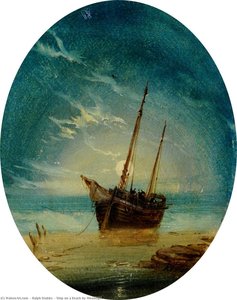
Ship on a Beach by Moonlight (1842) is the Ralph Stubbs painting that draws the most eyes; the original belongs to the Ferens Art Gallery, Hull. After it, the eye goes to After the Storm (1863) and Sailing Ship on a Beach (1866). Among the 7 works of Ralph Stubbs in our catalog, these 7 are the most famous, each a unique original presented with its year, its museum and the reason it endures.




The 3 museums that hold the most of the paintings on this page.
| Museum | City | Works by Ralph Stubbs | Paintings from this list |
|---|---|---|---|
 Ferens Art Gallery |
Hull | 3 | Ship on a Beach by Moonlight, Sailing Ship on a Beach, Marine |
 Reading Museum - Town Hall |
Reading | 1 | After the Storm |
 The Hepworth Wakefield |
Wakefield | 1 | Lake Landscape |
Pick a decade to see the original that defines it.
Ship on a Beach by Moonlight (1842), Ferens Art Gallery, Hull. After the Storm (1863) and Sailing Ship on a Beach (1866) come next.
18 years old: Ship on a Beach by Moonlight dates from 1842, and Ralph Stubbs was born in 1824.
Our catalog holds 7 works by Ralph Stubbs, dated from 1842 to 1879.
Mostly in Ferens Art Gallery (Hull), Reading Museum - Town Hall (Reading) and The Hepworth Wakefield (Wakefield). The museum table above lists them all.
In 1860s: 4 of the 7 works on this page were made then, After the Storm among them.
On this page, the earliest is Ship on a Beach by Moonlight (1842) and the latest Lake Landscape (1879).
Ship on a Beach by Moonlight, Sailing Ship on a Beach and Marine: the Ferens Art Gallery, Hull holds 3 of the works on this page.
The rugged beauty of the North Sea coastline, a realm of relentless winds and dramatic skies, has long captivated artists. Few have captured its essence with such poignant realism and emotional depth as Ralph Stubbs (1824-1879), a British marine painter whose legacy endures through his evocative depictions of coastal life, ships battling the elements, and the ever-changing moods of the sea. Born in Whitby, Yorkshire, a town inextricably linked to maritime history and legend, Stubbs’s artistic journey was shaped by both its tangible realities and the powerful folklore that permeated its atmosphere.
Stubbs' early life was steeped in the traditions of the fishing industry. His father, also a marine artist, instilled in him a deep respect for the sea and an understanding of its unforgiving nature. This practical knowledge, combined with a keen observational eye, formed the bedrock of his artistic practice. Unlike many artists of his time who relied on idealized representations, Stubbs meticulously rendered every detail – the weathered faces of fishermen, the splintered timbers of battered vessels, the churning foam of crashing waves – conveying not just what he saw but also the palpable sense of struggle and resilience inherent in coastal existence.
Stubbs’s artistic development can be traced through a progression of stylistic choices. Initially influenced by the Romantic tradition, particularly the dramatic landscapes of Turner, his early works exhibited a certain theatricality and emphasis on atmospheric effects. However, as he matured, Stubbs moved towards a more restrained and observational approach. He began to prioritize accuracy in depicting the physical details of ships and harbors, meticulously studying their construction and rigging. This shift is most evident in his later paintings, such as “After the Storm,” a monumental canvas that captures the aftermath of a violent gale with breathtaking power and precision.
A key element of Stubbs’s style was his masterful use of light and shadow. He expertly employed chiaroscuro – the dramatic contrast between light and dark – to create a sense of depth, volume, and movement within his compositions. His brushwork, often loose and expressive, conveyed the texture of weathered wood, damp stone, and turbulent water. He wasn’t simply painting scenes; he was conveying an experience, a feeling of being present in that harsh but beautiful environment.
Stubbs' oeuvre is dominated by maritime subjects – fishing boats battling against towering waves, the silhouettes of ships against a fiery sunset, and the quiet solitude of harbors at dusk. He frequently depicted scenes from Whitby’s bustling harbor, capturing the daily rhythms of its fishermen and merchants. Beyond these immediate depictions of coastal life, Stubbs also explored themes of isolation, loss, and the enduring connection between humanity and the sea. His paintings often evoke a sense of melancholy and contemplation, reflecting the inherent vulnerability of those who depend on the ocean’s bounty.
His most famous work, “After the Storm,” exemplifies this thematic depth. The painting isn't merely a record of a natural event; it’s an exploration of its aftermath – the wreckage strewn across the beach, the exhausted figures of the fishermen, and the lingering sense of both devastation and renewal. It speaks to the cyclical nature of life and the enduring spirit of those who face adversity with stoic determination.
Despite his considerable talent, Stubbs’s recognition during his lifetime was limited. He struggled financially throughout much of his career, often relying on commissions for portraits and smaller works to supplement his income. However, his paintings gradually gained appreciation in the decades following his death, establishing him as a significant figure in British marine art. Today, Ralph Stubbs is celebrated as one of the foremost artists who captured the spirit of the North Sea coast – a testament to his skill, observation, and profound understanding of the human condition.
His work continues to resonate with viewers today, offering a powerful reminder of the enduring relationship between humanity and the sea, and the beauty and brutality that coexist within its vast expanse. The National Gallery holds several important examples of his work, ensuring that this master of the Northern Seas will continue to inspire and captivate generations to come.