Portrait of Nikolai Astrup

The 96 Most Famous Nikolai Astrup Paintings, a Gallery Selection

Updated November 2026 · ranked by our popularity score (searches, visits and orders for each work) · 96 works by Nikolai Astrup in our catalogue

In short

Of all the originals Nikolai Astrup left, the most famous is Early Snow (1926), in the collection of the Bergen Kunstmuseum, Bergen. Close behind it come Foxgloves (1920) and Landscape with Seated Woman (1892). Our catalog holds 96 works by Nikolai Astrup; the gallery has kept the 96 the world admires most, each shown with its date, its museum and its story.

1880 – 1928, Bremanger Municipality Neo-romanticism Most works: Bergen Kunstmuseum

Nikolai Astrup's top 10 paintings: the gallery's choice

1
Early Snow (1926) by Nikolai Astrup

Early Snow

1926 · Oil On Canvas · Bergen Kunstmuseum, Bergen

In Early Snow, Nikolai Astrup captures a quiet moment within a winter landscape. The scene focuses on a rustic wooden cabin nestled in a snowy environment, where the weight of the season begins to settle over the terrain. It is a depiction of rural life, showing a profound connection to the natural world through the presence of a simple dwelling amidst the elements. The subject matter suggests a stillness that…

2
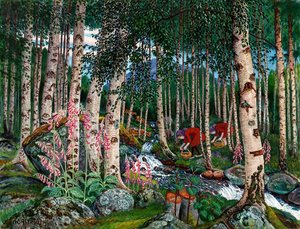
Foxgloves (1920) by Nikolai Astrup

Foxgloves

1920 · Painting · Bergen Kunstmuseum, Bergen

In the heart of the Norwegian landscape, where the mist clings to the valleys of Vestlandet, Nikolai Astrup captured a world that feels simultaneously grounded in reality and touched by magic. His 1920 masterpiece, Foxgloves, is far more than a mere botanical study; it is an immersive journey into a thriving, breathing ecosystem. The canvas unfolds as a lush forest sanctuary, where the dense canopy of healthy green leaves creates…

3
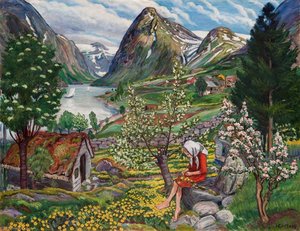
Landscape with Seated Woman (1892) by Nikolai Astrup

Landscape with Seated Woman

1892 · Oil On Panel · Sogn og Fjordane Kunstmuseum, Førde

In Landscape with Seated Woman, Nikolai Astrup presents a serene rural scene that invites a quiet contemplation of the Norwegian countryside. Painted in 1892, the work captures a moment of stillness within the natural world. The landscape unfolds with a sense of calm, focusing on the quietude of a remote setting. It is a scene that feels lived-in and deeply connected to the earth.

5
Cowshed Courting (1903) by Nikolai Astrup

Cowshed Courting

In this oil painting, Cowshed Courting by Nikolai Astrup, we find ourselves drawn into a private, dimly lit space. Created about 1903, the work captures a romantic encounter held within the rustic confines of a cowshed. On the left side of the foreground, a young man and woman are locked in an embrace. Their figures form a quiet, vertical focal point amidst the shadows of the barn. The man is…

6
The Artist's Father (1900) by Nikolai Astrup

The Artist's Father

1900 · Oil On Canvas · Sogn og Fjordane Kunstmuseum, Førde

In this intimate oil portrait, Nikolai Astrup turns his gaze toward a deeply personal subject: his father. Painted about 1900, the work captures an older man in a moment of quiet presence. It is a study of character and lineage, rendered with a focus on the individual's physical presence and the weight of years. The portrait moves beyond a mere likeness to offer a glimpse into the artist's own domestic…

7
The Artist's Mother (1900) by Nikolai Astrup

The Artist's Mother

1900 · Oil · Sogn og Fjordane Kunstmuseum, Førde

is an oil portrait by the Norwegian artist Nikolai Astrup. Executed about 1900, the work captures an intimate moment of domestic life. The subject is an elderly woman captured in a medium close-up, presented from the waist up as she engages in the quiet task of knitting.

10
Sandalstrand (1926) by Nikolai Astrup

Sandalstrand

1926 · Oil On Canvas · KODE Art museums and composer homes, Bergen

Executed in 1926, Sandalstrand by Nikolai Astrup presents a serene rural scene in Norway. The work captures a specific moment of pastoral life, focusing on the quietude of the Norwegian countryside. It reflects the artist's deep connection to the landscape of Vestlandet, specifically the area around Jølster.

The Nikolai Astrup selection continues, 11 to 96

11In Paradise by Nikolai AstrupIn ParadiseBergen Kunstmuseum 12Job by Nikolai AstrupJobBergen Kunstmuseum 13From Sunde (1921) by Nikolai AstrupFrom Sunde1921 · Bergen Kunstmuseum 14June Night and Old West Country Farmyard (1908) by Nikolai AstrupJune Night and Old West Country Farmyard1908 · Bergen Kunstmuseum 15Gethsemane (1926) by Nikolai AstrupGethsemane1926 · Bergen Kunstmuseum 16Svanøybukta (1905) by Nikolai AstrupSvanøybukta1905 · KODE Art museums and composer homes 17Landscape with Children (1903) by Nikolai AstrupLandscape with Children1903 · National Museum of Art, Architecture and Design 18Autumnrain in the Mountain Valley (1899) by Nikolai AstrupAutumnrain in the Mountain Valley1899 · National Museum of Art, Architecture and Design 19Night (1902) by Nikolai AstrupNight1902 · Sogn og Fjordane Kunstmuseum 20Going to the Mill (1905) by Nikolai AstrupGoing to the Mill1905 · Bergen Kunstmuseum 21Landscape in Spring (1908) by Nikolai AstrupLandscape in Spring1908 · National Museum of Art, Architecture and Design 22Mountainlandscape (1908) by Nikolai AstrupMountainlandscape1908 · National Museum of Art, Architecture and Design 23Foxgloves (1909) by Nikolai AstrupFoxgloves1909 · National Museum of Art, Architecture and Design 24Landscape in Moonlight (1907) by Nikolai AstrupLandscape in Moonlight1907 · National Museum of Art, Architecture and Design 25Landscape with Figures by Nikolai AstrupLandscape with FiguresNational Museum of Art, Architecture and Design 26The white Horse in Spring (1910) by Nikolai AstrupThe white Horse in Spring1910 · National Museum of Art, Architecture and Design 27Warmth Enters the Earth (1908) by Nikolai AstrupWarmth Enters the Earth1908 · Lillehammer Art Museum 28Rhubarb by Nikolai AstrupRhubarbKODE Art museums and composer homes 29Spring night in the garden (1909) by Nikolai AstrupSpring night in the garden1909 · KODE Art museums and composer homes 30Midsummer Eve Bonfire by Lake Jølstravatnet (1909) by Nikolai AstrupMidsummer Eve Bonfire by Lake Jølstravatnet1909 31Night in Spring (1909) by Nikolai AstrupNight in Spring1909 · Bergen Kunstmuseum 32Old Man with Beard by Nikolai AstrupOld Man with BeardSogn og Fjordane Kunstmuseum 33The Farewell by Nikolai AstrupThe FarewellBergen Kunstmuseum 34Head, Old Man with Beard by Nikolai AstrupHead, Old Man with BeardBergen Kunstmuseum 35Man Plowing (also known as Ploughman) by Nikolai AstrupMan Plowing (also known as Ploughman)Bergen Kunstmuseum 36The Fisherman by Nikolai AstrupThe FishermanBergen Kunstmuseum 37Bird on Stone (1912) by Nikolai AstrupBird on Stone1912 · KODE Art museums and composer homes 38Downy Night (1912) by Nikolai AstrupDowny Night1912 · Bergen Kunstmuseum 39Mill Water (1916) by Nikolai AstrupMill Water1916 · Bergen Kunstmuseum 40Midsummer Night Bonfire (1915) by Nikolai AstrupMidsummer Night Bonfire1915 · Bergen Kunstmuseum 41Corn Store (1920) by Nikolai AstrupCorn Store1920 · KODE Art museums and composer homes 42March Morning (1920) by Nikolai AstrupMarch Morning1920 · Bergen Kunstmuseum 43Kari Motif from Sunde (1918) by Nikolai AstrupKari Motif from Sunde1918 · Bergen Kunstmuseum 44Spring in Jølster (1925) by Nikolai AstrupSpring in Jølster1925 · National Museum of Art, Architecture and Design 45Interior with Cradle (1925) by Nikolai AstrupInterior with Cradle1925 · Bergen Kunstmuseum 46The Goose (1926) by Nikolai AstrupThe Goose1926 · Bergen Kunstmuseum 47Clear June Night by Nikolai AstrupClear June NightKODE Art museums and composer homes 48The Parsonage Garden by Nikolai AstrupThe Parsonage GardenKODE Art museums and composer homes 49At 2 PM July 14th by Nikolai AstrupAt 2 PM July 14th 50The Old Woman with the Lantern by Nikolai AstrupThe Old Woman with the LanternKODE Art museums and composer homes 51Grain Stacks by Nikolai AstrupGrain StacksSogn og Fjordane Kunstmuseum 52Storehouse in Jølster by Nikolai AstrupStorehouse in JølsterNational Museum of Art, Architecture and Design 53Wood in Winter by Nikolai AstrupWood in WinterNational Museum of Art, Architecture and Design 54Myklebust by Nikolai AstrupMyklebustSogn og Fjordane Kunstmuseum 55Fisherman by Nikolai AstrupFisherman 56Landscape from Ålhus by Nikolai AstrupLandscape from ÅlhusBergen Kunstmuseum 57Naked Trees by Nikolai AstrupNaked TreesBergen Kunstmuseum 58The Farmer by Nikolai AstrupThe FarmerBergen Kunstmuseum 59Girl Spinning by Nikolai AstrupGirl SpinningBergen Kunstmuseum 60Marigold Night (also known as Soleienatt) by Nikolai AstrupMarigold Night (also known as Soleienatt) 61Menu 9 7.22 by Nikolai AstrupMenu 9 7.22Bergen Kunstmuseum 62Jølster Woman with Hood by Nikolai AstrupJølster Woman with HoodBergen Kunstmuseum 63Juninatt i haven (A Night in June in the Garden) by Nikolai AstrupJuninatt i haven (A Night in June in the Garden) 64Man's Head with Cap by Nikolai AstrupMan's Head with CapBergen Kunstmuseum 65Ålhustunet, Jølster by Nikolai AstrupÅlhustunet, Jølster 66Landscape Ålhusdalen by Nikolai AstrupLandscape ÅlhusdalenBergen Kunstmuseum 67Landscape with Pine by Nikolai AstrupLandscape with PineBergen Kunstmuseum 68Men Binding Hay Racks by Nikolai AstrupMen Binding Hay RacksBergen Kunstmuseum 69Kari paa Sunde by Nikolai AstrupKari paa Sunde 70Inger Grimsbø, Old Jølster Girl by Nikolai AstrupInger Grimsbø, Old Jølster GirlBergen Kunstmuseum 71The Hat Thief by Nikolai AstrupThe Hat ThiefBergen Kunstmuseum 72May Moon by Nikolai AstrupMay MoonBergen Kunstmuseum 73Man Cutting Branches from Sallow by Nikolai AstrupMan Cutting Branches from SallowBergen Kunstmuseum 74Landscape with Hay Rack and House by Nikolai AstrupLandscape with Hay Rack and HouseBergen Kunstmuseum 75Elements from Spring and Will by Nikolai AstrupElements from Spring and WillBergen Kunstmuseum 76The Godly Cobbler by Nikolai AstrupThe Godly CobblerBergen Kunstmuseum 77Landscape with White House by Nikolai AstrupLandscape with White HouseBergen Kunstmuseum 78Knitting Woman by Nikolai AstrupKnitting WomanBergen Kunstmuseum 79Great Grandfather of Half the Village by Nikolai AstrupGreat Grandfather of Half the VillageBergen Kunstmuseum 80The Eager Suitor by Nikolai AstrupThe Eager SuitorBergen Kunstmuseum 81June Night by Nikolai AstrupJune NightBergen Kunstmuseum 82Jølster Tale by Nikolai AstrupJølster TaleBergen Kunstmuseum 83Early Summer in Jølster by Nikolai AstrupEarly Summer in JølsterBergen Kunstmuseum 84Home from Work by Nikolai AstrupHome from WorkBergen Kunstmuseum 85Marigold Night by Nikolai AstrupMarigold NightBergen Kunstmuseum 86Growing Weather in Sandalstrand by Nikolai AstrupGrowing Weather in SandalstrandBergen Kunstmuseum 87Large Stook by Nikolai AstrupLarge StookBergen Kunstmuseum 88Midsummer Night Bonfire (sketch) by Nikolai AstrupMidsummer Night Bonfire (sketch)Bergen Kunstmuseum 89Mill Water (woodcut) by Nikolai AstrupMill Water (woodcut)Bergen Kunstmuseum 90The Gypsy Girl by Nikolai AstrupThe Gypsy GirlBergen Kunstmuseum 91May Moon, Winter Night by Nikolai AstrupMay Moon, Winter NightBergen Kunstmuseum 92Haymaking by Nikolai AstrupHaymakingBergen Kunstmuseum 93Midsummer Night Bonfire (woodcut) by Nikolai AstrupMidsummer Night Bonfire (woodcut)Bergen Kunstmuseum 94The Doll House by Nikolai AstrupThe Doll HouseBergen Kunstmuseum 95Mother and Child(ren ) by the Garden Table by Nikolai AstrupMother and Child(ren ) by the Garden TableBergen Kunstmuseum 96Bonfire celebrating Midsummer Night (1912) by Nikolai AstrupBonfire celebrating Midsummer Night1912 · National Museum of Art, Architecture and Design

Nikolai Astrup's famous paintings, period by period

The subjects that held Nikolai Astrup's eye

The four subjects that come back most often in these originals, each with its finest example.

The museums that keep Nikolai Astrup's originals

The 5 museums that hold the most of the paintings on this page.

Museum City Works by Nikolai Astrup Paintings from this list
Bergen Kunstmuseum, BergenBergen Kunstmuseum Bergen 56 Early Snow, Foxgloves, In Paradise
National Museum of Art, Architecture and Design, OsloNational Museum of Art, Architecture and Design Oslo 15 Portrait of a young Girl, Landscape with Figures, Spring Evening in Jølster
KODE Art museums and composer homes Bergen 10 Cowshed Courting, Sandalstrand, Svanøybukta
Sogn og Fjordane Kunstmuseum, FørdeSogn og Fjordane Kunstmuseum Førde 7 Landscape with Seated Woman, The Artist's Father, The Artist's Mother
Lillehammer Art Museum, LillehammerLillehammer Art Museum Lillehammer 1 Warmth Enters the Earth

Nikolai Astrup decade by decade: the original that defines each

Works per decade

Pick a decade to see the original that defines it.

Collectors' questions about Nikolai Astrup's paintings

Which work is Nikolai Astrup most famous for?Reveal the answer

Early Snow (1926), Bergen Kunstmuseum, Bergen. Foxgloves (1920) and Landscape with Seated Woman (1892) come next.

What age was Nikolai Astrup when Early Snow was made?Reveal the answer

46 years old: Early Snow dates from 1926, and Nikolai Astrup was born in 1880.

What are the ten most famous Nikolai Astrup paintings?Reveal the answer

Early Snow, Foxgloves, Landscape with Seated Woman, Portrait of a young Girl, Cowshed Courting, The Artist's Father, The Artist's Mother, Landscape with Figures, Spring Evening in Jølster and Sandalstrand. The ranking above gives each one's year and museum.

How many paintings did Nikolai Astrup leave?Reveal the answer

Our catalog holds 96 works by Nikolai Astrup, dated from 1892 to 1926.

In which museums do Nikolai Astrup's masterpieces hang?Reveal the answer

Mostly in Bergen Kunstmuseum (Bergen), National Museum of Art, Architecture and Design (Oslo) and KODE Art museums and composer homes (Bergen). The museum table above lists them all.

In which years did Nikolai Astrup paint the most famous works?Reveal the answer

In 1900s: 18 of the 96 works on this page were made then, Portrait of a young Girl among them.

What are the first and the last famous originals of Nikolai Astrup?Reveal the answer

On this page, the earliest is Landscape with Seated Woman (1892) and the latest Early Snow (1926).

Which subjects did Nikolai Astrup choose most often?Reveal the answer

Trees (6), Woman (5) and Landscape (4), across the 96 works on this page.

Which technique did Nikolai Astrup use most?Reveal the answer

Oil On Canvas, for 7 of the 96 works on this page.

To which art movement does Nikolai Astrup belong?Reveal the answer

Neo-romanticism, judging by the originals on this page.

Which Nikolai Astrup works hang at the Bergen Kunstmuseum?Reveal the answer

Early Snow, Foxgloves and In Paradise: the Bergen Kunstmuseum, Bergen holds 56 of the works on this page.

Nikolai Astrup: life and work

A Visionary of the Norwegian Wilds

Nikolai Astrup stands as a singular figure in Norwegian art history—a painter whose deeply felt connection to the landscapes and traditions of Vestlandet cemented his place among the most distinctive neo-romantic artists of his time. Born on August 30, 1880, in the coastal village of Kalvåg, within the rugged Bremanger region, Astrup’s early life was steeped in the atmospheric beauty of the fjords and mountains. As the eldest son of a parish priest, his upbringing was marked by a certain familial piety, yet his heart was irrevocably drawn to the vibrant, living pulse of the natural world. This profound connection to his ancestral roots would eventually propel him toward a style characterized by intense color palettes and an unwavering dedication to portraying the everyday life and folklore of rural Norway.

His journey toward artistic mastery was not a straight path but rather a soulful exploration of both tradition and modernity. While initial inclinations suggested a life in theological studies, Astrup’s passion for drawing led him away from the Trondheim Cathedral School and toward the burgeoning art scene in Kristiania (Oslo). It was here, under the influential tutelage of Harriet Backer, that he began to hone his technical skills. A brief but transformative stint in Paris further enriched his vision, exposing him to the avant-garde movements of the era and fostering connections with fellow artists like Christian Krohg. These encounters with Impressionistic techniques and a broader European perspective provided him with the tools to eventually weave tradition and innovation into a singular, cohesive artistic language.

The Soul of Jølster and the Magic of Realism

In 1902, Astrup made the pivotal decision to return to his childhood home in Jølster, settling on the property of Sandalstrand. This return was more than a homecoming; it was an immersion into a lifelong muse. Alongside his wife, Engel Sunde, he raised eight children amidst the demanding economic realities of rural life, yet this very hardship fueled his creative drive. He became a master of capturing the magical realism of the Norwegian landscape, where the lush greenery of summer and the stark, quiet solitude of winter were rendered with an almost supernatural intensity. His work often transcends mere representation, utilizing a vibrant, colorful palette to evoke the mystical atmosphere of the mountains and the seasonal shifts of the fjords.

Astrup’s technique was as much about emotion as it was about observation. He was a skilled printmaker and horticulturalist, qualities that informed his complex approach to composition. In his woodcuts and paintings, one can observe how he modified moods through subtle changes in color and the strategic addition or deletion of motifs. His oeuvre is celebrated for its ability to capture the sublime—that breathtaking intersection of beauty and awe. Whether depicting a serene winter scene like Mill Water or the hauntingly beautiful monochrome landscapes of Naked Trees, Astrup’s work invites the viewer into a world where the boundaries between the physical landscape and the spiritual realm are beautifully blurred.

Legacy of a National Visual Language

Beyond his individual canvases, Nikolai Astrup’s historical significance lies in his pioneering effort to capture a national visual language. He did not merely paint scenery; he documented the very essence of the Norwegian identity, celebrating the traditional way of life and the folklore that defined the region of Vestlandet. His ability to blend the local with the universal allowed his work to resonate far beyond the borders of Norway, even if he remained largely unknown to much of the international community during his lifetime. He remains a cornerstone of Norwegian modernism, an artist who found the infinite within the intimate.

The enduring impact of his life and work can be summarized through these defining elements:

  • Artistic Innovation: The seamless integration of Impressionistic brushwork with Neo-Romantic themes.
  • Cultural Preservation: A dedicated focus on the traditions, customs, and landscapes of the Jølster region.
  • Technical Mastery: An extraordinary command over color and printmaking that allowed for deep emotional resonance.
  • Ecological Connection: His life at Sandalstrand served as an early manifestation of a deep-seated respect for the natural environment and conservation.

Though his life was tragically short, ending in 1928 at the age of forty-seven, the legacy of Nikolai Astrup continues to flourish. His paintings remain vibrant windows into a lost era, offering a timeless glimpse into the heart of the Norwegian wilderness.