Portrait of Michael Albert Smith

The 16 Most Famous Michael Albert Smith Paintings, Each One of a Kind

Updated November 2026 · ranked by our popularity score (searches, visits and orders for each work) · 17 works by Michael Albert Smith in our catalogue

In short

Mahalia Jackson & Duke Ellington at the First N.O. Jazz Fest (1970) is the Michael Albert Smith painting that draws the most eyes; the original belongs to the The Historic New Orleans Collection, New Orleans. After it, the eye goes to Emile Victor Clay funeral (1996) and Irma Thomas (1975). Among the 17 works of Michael Albert Smith in our catalog, these 16 are the most famous, each a unique original presented with its year, its museum and the reason it endures.

born 1963, Rochester Documentary photography Most works: The Historic New Orleans Collection

Top 10 paintings by Michael Albert Smith, through the gallery's eye

1
Mahalia Jackson & Duke Ellington at the First N.O. Jazz Fest (1970) by Michael Albert Smith

Mahalia Jackson & Duke Ellington at the First N.O. Jazz Fest

1970 · Black and White Photography · The Historic New Orleans Collection, New Orleans

The black and white photograph captures a gathering at the 1970 New Orleans Jazz and Heritage Festival. In the center of the frame, Mahalia Jackson holds a microphone, positioned near Duke Ellington. They are surrounded by a crowd of people within the Municipal Auditorium. To the side, George Wein stands near an individual operating a video camera, while Cousin Joe is visible on the right edge of the composition. The…

2
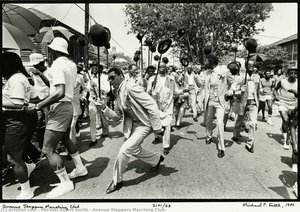
Emile Victor Clay funeral (1996) by Michael Albert Smith

Emile Victor Clay funeral

1996 · Black and White Photography · The Historic New Orleans Collection, New Orleans

This black and white photograph captures a dynamic scene of a jazz funeral held for Emile Victor Clay. The image depicts a large group of African American men dressed in formal suits, parading and dancing through a residential street. In the foreground, a man is captured mid-motion, jumping into the air. The Pin Stripe Brass Band is visible performing as part of the procession, which includes mourners and community onlookers…

3
Irma Thomas (1975) by Michael Albert Smith

Irma Thomas

1975 · Black and White Photography · The Historic New Orleans Collection, New Orleans

In this photograph by Michael Albert Smith, we find Irma Thomas performing at Jazz Fest. The image captures a specific moment of musical expression, documenting the singer amidst the energy of the festival. It is a piece held within the Michael P. Smith Archive, offering a glimpse into the performance history of the artist. The scene focuses on the connection between the performer and the crowd during this live event.

4
Bishop I. Butler, founder, Beauty of Holiness Church of the Lord Jesus Christ (1974) by Michael Albert Smith

Bishop I. Butler, founder, Beauty of Holiness Church of the Lord Jesus Christ

1974 · Black and White Photography · The Historic New Orleans Collection, New Orleans

The air feels heavy with a quiet, sacred stillness as an elderly African American woman stands before a modest house. She is a figure of profound dignity, draped in a long, flowing white robe that catches the natural light, contrasted by a dark sash that anchors her silhouette. A wide-brimmed hat, adorned with delicate feathers, rests upon her head, adding a sense of ceremonial weight to her stature. In one…

7
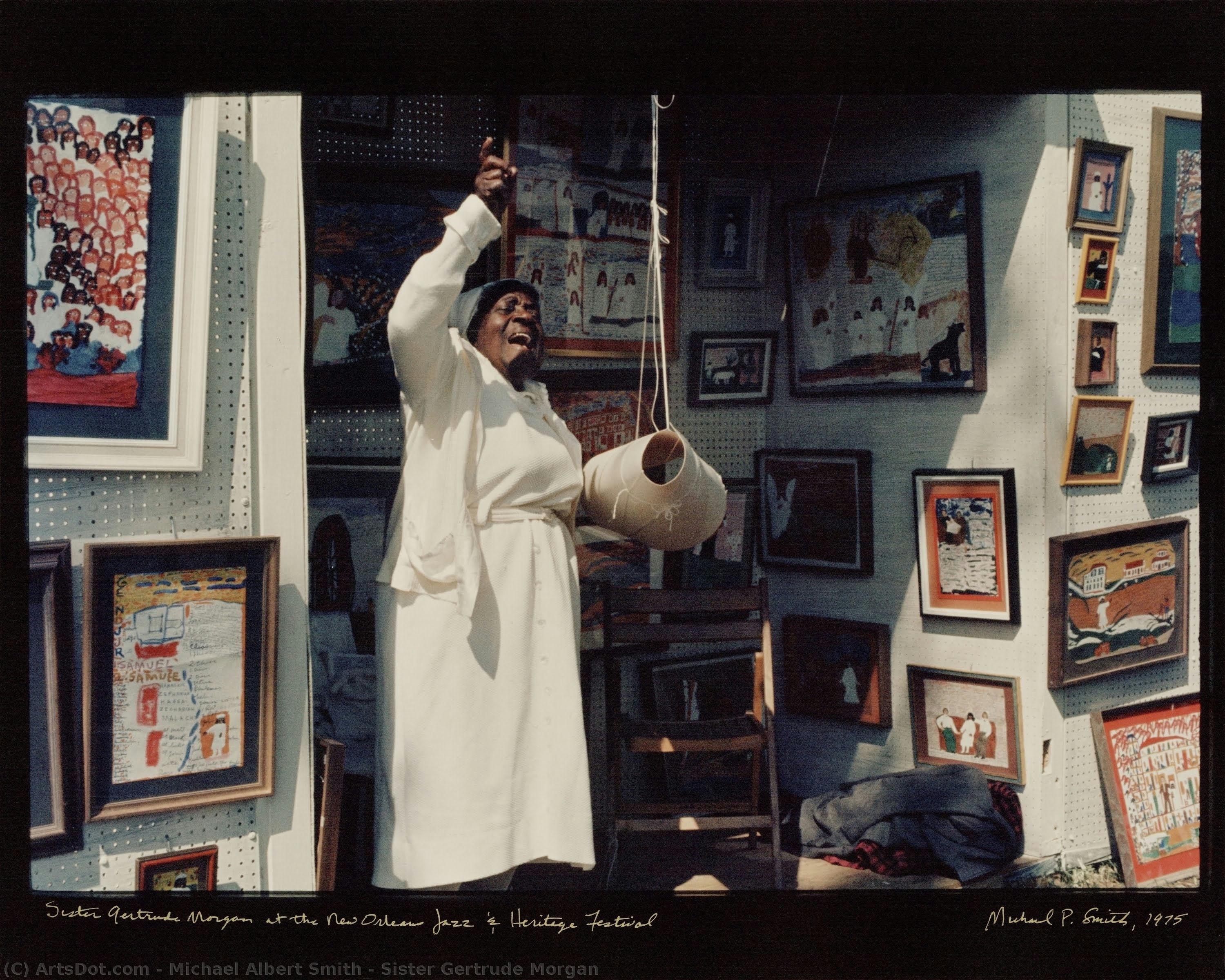
Sister Gertrude Morgan (1973) by Michael Albert Smith

Sister Gertrude Morgan

View of Sister Gertrude Morgan preaching while standing in her craft booth at the 1973 New Orleans Jazz and Heritage Festival. She is seen wearing a white dress, sweater and headdress. A makeshift megaphone constructed of what appears to be paper and string is visible hanging from the ceiling. Framed paintings are seen hung on the walls of the craft booth.

Michael Albert Smith's famous paintings, numbers 11 to 16

The subjects that held Michael Albert Smith's eye

The four subjects that come back most often in these originals, each with its finest example.

The museums that keep Michael Albert Smith's originals

The 3 museums that hold the most of the paintings on this page.

Museum City Works by Michael Albert Smith Paintings from this list
The Historic New Orleans Collection, New OrleansThe Historic New Orleans Collection New Orleans 14 Mahalia Jackson & Duke Ellington at the First N.O. Jazz Fest, Emile Victor Clay funeral, Irma Thomas
Paintings in Hospitals, LondonPaintings in Hospitals London 1 Annie Payne - Deputy Sister.
James A. Michener Art Museum, DoylestownJames A. Michener Art Museum Doylestown 1 Atchafalaya Basin, Louisiana

Michael Albert Smith across the decades: one unique original for each

Works per decade

Pick a decade to see the original that defines it.

Michael Albert Smith's paintings: questions for the gallery

What is the single most famous work of Michael Albert Smith?Reveal the answer

Mahalia Jackson & Duke Ellington at the First N.O. Jazz Fest (1970), The Historic New Orleans Collection, New Orleans. Emile Victor Clay funeral (1996) and Irma Thomas (1975) come next.

Which ten paintings by Michael Albert Smith are the most famous?Reveal the answer

Mahalia Jackson & Duke Ellington at the First N.O. Jazz Fest, Emile Victor Clay funeral, Irma Thomas, Bishop I. Butler, founder, Beauty of Holiness Church of the Lord Jesus Christ, Allison, Henry Roeland Byrd at Parish Prison, Sister Gertrude Morgan, James Booker at the New Orleans Jazz Fest, Etta James and Trombone Shorty on stage with Bo Diddley, New Orleans Jazz and Heritage Festival. The ranking above gives each one's year and museum.

How many works by Michael Albert Smith are known?Reveal the answer

Our catalog holds 17 works by Michael Albert Smith, dated from 1973 to 2020.

Where can the most famous Michael Albert Smith originals be seen?Reveal the answer

Mostly in The Historic New Orleans Collection (New Orleans), Paintings in Hospitals (London) and James A. Michener Art Museum (Doylestown). The museum table above lists them all.

During which period did Michael Albert Smith create the best-known paintings?Reveal the answer

In 1970s: 8 of the 16 works on this page were made then, Irma Thomas among them.

Which famous Michael Albert Smith painting is the earliest, and which the latest?Reveal the answer

On this page, the earliest is Henry Roeland Byrd at Parish Prison (1973) and the latest Annie Payne - Deputy Sister. (2020).

What subjects did Michael Albert Smith favour?Reveal the answer

Black and white (4), New orleans (2) and Community (2), across the 16 works on this page.

What materials did Michael Albert Smith paint with most?Reveal the answer

Black and White Photography, for 6 of the 16 works on this page.

Which movement does the work of Michael Albert Smith belong to?Reveal the answer

Documentary photography, judging by the originals on this page.

What Michael Albert Smith originals can I see at the The Historic New Orleans Collection?Reveal the answer

Mahalia Jackson & Duke Ellington at the First N.O. Jazz Fest, Emile Victor Clay funeral and Irma Thomas: the The Historic New Orleans Collection, New Orleans holds 14 of the works on this page.

Michael Albert Smith: a portrait of the artist

Michael Albert Smith: A Chronicle of New Orleans Soul

Born in Rochester, New York, in 1963, Michael Albert Smith’s artistic journey is inextricably linked to the vibrant pulse of New Orleans. Initially a basketball player drafted by the Boston Celtics – a surprising detour from his creative pursuits – Smith ultimately found his true calling not on the court but through the lens of his camera. His work transcends mere documentation; it's an immersive exploration of culture, faith, and the human spirit within the unique landscape of Louisiana’s musical heartland. From the poignant black-and-white portraits of gospel legends to the dynamic captures of jazz funerals, Smith’s photographs resonate with a deep understanding of community, resilience, and the stories embedded within everyday life.

Smith's early career began in the late 1970s, marked by significant recognition from prestigious organizations. A National Endowment for the Arts Photography Fellowship in 1977 laid the foundation for his artistic development, followed by a commission from The Toledo Museum of Art in 1980 and an international award from the International Festival of Photography at Arles in France in 1981. These early accolades signaled a rising talent deeply attuned to visual storytelling. His work quickly gained attention through publications like *Crisis* magazine, where his images of Bishop I. Butler and Mahalia Jackson & Duke Ellington were prominently featured, solidifying his place within the broader narrative of Black cultural representation.

The Gospel Portraits: Faith and Community

Perhaps Smith’s most enduring legacy lies in his series of portraits of gospel musicians and church leaders. These images—including the iconic photograph of Bishop I. Butler, founder of Beauty of Holiness Church of the Lord Jesus Christ (1974)—are not simply representations; they are intimate studies of faith, leadership, and community. The stark black-and-white tones heighten the emotional impact, emphasizing the dignity and strength of these figures within their sacred spaces. Smith’s approach is deeply respectful, capturing not just appearances but also the essence of his subjects—their conviction, their warmth, and their connection to a rich spiritual tradition.

The 1996 photograph of Emile Victor Clay's funeral, a powerful document of New Orleans jazz funeral traditions, exemplifies Smith’s ability to capture pivotal moments in community life. The image is a testament to the city’s enduring cultural resilience—a celebration of life interwoven with mourning, a vibrant display of collective grief and communal support. It’s a scene brimming with color, movement, and deeply felt emotion, offering a glimpse into the soul of New Orleans.

New Orleans Jazz: A Photographic Symphony

Smith's fascination with New Orleans music is central to his artistic identity. His photographs of Mahalia Jackson & Duke Ellington at the First N.O. Jazz Fest in 1970 are particularly significant, capturing a historic moment that solidified the city’s reputation as a global center for jazz. These images aren’t just snapshots; they're windows into a vibrant musical ecosystem—a celebration of improvisation, collaboration, and the raw energy of live performance. The photographs convey the excitement and communal spirit of the festival, transporting the viewer to the heart of New Orleans’ musical heritage.

Beyond specific events, Smith’s broader body of work on New Orleans jazz reflects a deep appreciation for the city's unique musical culture. He consistently sought to document not just the performers but also the people who shaped and sustained that music—the musicians, the audiences, and the community as a whole. His images are imbued with a sense of reverence and respect for this vital cultural tradition.

Beyond New Orleans: A Broader Artistic Vision

While his work is most closely associated with New Orleans, Smith’s artistic interests extend beyond the city's borders. He has documented diverse communities across the United States, capturing portraits of individuals and scenes that offer insights into American life. His photography reflects a commitment to social justice and cultural understanding—a desire to tell stories that might otherwise go unheard.

Furthermore, Smith’s artistic practice encompasses other mediums, including painting and golf – demonstrating a multifaceted creative spirit. His background as a basketball player also informs his work, providing him with an appreciation for athleticism, competition, and the dynamics of human interaction.

Legacy and Influence

Michael Albert Smith’s photographs are more than just images; they're windows into the soul of New Orleans and the broader American experience. His work has been exhibited in museums and galleries across the United States and internationally, earning him critical acclaim and recognition as a leading figure in contemporary photography. His legacy lies not only in his stunning visual artistry but also in his commitment to documenting marginalized communities and preserving cultural traditions. Smith’s photographs continue to resonate with audiences today, offering a powerful reminder of the beauty, resilience, and complexity of the human spirit.