A Life in Paris
Born in Paris on October 10, 1826, Jules Emmanuel Valadon entered a world shaped by the architectural precision of his father, Michel Emmanuel Valadon. Growing up as the son of an architect and builder, he found his own path through the disciplined halls of the School of Beaux Arts. By 1846, he was immersed in the rigorous academic traditions of Paris, likely refining his hand under the guidance of Léon Cogniet, Drolling, and Lehmann.
His emergence into the public eye began with his debut at the Paris Salon in 1857. This period marked the beginning of a steady professional ascent within the French art establishment. He did not seek sudden fame but rather built a reputation through consistent presence and technical merit. His career was punctuated by recognized achievements, including a bronze medal at the Salon in 1880 and a silver medal in 1886.
The Precision of the Brush
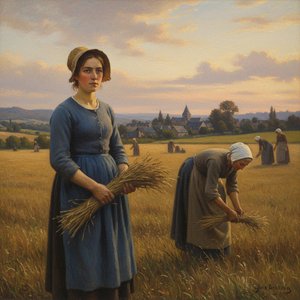
Valadon’s repertoire was defined by a quiet focus on the tangible world. He turned his attention to portraits, garden scenes, and still lifes, approaching each subject with a specific technical rigor. His still-lifes, in particular, were noted for their virtuosity and an exacting attention to detail that demanded much from both the artist and the viewer.
His work often captured the essence of his subjects through careful observation:
- Portraiture: Works such as his portrait of a young Breton peasant demonstrate a delicate handling of oil on panel.
- Nature and Landscape: Pieces like Corner of the Garden reflect a settled, observant eye for the natural environment.
- Printmaking: His lithographic work, including Douleur (Sorrow) from 1895, shows a different facet of his graphic capability using blue-black ink on heavy japan paper.
A Final Chapter
As the nineteenth century drew to a close, Valadon’s presence remained felt in the collections of significant institutions. His portrait of Alphonse Osbert found a permanent home in the Musée d'Orsay in Paris, ensuring his technical contributions remained part of the city's artistic record. He passed away in 1900, leaving behind a body of work that remains anchored in the academic and naturalist traditions of his era.