


1


Updated November 2026 · ranked by our popularity score (searches, visits and orders for each work) · 45 works by Gilbert Spencer in our catalogue
In short
Boy Holding a Rabbit (1931) is the Gilbert Spencer painting that draws the most eyes. After it, the eye goes to A Cotswold Farm (1930) and Portrait of a Youth (1925). Among the 45 works of Gilbert Spencer in our catalog, these 43 are the most famous, each a unique original presented with its year, its museum and the reason it endures.


The choice of wallpaper—floral motifs rendered in muted hues—is more than just decorative; it serves as a powerful symbol. In Edwardian England, domestic interiors were meticulously curated to project an image of refinement and stability. The floral pattern embodies this aspiration for harmony and beauty within the home, mirroring the quiet dignity conveyed by the young man’s demeanor.

In this 1936 oil on canvas, we find ourselves in a room defined by a profound sense of stillness. The subject, Duncan Campbell Macgregor, sits before a fireplace, his hands clasped in a gesture of contemplation. There is a weight to his posture, the quiet dignity of a man accustomed to the rigors of academic thought. He is dressed in a suit and tie, the attire of a professional, yet…

A waterway flows through the center of this 1927 oil on canvas, cutting a path between banks lined with mature trees and dense foliage. The scene depicts the Mill Pond in Durweston, where the water's surface reflects the sky above. Several figures are positioned throughout the composition; some stand near the edge of the water while others are situated further back among the greenery. Two boats are visible on the…

In the quietude of 1925, Gilbert Spencer captured a moment of profound stillness in his masterpiece, Elm Trees at Garsington. This evocative landscape serves as more than just a depiction of the Oxfordshire countryside; it is an invitation into a world where time seems to slow, allowing the viewer to breathe in the pastoral tranquility of rural England. The composition is anchored by a majestic group of elm trees that…


 Gilbert Spencer1919
12
 Oxfordshire Landscape1922 · Herbert Art Gallery - Museum
13
 The Rat Catcher1922
14
 Gwen Harter in a Red Bead Necklace1920 · Ferens Art Gallery
15
 The Terrace1927
16
 Self Portrait1928
17
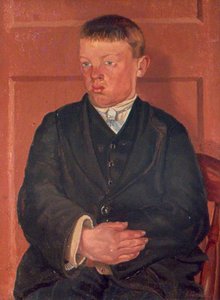 Reading Boy1923 · Reading Museum - Town Hall
18
 Little Milton near Garsington1926
19
 The Farmyard, Garsington, Oxfordshire1925
20
 View of Egdon Heath from the Crest of Clouds Hill, Looking North1925 · National Trust
21
 Blackmoor Vale1931
22
 Chicken Boy1931
23
 Cotswold Meadows1930
24
 Lansdowne Crescent, London1931 · Laing Art Gallery
25
 Wangford1934 · Government Art Collection
26
 Air Raid Warning1940
27
 Blackmore Vale from Compton Abbas1942
28
 Burdens Farm with Melbury Beacon1943
29
 Budden's Lane1939 · Arts Council Collection
30
 Soldiers Relaxing, Hook End Farm, Basildon, Berkshire1940 · Reading Museum - Town Hall
31
 The School on Peggy Hill, Ambleside1952
32
 Bryn og1952 · Reading Museum - Town Hall
33
 Troops in the Countryside
34
 Dorset Downs1919 · Fitzwilliam College
35
 The Cottage Window
36
 Twyford, Dorset
37
 LandscapeAbbot Hall Art Gallery
38
 A Marshy LandscapeReading Museum - Town Hall
39
 Landscape with Cows
40
 The Drayman
41
 Sheep in a FieldTouchstones Rochdale
42
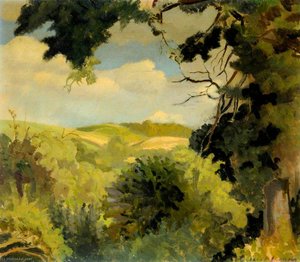 Dorset Landscape No.1
43
 Mountain Landscape with a WindmillNational Trust
The four subjects that come back most often in these originals, each with its finest example.
The 8 museums that hold the most of the paintings on this page.
| Museum | City | Works by Gilbert Spencer | Paintings from this list |
|---|---|---|---|
 Reading Museum - Town Hall |
Reading | 4 | Reading Boy, Soldiers Relaxing, Hook End Farm, Basildon, Berkshire, Bryn og |
 The Ashmolean Museum of Art And Archaeology |
Oxford | 3 | Mill Pond, Durweston, Elm Trees at Garsington, Pegwell Bay, Kent |
 Victoria Art Gallery |
Bath | 1 | Portrait of a Youth |
 Balliol College |
Oxford | 1 | Duncan Campbell Macgregor (1888–1939), Fellow (1919–1939), University Lecturer in Greek History (1929) |
 Royal West of England Academy |
Bristol | 1 | Summer Evening, Durdham Downs |
 Herbert Art Gallery - Museum |
Coventry | 1 | Oxfordshire Landscape |
 Ferens Art Gallery |
Hull | 1 | Gwen Harter in a Red Bead Necklace |
 National Trust |
Wareham | 1 | View of Egdon Heath from the Crest of Clouds Hill, Looking North |
Pick a decade to see the original that defines it.
The choice of wallpaper—floral motifs rendered in muted hues—is more than just decorative; it serves as a powerful symbol. In Edwardian England, domestic interiors were meticulously curated to project an image of refinement and stability. The floral pattern embodies this aspiration for harmony and beauty within the home, mirroring the quiet dignity conveyed by the young man’s demeanor.


Boy Holding a Rabbit (1931). A Cotswold Farm (1930) and Portrait of a Youth (1925) come next.
39 years old: Boy Holding a Rabbit dates from 1931, and Gilbert Spencer was born in 1892.
Boy Holding a Rabbit, A Cotswold Farm, Portrait of a Youth, Duncan Campbell Macgregor (1888–1939), Fellow (1919–1939), University Lecturer in Greek History (1929), Mill Pond, Durweston, Elm Trees at Garsington, Summer Evening, Durdham Downs, Sashes Meadow, Cookham, The Crucifixion and Pegwell Bay, Kent. The ranking above gives each one's year and museum.
Our catalog holds 45 works by Gilbert Spencer, dated from 1914 to 1952.
Mostly in Reading Museum - Town Hall (Reading), The Ashmolean Museum of Art And Archaeology (Oxford) and Victoria Art Gallery (Bath). The museum table above lists them all.
In 1920s: 13 of the 43 works on this page were made then, Portrait of a Youth among them.
On this page, the earliest is Sashes Meadow, Cookham (1914) and the latest The School on Peggy Hill, Ambleside (1952).
Landscape (5), English countryside (4) and Rural landscape (4), across the 43 works on this page.
Oil On Canvas, for 5 of the 43 works on this page.
Contemporary realism and Impressionism, judging by the originals on this page.
Reading Boy, Soldiers Relaxing, Hook End Farm, Basildon, Berkshire and Bryn og: the Reading Museum - Town Hall, Reading holds 4 of the works on this page.

