Portrait of Eva Hesse

The 13 Most Famous Eva Hesse Paintings, a Gallery Selection

Updated November 2026 · ranked by our popularity score (searches, visits and orders for each work) · 13 works by Eva Hesse in our catalogue

In short

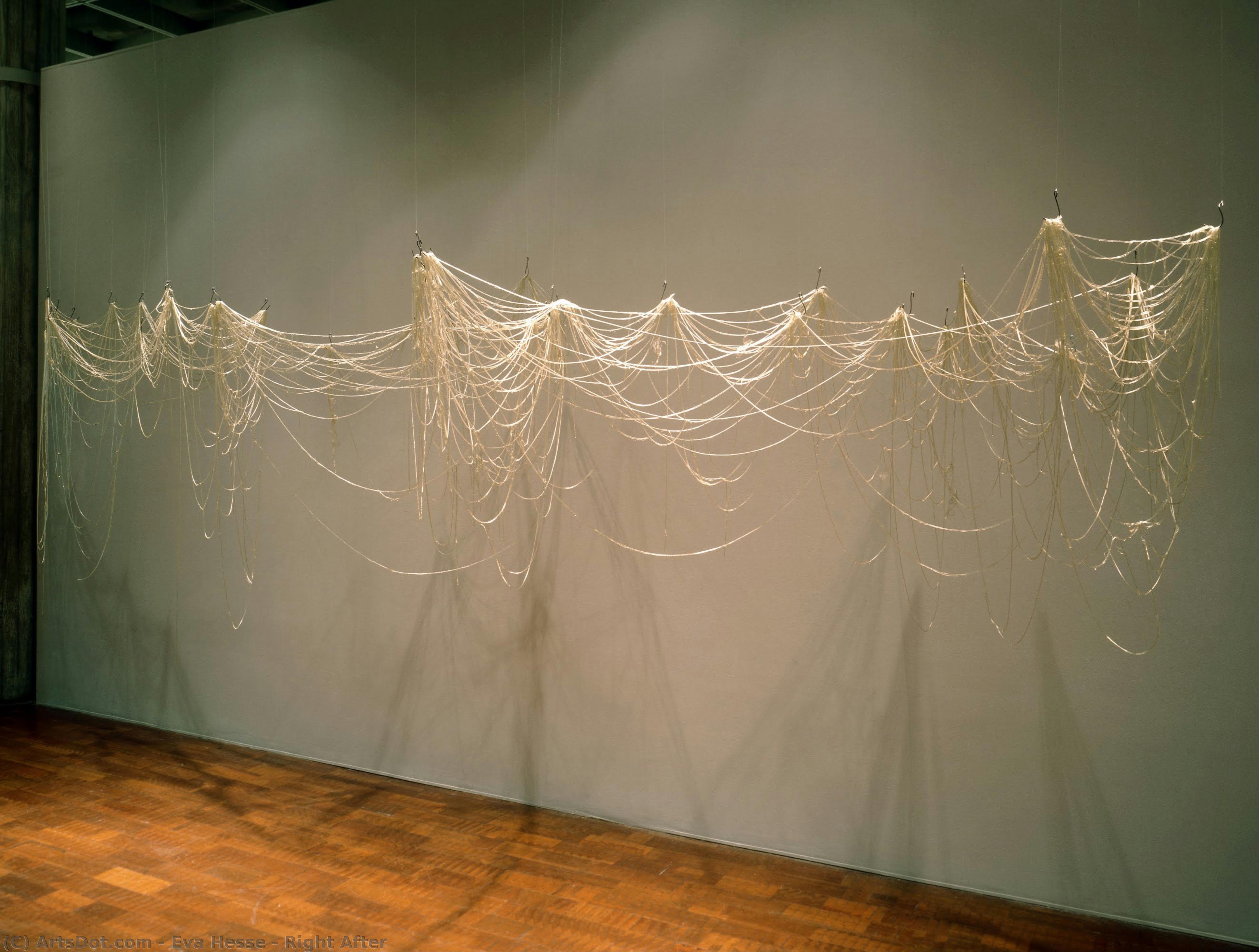
Of all the originals Eva Hesse left, the most famous is Repetition Nineteen III (1968), in the collection of the MOMA - Museum of Modern Art, New York City. Close behind it come Tomorrow's Apples (5 in White) (1965) and Right After (1969). Our catalog holds 13 works by Eva Hesse; the gallery has kept the 13 the world admires most, each shown with its date, its museum and its story.

1936 – 1970, Hamburg Post-minimalism Most works: Tate Modern

Eva Hesse's top 10 paintings: the gallery's choice

1
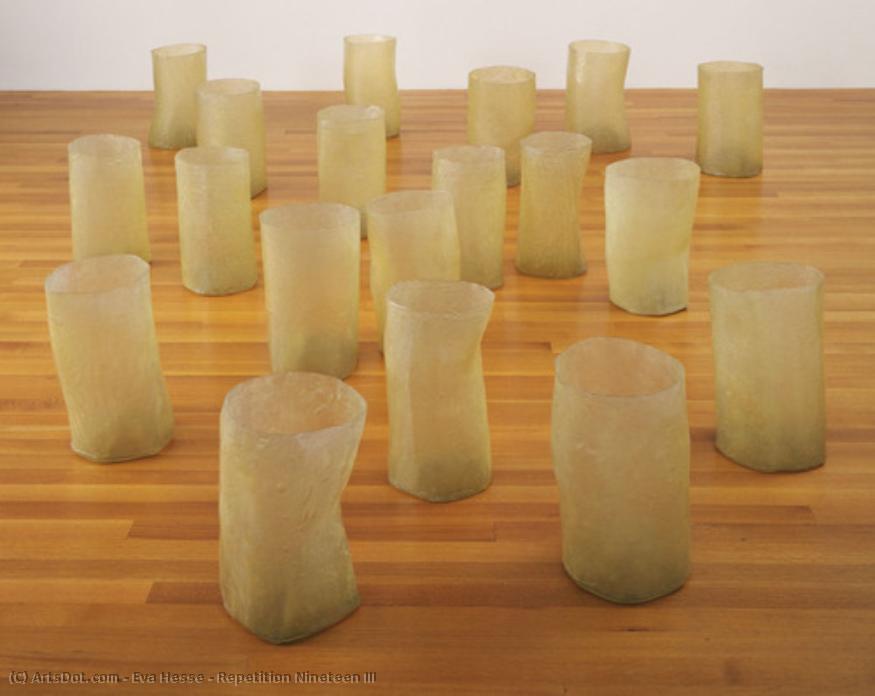
Repetition Nineteen III (1968) by Eva Hesse

Repetition Nineteen III

1968 · Resin · MOMA - Museum of Modern Art, New York City

To stand before Repetition Nineteen III is to encounter not merely an arrangement of objects, but a meditation on persistence and the beautiful imperfection of being. Eva Hesse’s work from this period pulses with a quiet, almost visceral energy. The sculpture presents a constellation of roughly hewn, organic forms resting upon a grounding plane of warm wood. These pieces, cast in a muted, pale green material—perhaps resin or fiberglass—reject the…

2
Tomorrow's Apples (5 in White) (1965) by Eva Hesse

Tomorrow's Apples (5 in White)

1965 · Sculpture · Tate Modern, London

In the quiet, evocative realm of Eva Hesse, materiality speaks where words fail. Her 1965 masterpiece, Tomorrow's Apples (5 in White), stands as a profound testament to the beauty found in imperfection and the delicate balance between structure and decay. At first glance, the viewer is met with a minimalist landscape: five vibrant, rope-like forms—hues of blue, red, pink, yellow, and green—casually draped across a stark, textured white expanse. These…

5
Contingent (1968) by Eva Hesse

Contingent

1968 · Mixed Media · National Gallery of Australia, Canberra

Eva Hesse’s 1968 work, “Contingent,” isn't merely a sculpture; it’s an embodied meditation on vulnerability and the precarious nature of existence. Born from the tumultuous backdrop of post-war Germany and Hesse’s deeply personal experiences – displacement, loss, and the lingering shadow of her mother’s suicide – the piece speaks to a profound sense of uncertainty and reliance. Hesse, a pivotal figure in the emergence of Post-Minimalism, deliberately eschewed the rigid…

7
Hang Up (1966) by Eva Hesse

Hang Up

1966 · Art Institute of Chicago, Chicago

Eva Hesse’s “Hang Up,” created in 1966, isn't merely a sculpture; it’s an arresting meditation on the very nature of art and its relationship to space. Captured with remarkable clarity in this photograph, the work immediately commands attention with its stark simplicity – a rectangular frame, painted a subtly grayish-blue, suspended from a thick, black cord that descends dramatically to the floor. This seemingly austere composition belies a profound depth…

The Eva Hesse selection continues, 11 to 13

Eva Hesse's famous paintings, period by period

The subjects that held Eva Hesse's eye

The four subjects that come back most often in these originals, each with its finest example.

The museums that keep Eva Hesse's originals

The 5 museums that hold the most of the paintings on this page.

Museum City Works by Eva Hesse Paintings from this list
Tate Modern, LondonTate Modern London 2 Tomorrow's Apples (5 in White), Untitled
Detroit Institute of Arts, DetroitDetroit Institute of Arts Detroit 2 Accession II, Accession II
MOMA - Museum of Modern Art, New York CityMOMA - Museum of Modern Art New York City 1 Repetition Nineteen III
National Gallery of Australia, CanberraNational Gallery of Australia Canberra 1 Contingent
Art Institute of Chicago, ChicagoArt Institute of Chicago Chicago 1 Hang Up

Eva Hesse year by year: the originals that define each

Barely a decade, 1960 to 1969, gave the world every dated Eva Hesse original in this selection: here it is, year by year.

Works per year

Pick a year to see its originals.

Collectors' questions about Eva Hesse's paintings

Which work is Eva Hesse most famous for?Reveal the answer

Repetition Nineteen III (1968), MOMA - Museum of Modern Art, New York City. Tomorrow's Apples (5 in White) (1965) and Right After (1969) come next.

What age was Eva Hesse when Repetition Nineteen III was made?Reveal the answer

32 years old: Repetition Nineteen III dates from 1968, and Eva Hesse was born in 1936.

What are the ten most famous Eva Hesse paintings?Reveal the answer

Repetition Nineteen III, Tomorrow's Apples (5 in White), Right After, No Title (Spectres series), Contingent, Untitled, Hang Up, Untitled, Expanded Expansion and Addendum. The ranking above gives each one's year and museum.

How many paintings did Eva Hesse leave?Reveal the answer

Our catalog holds 13 works by Eva Hesse, dated from 1960 to 1969.

In which museums do Eva Hesse's masterpieces hang?Reveal the answer

Mostly in Tate Modern (London), Detroit Institute of Arts (Detroit) and MOMA - Museum of Modern Art (New York City). The museum table above lists them all.

In which years did Eva Hesse paint the most famous works?Reveal the answer

In 1965: 3 of the 13 works on this page were made then, Tomorrow's Apples (5 in White) among them.

What are the first and the last famous originals of Eva Hesse?Reveal the answer

On this page, the earliest is No Title (Spectres series) (1960) and the latest Right After (1969).

Which subjects did Eva Hesse choose most often?Reveal the answer

Materiality (4), Fragility (4) and Organic forms (2), across the 13 works on this page.

Which technique did Eva Hesse use most?Reveal the answer

Sculpture, for 2 of the 13 works on this page.

To which art movement does Eva Hesse belong?Reveal the answer

Post-minimalism and Postminimalism, judging by the originals on this page.

Which Eva Hesse works hang at the Tate Modern?Reveal the answer

Tomorrow's Apples (5 in White) and Untitled: the Tate Modern, London holds 2 of the works on this page.

Eva Hesse: life and work

A Life Interrupted: The Poetic Vulnerability of Eva Hesse

Eva Hesse’s story is one of profound displacement and a relentless pursuit of artistic expression in the face of personal tragedy. Born in 1936 in Hamburg, Germany, her early life was irrevocably altered by the looming shadow of Nazism. Fleeing persecution, her family sought refuge in the United States in 1938, an act that would forever shape Hesse’s identity as a displaced person navigating two worlds. This sense of rootlessness, coupled with the emotional trauma of her parents' separation and her mother’s subsequent suicide when Hesse was just ten years old, became a subtle yet powerful undercurrent in her art—a haunting exploration of fragility, loss, and the ephemeral nature of existence. Her formal artistic training began at the Pratt Institute in Brooklyn, followed by studies at Cooper Union and Yale University School of Art and Architecture, where she encountered the rigorous material explorations championed by Josef Albers. However, it was not within the confines of traditional painting that Hesse found her true voice; rather, she embarked on a path of radical experimentation with materials and form, ultimately becoming a pivotal figure in the development of Postminimalism and Eccentric Abstraction.

From Painting to Materiality: A Sculptural Revolution

Initially drawn to abstract painting, Hesse soon felt constrained by its conventional limitations. She yearned for a more direct engagement with materiality—a way to imbue her work with the raw immediacy of feeling and experience. This desire led her to explore a diverse range of artistic influences, from the Surrealist explorations of form and subconscious imagery to the gestural energy of Abstract Expressionism and the biomorphic sculptures of artists like Hans Arp and Jean Dubuffet. A particularly formative moment came during an exhibition featuring the work of Louise Bourgeois; Bourgeois’s psychologically charged sculptures resonated deeply with Hesse, revealing the potential for art to confront personal trauma and explore the complexities of the human psyche. Moving to New York in the late 1950s placed her at the heart of a vibrant artistic community, further fueling her experimentation. By the mid-1960s, Hesse decisively turned towards sculpture, embracing unconventional materials like latex, fiberglass, resin, and rope—materials often associated with industrial production or everyday life. She wasn’t interested in their intended purpose; instead, she manipulated them in unexpected ways, brushing latex like paint to create layered surfaces, allowing materials to sag, droop, and defy conventional notions of form and stability.

Fragility and Repetition: Defining a Unique Aesthetic

Hesse’s sculptures are characterized by a distinctive aesthetic—one that embraces imperfection, vulnerability, and organic irregularity. Often featuring repetitive forms arranged in grid structures or clustered arrangements, her work evokes a sense of both order and chaos, control and surrender. “Hang Up” (1966), for example, is a striking early exploration of these themes—a seemingly simple arrangement of painted circles suspended from cords that Hesse herself described as expressing “absurdity or extreme feeling.” The Repetition Nineteen III series (1968) further exemplifies her fascination with repetition and material properties, showcasing translucent fiberglass buckets arranged in a grid, each containing subtly different forms. Works like “Schema and Sequel” (1967-68), early explorations with latex, demonstrate Hesse’s innovative use of the material, pushing its boundaries and revealing its inherent qualities. “Accession II” (1968) features translucent fiberglass boxes containing phallic forms, delving into themes of the body and sexuality with a frankness that was groundbreaking for the time. “Contingent” (1969), a large-scale installation consisting of five hanging latex-covered mounds, showcases her mastery of space and form, creating an immersive environment that invites contemplation and emotional response. Even in pieces like “Tomorrow’s Apples (5 in White)” (1966), Hesse's use of repetition and organic forms hints at a deeper exploration of life cycles and the passage of time.

A Lasting Legacy: Challenging Conventions and Inspiring Generations

Despite her tragically short career—she succumbed to cancer in 1970 at the age of thirty-four—Eva Hesse’s impact on the art world has been profound and enduring. She is now widely recognized as a pivotal figure in Postminimalism and Eccentric Abstraction, challenging the rigid formalism of Minimalism by introducing elements of subjectivity, emotion, and organic form. Her willingness to embrace imperfection and explore deeply personal themes resonated with feminist art critics and artists, who saw in her work a powerful expression of female experience and a rejection of patriarchal norms. Hesse’s exploration of the body, sexuality, and vulnerability continues to inspire contemporary artists today. She expanded the possibilities of sculpture by challenging traditional materials and techniques, paving the way for new forms of artistic expression. Her legacy lies not only in the beauty and originality of her work but also in her courage to confront difficult emotions and explore the complexities of human existence with honesty and vulnerability. Hesse’s art remains a testament to the power of creativity to transcend personal tragedy and offer profound insights into the human condition.