In short
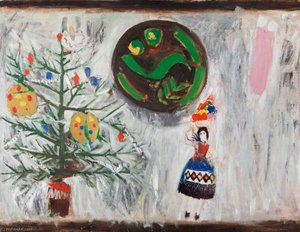
To the gallery's eye, David Michie's most famous painting is Life Painting (1952), whose original hangs in the Edinburgh College of Art, Edinburgh. Star of the Veldt and Waiting, Bahrain complete the trio every eye recognises. Of the 18 works by David Michie in our catalog, the gallery presents the 18 most famous below, each original with its year, its museum and what makes it unique.
The gallery's top 10 David Michie paintings
David Michie paintings, ranked 11 to 18
The subjects that held David Michie's eye
The four subjects that come back most often in these originals, each with its finest example.
Coastal scene 2 works
The museums that keep David Michie's originals
The 8 museums that hold the most of the paintings on this page.
| Museum | City | Works by David Michie | Paintings from this list |
|---|---|---|---|
| Bristol | 2 | Picotee Poppies and Pink Sweet Peas, Mantis, Snails and Flying Beetle | |
| Edinburgh | 1 | Life Painting | |
| Edinburgh | 1 | Star of the Veldt | |
| Edinburgh | 1 | Waiting, Bahrain | |
| Leicester | 1 | The Swimming Pool | |
| Wakefield | 1 | Pigeons | |
| London | 1 | Sitting Pigeon | |
| Inverness | 1 | Shopfront with Wheelbarrow |
David Michie, the signature paintings of each year
55 years of David Michie's art, 1952 to 2006: the gallery follows them year by year, through the most famous originals of each.
Works per year
Pick a year to see its originals.
David Michie's paintings: the gallery answers
Which David Michie painting is the most famous of all?Reveal the answer
Life Painting (1952), Edinburgh College of Art, Edinburgh. Star of the Veldt and Waiting, Bahrain come next.
How old was David Michie on completing Life Painting?Reveal the answer
24 years old: Life Painting dates from 1952, and David Michie was born in 1928.
Which are David Michie's top 10 paintings?Reveal the answer
Life Painting, Star of the Veldt, Waiting, Bahrain, Swimming Pool, Dark Garden with a Yellow Border, Lovers from Metepec, The Swimming Pool, Midnight, Matacuna, Anniversary and Painted Lady, Pigeons and Sitting Pigeon. The ranking above gives each one's year and museum.
How many works did David Michie create?Reveal the answer
Our catalog holds 18 works by David Michie, dated from 1952 to 2006.
Where do David Michie's most famous originals hang?Reveal the answer
Mostly in Royal West of England Academy (Bristol), Edinburgh College of Art (Edinburgh) and Heriot-watt University (Edinburgh). The museum table above lists them all.
Which are David Michie's earliest and latest famous works?Reveal the answer
On this page, the earliest is Life Painting (1952) and the latest Midnight, Matacuna, Anniversary and Painted Lady (2006).
Which David Michie originals does the Royal West of England Academy hold?Reveal the answer
Picotee Poppies and Pink Sweet Peas and Mantis, Snails and Flying Beetle: the Royal West of England Academy, Bristol holds 2 of the works on this page.
David Michie: the artist
A Life Immersed in Colour and Form: The Artistic Journey of David Alan Redpath Michie
David Alan Redpath Michie is a contemporary artist whose work resonates with a deep understanding of colour theory, abstract expressionism, and the emotive power of landscape. While biographical details remain somewhat private, his artistic output speaks volumes about a life dedicated to exploring the interplay between inner experience and the external world. Born in , Michie’s journey as an artist has been one of continuous evolution, marked by a commitment to pushing the boundaries of abstract painting while retaining a profound connection to nature's beauty. He continues to live and work today, his canvases serving as vibrant testaments to a lifelong passion for art.Early Influences and Artistic Development
Though specific details regarding Michie’s formal training are limited, the influence of 20th-century abstract masters is readily apparent in his oeuvre. The bold colour palettes and dynamic compositions of artists like Mark Rothko and Wassily Kandinsky clearly inform his early work. However, Michie doesn't simply replicate these styles; he synthesizes them with a uniquely personal vision. His paintings are not merely exercises in abstraction but rather explorations of feeling—attempts to capture the essence of a place or an emotion through colour and form. Early experimentation involved various media, but Michie quickly gravitated towards acrylics on canvas, finding in their versatility the perfect means to express his increasingly complex ideas. A key formative influence appears to be the Scottish landscape, particularly the dramatic skies and rugged terrain of his homeland. This connection to nature is not represented literally in his work; instead, it manifests as a subtle undercurrent—a sense of vastness, depth, and atmospheric intensity.The Evolution of a Signature Style
Michie’s artistic style has undergone a fascinating transformation over the years. His earlier paintings tended towards more structured compositions, often featuring geometric shapes and clearly defined colour fields. As his career progressed, however, he embraced a looser, more gestural approach. This shift reflects a growing interest in spontaneity and intuition. His canvases became increasingly layered, with colours blending and overlapping to create rich, complex surfaces. The application of paint itself—the brushstrokes, the drips, the textures—became an integral part of the artwork’s meaning. He developed a distinctive technique involving the layering of translucent acrylic washes, creating luminous effects that evoke light and atmosphere. This method allows him to build depth and complexity within his abstract forms, drawing the viewer into a meditative space. The artist's work is characterized by a harmonious balance between control and chance, resulting in paintings that feel both deliberate and organic.Themes and Symbolism
While Michie’s work is primarily abstract, it is not devoid of meaning. Recurring themes include the power of nature, the search for inner peace, and the exploration of human emotion.- His paintings often evoke a sense of longing or nostalgia—a yearning for something beyond the tangible world.
- Colour plays a crucial role in conveying these emotions; blues and greens suggest tranquility and contemplation, while reds and oranges represent passion and energy.
- The artist frequently employs layering techniques to symbolize the complexities of human experience—the multiple facets of personality, the interplay between memory and reality.