Portrait of Aleksandr Deyneka

The 100 Most Famous Aleksandr Deyneka Paintings, a Gallery Selection

Updated November 2026 · ranked by our popularity score (searches, visits and orders for each work) · 384 works by Aleksandr Deyneka in our catalogue

In short

Of all the originals Aleksandr Deyneka left, the most famous is Mother (1932). Close behind it come Maiden (1954) and Crimean Pioneers (1934). Our catalog holds 384 works by Aleksandr Deyneka; the gallery has kept the 100 the world admires most, each shown with its date, its museum and its story.

1899 – 1969, Kursk Socialist realism

Aleksandr Deyneka's top 10 paintings: the gallery's choice

1
Mother (1932) by Aleksandr Deyneka

Mother

1932 · Oil On Canvas

A woman holds a child against her chest. The baby is a small weight, a soft presence pressed into the center of the frame. She is the anchor of the composition. Her face carries the stillness of a long afternoon. Around them, the world continues in the periphery. Two figures linger in the background, shadows of a larger gathering, yet they remain distant. The focus remains on the tactile connection…

2
Maiden (1954) by Aleksandr Deyneka

Maiden

1954 · Oil On Canvas

Aleksandr Deyneka’s Maiden is more than just a painting; it is a vibrant celebration captured on canvas, a moment of pure, unbridled joy set against the stark beauty of a Russian winter. The eye is immediately drawn to the central figure—a maiden whose spirit seems to radiate warmth despite the surrounding snowscape. Her striking red dress acts as an immediate focal point, a bold splash of color that defies the…

3
Crimean Pioneers (1934) by Aleksandr Deyneka

Crimean Pioneers

1934 · Oil On Canvas

To stand before Aleksandr Deyneka's Crimean Pioneers is to step directly into the vibrant, idealized heart of the early Soviet era. This painting is far more than a mere depiction of two boys on a balcony; it is a carefully constructed tableau vivant, saturated with the potent spirit of Socialist Realism. The scene captures a moment of youthful contemplation against the vast expanse of a brilliant blue sky. Notice the…

4
After the battle (1944) by Aleksandr Deyneka

After the battle

1944 · Oil

We are looking at After the battle, a work from 1944 by Aleksandr Deyneka. This piece emerged during a period of profound transformation, reflecting the specific aesthetic and ideological currents of its time. The artist, Aleksandr Deyneka, was a central figure in the development of the socialist realism style, a movement that sought to capture the spirit and the social realities of the era through a structured and monumental lens.

5
Operating margin (1929) by Aleksandr Deyneka

Operating margin

1929 · Lithograph

The artwork presents a monochromatic scene rendered in shades of gray, black, and white. A central female figure stands vertically, positioned against the backdrop of a large factory building. Her posture is upright, facing the viewer. Below her, several infants are scattered across the foreground. To the left, a man sits in a partially shadowed area. The factory structure is composed of geometric shapes that contrast with the organic forms…

6
Morning (1933) by Aleksandr Deyneka

Morning

1933 · Charcoal

The artwork presents a monochrome study of the human form, rendered in shades of gray that range from near-white highlights to deep blacks. A female figure occupies the center of the composition, kneeling and facing slightly to the left. Her arms are raised, creating a sense of stretching or physical support. The figure's musculature is defined by strong, directional lighting that enters from the left side of the frame, casting…

7
Who will defeat whom (1932) by Aleksandr Deyneka

Who will defeat whom

1932 · Oil

This large-scale mural, titled Who will defeat whom, was executed by Aleksandr Deyneka in 1932. It captures a moment of significant transition, presenting a scene that moves with a sense of forward momentum. The work is a product of a period defined by rapid industrialization and shifting social structures, reflecting the energy of a nation in flux.

8
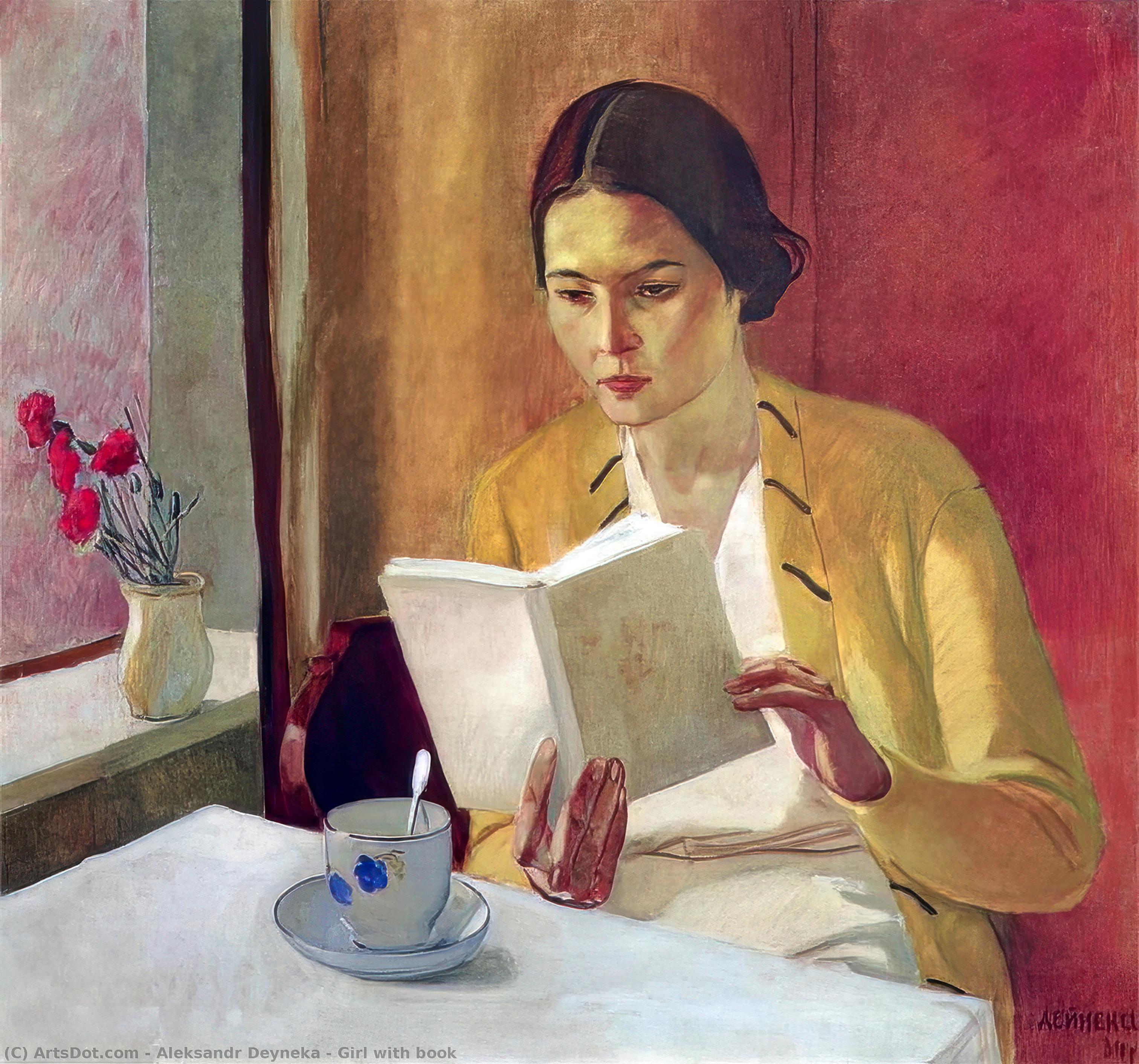
Girl with book (1934) by Aleksandr Deyneka

Girl with book

1934 · Oil On Canvas

In the vast and often turbulent tapestry of twentieth-century art, there exist rare moments of profound stillness that capture the very essence of human contemplation. Aleksandr Deyneka’s 1934 masterpiece, Girl with Book, is precisely such a moment. This evocative portrait invites the viewer into a private sanctuary, far removed from the industrial clamor and political shifts of the Soviet era. The scene depicts a young woman seated at a dining…

9
Day off (1949) by Aleksandr Deyneka

Day off

1949 · Oil On Canvas

In this 1949 work, we find ourselves observing a private, unhurried moment between two women. They move through a garden, their presence marked by a sense of ease and companionship. Dressed in bathing suits, they appear to have just come from the water, perhaps a nearby beach or a local swimming area, seeking the shade of the greenery. The atmosphere is defined by a certain stillness, the kind found in…

10
Defence of Sevastopol (1942) by Aleksandr Deyneka

Defence of Sevastopol

1942 · Oil On Canvas

The painting titled Defence of Sevastopol was executed by the artist Aleksandr Deyneka. This work was created in 1942. It is an oil on canvas that depicts the Battle of Sevastopol during World War II. The scene focuses on the military engagement occurring on the Eastern Front.

The Aleksandr Deyneka selection continues, 11 to 100

11In the south (1966) by Aleksandr DeynekaIn the south1966 12New York (1935) by Aleksandr DeynekaNew York1935 13Seaside (1957) by Aleksandr DeynekaSeaside1957 14Running girl (1941) by Aleksandr DeynekaRunning girl1941 15Noon (1932) by Aleksandr DeynekaNoon1932 16The road to Mount Vernon (1935) by Aleksandr DeynekaThe road to Mount Vernon1935 17Locomotive. In the Donbas (1924) by Aleksandr DeynekaLocomotive. In the Donbas1924 18On building new plants (1926) by Aleksandr DeynekaOn building new plants1926 19Noon (Dream) (1932) by Aleksandr DeynekaNoon (Dream)1932 20American landscape (1935) by Aleksandr DeynekaAmerican landscape1935 21Philadelphia. Old Square (1935) by Aleksandr DeynekaPhiladelphia. Old Square1935 22Go to war (1944) by Aleksandr DeynekaGo to war1944 23Expanse (1944) by Aleksandr DeynekaExpanse1944 24Berlin. Tiergarten (1945) by Aleksandr DeynekaBerlin. Tiergarten1945 25Moscow. Landscape (1952) by Aleksandr DeynekaMoscow. Landscape1952 26Friends (1962) by Aleksandr DeynekaFriends1962 27'Picture for children's book ''The Electrician''' (1930) by Aleksandr Deyneka'Picture for children's book ''The Electrician'''1930 28Red-winged giant (1937) by Aleksandr DeynekaRed-winged giant1937 29Boys (1935) by Aleksandr DeynekaBoys1935 30Pioneer (1934) by Aleksandr DeynekaPioneer1934 31Conquerors of Space (1961) by Aleksandr DeynekaConquerors of Space1961 32Good morning (1960) by Aleksandr DeynekaGood morning1960 33Boy (1914) by Aleksandr DeynekaBoy1914 34Portrait of a student (1916) by Aleksandr DeynekaPortrait of a student1916 35Portrait of an old man (1916) by Aleksandr DeynekaPortrait of an old man1916 36Theater (1921) by Aleksandr DeynekaTheater1921 37Female figure (1921) by Aleksandr DeynekaFemale figure1921 38Portrait of a Woman (1922) by Aleksandr DeynekaPortrait of a Woman1922 39Female figure (1922) by Aleksandr DeynekaFemale figure1922 40Pop dance (1922) by Aleksandr DeynekaPop dance1922 41Portrait of a Woman (1921) by Aleksandr DeynekaPortrait of a Woman1921 42Cabaret (1921) by Aleksandr DeynekaCabaret1921 43Portrait of Mother (1920) by Aleksandr DeynekaPortrait of Mother1920 44End (1926) by Aleksandr DeynekaEnd1926 45We took. Raise production (1924) by Aleksandr DeynekaWe took. Raise production1924 46Decided unanimously (1925) by Aleksandr DeynekaDecided unanimously1925 47In the workplace (1925) by Aleksandr DeynekaIn the workplace1925 48Sportsground. At the finish line (1927) by Aleksandr DeynekaSportsground. At the finish line1927 49In the Donbas. Picture from magazine ''At the bench'' (1924) by Aleksandr DeynekaIn the Donbas. Picture from magazine ''At the bench''1924 50Skiers. Cover for magazine Krasnaya Niva (1927) by Aleksandr DeynekaSkiers. Cover for magazine Krasnaya Niva1927 51The girl in the mirror (1927) by Aleksandr DeynekaThe girl in the mirror1927 52The old man and a boy. Figure for ''At the bench'' (1924) by Aleksandr DeynekaThe old man and a boy. Figure for ''At the bench''1924 53With change (1927) by Aleksandr DeynekaWith change1927 54Portrait of a Man (1924) by Aleksandr DeynekaPortrait of a Man1924 55Football. Picture for ''Red cornfield'' (1927) by Aleksandr DeynekaFootball. Picture for ''Red cornfield''1927 56Donbass (1924) by Aleksandr DeynekaDonbass1924 57Imperishable (1924) by Aleksandr DeynekaImperishable1924 58Portrait of a Woman (1923) by Aleksandr DeynekaPortrait of a Woman1923 59Fist (1925) by Aleksandr DeynekaFist1925 60NEP-typen, Illustration for ''At the bench'' (1926) by Aleksandr DeynekaNEP-typen, Illustration for ''At the bench''1926 61The warm water (1924) by Aleksandr DeynekaThe warm water1924 62The city (1928) by Aleksandr DeynekaThe city1928 63Portrait of a Girl (1923) by Aleksandr DeynekaPortrait of a Girl1923 64Tennis (1923) by Aleksandr DeynekaTennis1923 65Football (1923) by Aleksandr DeynekaFootball1923 66Picture for magazine (1925) by Aleksandr DeynekaPicture for magazine1925 67A worker at the loom. Picture for ''At the bench'' (1925) by Aleksandr DeynekaA worker at the loom. Picture for ''At the bench''1925 68Female figures. Etching (1923) by Aleksandr DeynekaFemale figures. Etching1923 69Longing for a graceful life. Picture for ''Searchlight'' (1927) by Aleksandr DeynekaLonging for a graceful life. Picture for ''Searchlight''1927 70Tennis (1928) by Aleksandr DeynekaTennis1928 71The Model in front of a mirror (1928) by Aleksandr DeynekaThe Model in front of a mirror1928 72Golden youth. Picture for magazine ''Searchlight'' (1928) by Aleksandr DeynekaGolden youth. Picture for magazine ''Searchlight''1928 73Skates (1927) by Aleksandr DeynekaSkates1927 74In the theater box (1925) by Aleksandr DeynekaIn the theater box1925 75Father complained himself (1925) by Aleksandr DeynekaFather complained himself1925 76Run. Magazine 'Spotlight' (1928) by Aleksandr DeynekaRun. Magazine 'Spotlight'1928 77Worker and peasant (1927) by Aleksandr DeynekaWorker and peasant1927 78Before going into mine (1925) by Aleksandr DeynekaBefore going into mine1925 79African hunters (1927) by Aleksandr DeynekaAfrican hunters1927 80The Model (1932) by Aleksandr DeynekaThe Model1932 81At work. Magazine Cover ''Red Panorama'' (1930) by Aleksandr DeynekaAt work. Magazine Cover ''Red Panorama''1930 82Advertising magazine cover ''Give.'' (1929) by Aleksandr DeynekaAdvertising magazine cover ''Give.''1929 83Civil aviation. Panels for the factory kitchen (1932) by Aleksandr DeynekaCivil aviation. Panels for the factory kitchen1932 84City (1929) by Aleksandr DeynekaCity1929 85Why Janie ran away and returned (1929) by Aleksandr DeynekaWhy Janie ran away and returned1929 86Order restored (1929) by Aleksandr DeynekaOrder restored1929 87Tennis. Paper (1931) by Aleksandr DeynekaTennis. Paper1931 88Cross (1932) by Aleksandr DeynekaCross1932 89Picture for children book ''In the cloud'' (1930) by Aleksandr DeynekaPicture for children book ''In the cloud''1930 90Country landscape with cows (1933) by Aleksandr DeynekaCountry landscape with cows1933 91Farmer (1930) by Aleksandr DeynekaFarmer1930 92Milkmaids (1929) by Aleksandr DeynekaMilkmaids1929 93Vacationers children (1933) by Aleksandr DeynekaVacationers children1933 94Stadium (1935) by Aleksandr DeynekaStadium1935 95When finally the war ended. Illustration to the book (1934) by Aleksandr DeynekaWhen finally the war ended. Illustration to the book1934 96Berlin. On the stairs (1945) by Aleksandr DeynekaBerlin. On the stairs1945 97Sketch Hall building Narkomzem (1934) by Aleksandr DeynekaSketch Hall building Narkomzem1934 98Negro burlesque (1935) by Aleksandr DeynekaNegro burlesque1935 99Seaplanes (1934) by Aleksandr DeynekaSeaplanes1934 100Pop dance (1935) by Aleksandr DeynekaPop dance1935

Aleksandr Deyneka's famous paintings, period by period

The subjects that held Aleksandr Deyneka's eye

The four subjects that come back most often in these originals, each with its finest example.

Aleksandr Deyneka decade by decade: the original that defines each

Works per decade

Pick a decade to see the original that defines it.

Collectors' questions about Aleksandr Deyneka's paintings

Which work is Aleksandr Deyneka most famous for?Reveal the answer

Mother (1932). Maiden (1954) and Crimean Pioneers (1934) come next.

What age was Aleksandr Deyneka when Mother was made?Reveal the answer

33 years old: Mother dates from 1932, and Aleksandr Deyneka was born in 1899.

What are the ten most famous Aleksandr Deyneka paintings?Reveal the answer

Mother, Maiden, Crimean Pioneers, After the battle, Operating margin, Morning, Who will defeat whom, Girl with book, Day off and Defence of Sevastopol. The ranking above gives each one's year and museum.

How many paintings did Aleksandr Deyneka leave?Reveal the answer

Our catalog holds 384 works by Aleksandr Deyneka, dated from 1914 to 1966.

In which years did Aleksandr Deyneka paint the most famous works?Reveal the answer

In 1920s: 52 of the 100 works on this page were made then, Operating margin among them.

What are the first and the last famous originals of Aleksandr Deyneka?Reveal the answer

On this page, the earliest is Boy (1914) and the latest In the south (1966).

Which subjects did Aleksandr Deyneka choose most often?Reveal the answer

People (9), Women (8) and Portraits (7), across the 100 works on this page.

Which technique did Aleksandr Deyneka use most?Reveal the answer

Oil On Canvas, for 18 of the 100 works on this page.

To which art movement does Aleksandr Deyneka belong?Reveal the answer

Socialist realism, judging by the originals on this page.

Aleksandr Deyneka: life and work

A Life Forged in Revolution: The Artistic Journey of Aleksandr Deyneka

Aleksandr Aleksandrovich Deyneka, born in 1899 in the provincial Russian city of Kursk, was an artist inextricably linked to the tumultuous currents of the twentieth century. His life and work mirrored the dramatic shifts of his nation – from the waning days of Tsarist Russia through the fervor of revolution, the industrialization of the Soviet era, and the shadow of war. Deyneka wasn’t merely a recorder of these events; he was an active participant, shaping and being shaped by the ideological forces that swept across his homeland. His early life offered little hint of the artistic prominence to come. He initially pursued studies at a railway college, simultaneously attending art workshops – a practical grounding that would later inform the dynamic energy and structural clarity present in his compositions. This period was cut short by the upheaval of 1917, propelling him towards Moscow and enrollment at Vkhutemas, the Higher State Artistic and Technical Workshops, a crucible of avant-garde thought and experimentation. It was here, under the tutelage of Vladimir Favorsky, that Deyneka honed his skills in graphic arts and printmaking, absorbing the principles of constructivism and developing a keen understanding of form and space.

The Rise of Socialist Realism and Defining an Era

Deyneka’s artistic development unfolded alongside the evolving aesthetic demands of the Soviet state. Initially aligned with groups like OST (Society of Easel Artists), he embraced modernist principles, exploring dynamic compositions and a bold visual language. However, as Stalin consolidated power and Socialist Realism became the officially sanctioned style, Deyneka adapted – not by abandoning his artistic vision entirely, but by channeling it into forms acceptable to the regime. This wasn’t simply capitulation; rather, it was a strategic negotiation that allowed him to continue creating impactful work while navigating a politically fraught landscape. His paintings of the 1930s, such as Collective Farmer on a Bicycle (1935), became iconic representations of Soviet ideals – celebrating labor, athleticism, and the promise of a new socialist society. The painting is not merely a depiction of rural life; it’s an embodiment of forward momentum, a visual manifesto of progress and optimism. This period also saw his involvement with the *Windows of ROSTA* project, creating powerful propaganda posters that disseminated revolutionary messages throughout the country. He wasn't just painting pictures; he was actively constructing a new cultural narrative.

Beyond Propaganda: Monumentality and Mosaic Mastery

While often categorized as a Socialist Realist painter, to limit Deyneka to this label is to overlook the breadth of his artistic talent. His ambition extended beyond easel paintings into monumental works and public art. He created large-scale canvases depicting historical events – The Defense of Petrograd (1928) being a prime example – imbued with dramatic intensity and a sense of epic scale. These weren’t simply illustrations of battles; they were attempts to capture the spirit of revolutionary struggle, transforming historical moments into mythic narratives. Perhaps less known but equally significant is his work in mosaics. Deyneka's designs for the Mayakovskaya metro station in Moscow are breathtaking examples of public art seamlessly integrated with architecture. These vibrant, dynamic compositions – depicting scenes of Soviet life and aspirations – transformed a utilitarian space into a palace of the people, demonstrating his versatility and mastery of different artistic mediums. These mosaics stand as enduring testaments to his ability to elevate everyday themes into grand visual statements.

Legacy and Enduring Influence

Aleksandr Deyneka passed away in 1969, leaving behind a vast body of work that continues to resonate today. His paintings, mosaics, and graphic designs offer a compelling window into the Soviet experience – its aspirations, contradictions, and artistic achievements. While his association with Socialist Realism has sometimes led to critical reassessment, his technical skill, compositional dynamism, and ability to capture the energy of his time remain undeniable. He is categorized as a “1A - world famous artist” in the United Artists Rating, a testament to his enduring international recognition. Exhibitions dedicated to his work, such as those held at the Gallery for Russian Arts and Design in London, continue to introduce new audiences to his art. Deyneka’s influence can be seen in subsequent generations of artists who sought to engage with social and political themes through powerful visual imagery. His ability to blend modernist techniques with socially conscious subject matter makes him a uniquely important figure in the history of twentieth-century art, a golden boy whose work continues to provoke thought and inspire awe.

A Complex Artistic Identity

Ultimately, Aleksandr Deyneka’s artistic identity is one of compelling complexity. He was an artist who navigated a shifting political landscape with both pragmatism and passion, adapting his style while maintaining a distinctive visual voice. His work wasn't simply propaganda; it was a reflection of the hopes and anxieties of a nation undergoing radical transformation.
  • He embraced modernity but also sought to connect with the traditions of Russian art.
  • He celebrated collective ideals yet retained a sense of individual artistic expression.
  • His work continues to spark debate about the relationship between art, politics, and ideology.
Deyneka’s legacy lies not only in his stunning visual creations but also in his ability to embody the contradictions and complexities of an era. He remains a vital figure for understanding both the artistic achievements and the ideological constraints of Soviet Russia, a testament to the enduring power of art to reflect – and shape – the world around us.