A Pioneer of American Modernism: The Life and Art of Abraham Walkowitz
Born in the remote Siberian city of Tyumen, Russia, in 1878, Abraham Walkowitz embarked on a journey that would place him at the very forefront of early American
modern art. His childhood was marked by displacement; he emigrated with his mother to the United States, an experience that perhaps instilled within him a lifelong sensitivity to movement and change. This formative period shaped not only his personal identity but also his artistic vision. Walkowitz received formal training at the
National Academy of Design in
New York City, honing his skills in traditional techniques before venturing across the Atlantic to study at the Académie Julian in Paris under
Jean-Paul Laurens. Even as a young boy, he demonstrated an innate artistic inclination, recalling spontaneous drawing sessions with
chalk on floors—a testament to an uncontainable creative impulse.
The Crucible of Modernity: Influences and Artistic Development
Walkowitz’s artistic trajectory was profoundly influenced by his association with
Alfred Stieglitz's 291 Gallery, a legendary hub for American modernists. This wasn’t merely a professional connection; it was an immersion into a vibrant community of artists—
Arthur Dove,
Marsden Hartley, and
John Marin among them—who were challenging conventional artistic norms. The gallery became his crucible, fostering experimentation and pushing the boundaries of representation. A pivotal moment in Walkowitz's development occurred during the 1907 memorial exhibition dedicated to
Paul Cézanne in Paris. This encounter proved transformative, profoundly influencing his approach to abstraction and solidifying his commitment to exploring form and structure beyond mere imitation of reality. He absorbed the spirit of European
modernism—the emphasis on subjective experience, flattened perspectives, and bold simplification—but crucially, he resisted becoming a mere imitator. Walkowitz sought to synthesize these influences with his own unique sensibility, forging an authentically American voice within the burgeoning modernist movement. This period also saw the beginning of his extraordinary series of drawings depicting
Isadora Duncan, the revolutionary dancer whose dynamic movements captivated him. Over five thousand such works attest to his fascination with capturing motion and the
human form in its most expressive state—a reflection of both modern dance’s radical energy and the sculptural qualities he perceived within it.
Capturing Essence: Key Works and Artistic Style
Walkowitz's artistic output was remarkably diverse, encompassing cityscapes, still lifes, and, most famously, his extensive portraits of
Isadora Duncan. The
Isadora Duncan Drawings stand as a monumental achievement—not simply representations of the dancer’s physical form but explorations of her very essence, her spirit of liberation and artistic innovation. These works are characterized by their fluid lines, dynamic compositions, and evocative use of
charcoal and
watercolor. His
New York Skyline (1913), a hazy
watercolor depiction of the city, showcases his mastery of
linear perspective and
atmospheric depth, while hinting at the energy and dynamism of
urban life. Later works, such as
Metropolis, No. 1 (1919), reveal a darker, more Expressionistic sensibility, reflecting themes of destruction and loss in its dramatic
charcoal rendering. Throughout his career, Walkowitz’s style evolved from representational depictions to increasingly
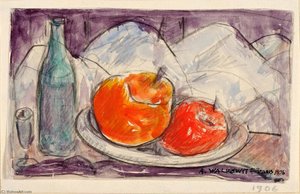
abstract forms, yet he always retained a distinctive American character—a blend of European influences filtered through his own unique vision. His still lifes demonstrate a similar exploration of form and color, pushing the boundaries of traditional
genre painting towards modernist abstraction.
A Lasting Legacy: Historical Significance
Abraham Walkowitz played an indispensable role in shaping the landscape of early
American Modernism. He served as a crucial bridge between the avant-garde ideas emanating from Europe and the emerging artistic identity taking root in America. His involvement with
Alfred Stieglitz’s 291 Gallery was instrumental in establishing a platform for
modern art, introducing European artists to an American audience, and fostering a community of like-minded innovators. The watershed moment of the Armory Show in 1913—where Walkowitz exhibited alongside other groundbreaking artists—marked a turning point in the acceptance of
modern art within the United States. Beyond his contributions to the broader modernist movement, Walkowitz’s extensive drawings of
Isadora Duncan provide invaluable insights into both her artistic practice and his own evolving style. Critics like
Oscar Bluemner recognized his unique ability to absorb modernist influences without sacrificing originality, highlighting his contribution to a distinctly American form of
modern art—one that was bold, innovative, and deeply personal. Walkowitz’s legacy continues to inspire artists today, reminding us of the power of artistic vision and the importance of forging one's own path in the pursuit of creative expression.