A Legacy of Venetian Light and Devotion
In the vibrant, shimmering atmosphere of the Quattrocento, Bartolomeo Vivarini emerged as a pivotal figure in the evolution of Venetian painting. Born in the storied glassmaking hub of Murano, Italy, he was part of an influential dynasty of artists that helped shape the visual identity of the Republic of Venice. As a member of the Vivarini family, his life and work were deeply intertwined with the artistic pulse of his homeland, bridging the transition from the ornate, gilded traditions of the late Gothic period to the burgeoning humanism of the early Renaissance.
The artistry of Vivarini is characterized by a profound sense of spiritual depth and technical precision. While he was a master of tempera, often utilizing gold leaf to imbue his compositions with a celestial luxury, he was also an innovator in the use of new mediums. It is noted that he learned the art of oil painting from Antonello da Messina, and he is credited with producing what is believed to be the first oil painting in Venice around 1473. This mastery allowed him to manipulate light and texture in ways that brought a new level of intimacy and serenity to his religious subjects.
Mastery of Form and Symbolism
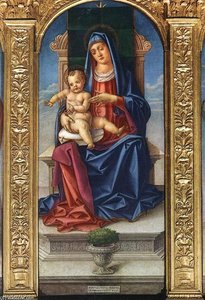
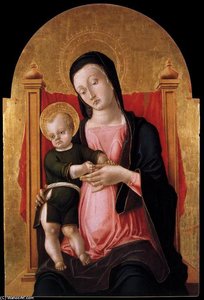
Vivarini’s work often presents a striking balance between hard, defined outlines and a rich, emotive color palette. His figures frequently possess a dignified and devout expression, capturing the solemnity required for the altarpieces that adorned Venetian basilicas. This ability to convey human emotion through structured forms made him a sought-after painter for significant religious commissions. A notable example of his skill is found in his Madonna and Child, where he uses light entering through windows and deep red drapery to create a sense of sacred space.
Beyond the figures themselves, Vivarini’s paintings are often layered with symbolic meaning:
- The use of gold: His frequent application of gold leaf serves not only as decoration but as a medium to represent divine light.
- Natural motifs: In a charming nod to his name—as vivarino translates to goldfinch in Italian—he occasionally included the small bird as a subtle signature within his works.
- Architectural depth: His compositions, such as the Conversano Polyptych, demonstrate a sophisticated understanding of perspective and the integration of sacred figures into complex, multi-paneled structures.
Historical Significance and Artistic Influence
The historical importance of Bartolomeo Vivarini lies in his role as a bridge between eras. He stood at the crossroads of the Byzantine-influenced traditions of his predecessors and the revolutionary Renaissance styles brought by artists like Fra Angelico and Giovanni Bellini. By blending these diverse influences, he helped establish a unique Venetian visual language—one that prioritized luminous color and emotional resonance.
His influence extended through his family lineage, notably impacting the work of his nephew, Alvise Vivarini, who would become a leading artist in Venice before the rise of Bellini. Through his meticulous detail and his pioneering adoption of oil techniques, Bartolomeo Vivarini left an indelible mark on the history of Italian art, ensuring that the spiritual and aesthetic grandeur of Murano and Venice would be preserved for generations to come.
Ερωτήσεις και Απαντήσεις
Από πού προέρχεται ο/η Μπαρτολομέο Βιβαρίνι;
Ο/Η Μπαρτολομέο Βιβαρίνι γεννήθηκε στην/στη Ιταλία.
Πού και πότε γεννήθηκε ο/η Μπαρτολομέο Βιβαρίνι;
Ο/Η Μπαρτολομέο Βιβαρίνι γεννήθηκε στην/στη Μουράνο το 1440.
Υπάρχει μια επισκόπηση όλων των θεμάτων που έχει ζωγραφίσει ο/η Μπαρτολομέο Βιβαρίνι;
Η σελίδα Ατλάς Θεμάτων αναλύει τα έργα του Μπαρτολομέο Βιβαρίνι ανά θέμα.
Πόσα έργα του/της Μπαρτολομέο Βιβαρίνι είναι διαθέσιμα για περιήγηση;
Μπορείτε να περιηγηθείτε σε 35 έργα τέχνης έργα του Μπαρτολομέο Βιβαρίνι στη σελίδα Όλα τα έργα.