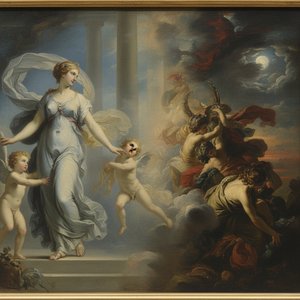
A Life Forged in the Shadows of History
The life of Antoine Duclaux was a profound testament to resilience, shaped by the turbulent currents of French history during the late eighteenth and nineteenth centuries. Born in Lyon in 1783, his early years were overshadowed by the terrifying specter of the Reign of Terror. The Duclaux family, once established, found themselves hunted through the streets of Lyon, forced into a precarious exile in Burgundy. This period of profound instability, marked by the tragic loss of his brothers to the guillotine and firing squads, instilled in the young artist a deep sense of survival and an observant eye for the natural world that would later define his artistry.
Despite the hardships of his youth, where he labored as a shop boy at the age of seventeen, Duclaux possessed an undeniable artistic spark. A pivotal turning point arrived around 1805 when a connection to General Fursy Compère opened the doors to a much wider world. This opportunity led him to Naples and eventually into the vibrant atmosphere of the court of Joseph Bonaparte. These travels were not merely geographical shifts but essential expansions of his visual vocabulary, allowing him to absorb the light and landscapes of Southern Europe, which would forever influence the warmth and depth of his later compositions.
The Mastery of the Lyon School
As a prominent figure of the Lyon School, Duclaux distinguished himself through a masterful command of both landscape and animal painting. His work is characterized by an evocative ability to capture the quiet dignity of nature and the spirited essence of the creatures that inhabit it. Rather than focusing on grand, theatrical historical scenes, he turned his brush toward the atmospheric beauty of the countryside and the intimate details of animal life, creating works that resonate with a sense of peace and enduring presence.
His technique often blended a meticulous attention to anatomical accuracy in his animals with a poetic approach to light and atmosphere. In his landscapes, one can observe:
- Luminous Atmosphere: A sophisticated use of light that suggests the shifting moods of the French countryside.
- Textural Depth: A careful rendering of organic elements, from the soft coat of a horse to the rugged terrain of a valley.
- Narrative Stillness: An ability to imbue a simple pastoral scene with a sense of profound, quiet storytelling.
Legacy and Artistic Significance
The historical significance of Antoine Duclaux lies in his contribution to the evolution of French naturalism. By moving away from the rigid structures of Neoclassicism toward a more emotive and observational style, he helped pave the way for future generations of landscape painters. His life, which spanned from the heights of Napoleonic influence to the mid-nineteenth century, mirrors the transformation of France itself—from a nation gripped by revolutionary violence to one finding beauty in the stability of its natural heritage.
Today, Duclaux is remembered not just as a painter of scenes, but as an artist who translated personal hardship into a serene and enduring visual legacy. His works remain vital examples of the Lyon School's ability to find the extraordinary within the ordinary, offering viewers a window into a vanished era of European pastoral life.
Ερωτήσεις και Απαντήσεις
Πού μπορώ να δω τα έργα του/της Antoine Duclaux ταξινομημένα ανά ατμόσφαιρα;
Στη σελίδα Κόρνερ Αίσθησης του Antoine Duclaux, τα έργα του καλλιτέχνη είναι διατεταγμένα ανάλογα με τη διάθεση.
Από πού προέρχεται ο/η Antoine Duclaux;
Ο/Η Antoine Duclaux γεννήθηκε στην/στη France.
Υπάρχει μια χρονολογική αναδρομή για τον/την Antoine Duclaux;
Η καριέρα του/της Antoine Duclaux αναπτύσσεται περίοδο προς περίοδο στη σελίδα Χρονικό έργο: μια χρονοσειρά των έργων, τα οποία είναι ομαδοποιημένα σε ενότητες ανά περίοδο της καριέρας του/της.
Σε ποια πόλη και χώρα γεννήθηκε ο/η Antoine Duclaux;
Ο/Η Antoine Duclaux γεννήθηκε στην/στη Lyon, στο/στη France.