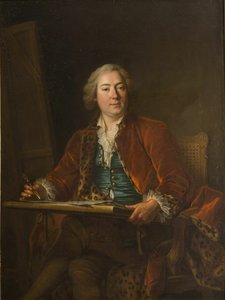
Έκδοση ελαιογραφίας
 Όλα για το Erigone







































 Για έργα τέχνης ή αναπαραγωγές με πλευρά υπερβαίνουσα των 105 εκ. (περίπου 41 ίντσες), το πλαίσιο θα αποσταλεί αποσυναρμολογημένο, σε μορφή κιτ. Η μέθοδος αυτή διασφαλίζει την ασφαλή παράδοση και προλαμβάνει τυχόν ζημιές κατά τη μεταφορά.


Identification of Erigone by Charles-André van Loo
The scene unfolds around Erigone, a work painted by Charles-André van Loo. This oil on canvas captures a moment of quiet power within a lush, natural setting. The subject is a nude female figure, her form central to the composition. She exists amidst a landscape of heavy vines and ripening fruit, embodying themes of abundance and fertility. One wonders at the connection between her graceful presence and the overflowing life surrounding her.
Created about 1747, this piece reflects the artist's ability to breathe life into mythological subjects. Charles-André van Loo places the figure within a world where the organic shapes of foliage and grapes seem to pulse with growth. The soft light catches the contours of her skin, grounding the mythological figure in a tangible, breathing reality. It is a vision of nature's bounty, held in a delicate balance between the human form and the wild, spreading vines.
Composition and Visual Elements
The figure rests at the very heart of the scene, a central presence held in balance against a landscape that stretches out in a richly detailed backdrop. Curvilinear lines guide the eye, tracing the soft contours of the woman’s body and following the winding, natural paths of the vines and trees. Every shape feels organic; rounded forms dominate the scene, from the heavy clusters of fruit to the flowing folds of the drapery and the lushness of the surrounding foliage. There is a sense of life in these curves, as if the very plants are reaching toward the light.
A soft, diffused light bathes the entire composition, creating a gentle glow that settles upon the subject’s features and skin. This light does not strike harshly but seems to emanate from within the atmosphere itself. The perspective feels somewhat flattened, a characteristic that keeps the viewer close to the subject, even as the landscape recedes slightly into the distance. Depth emerges through the careful layering of elements in the background, where atmospheric perspective causes the distant trees to appear paler and less distinct, pulling the eye deeper into the greenery.
Technique and Artistic Style
The scene unfolds through a Baroque sensibility, where dramatic lighting casts a soft, diffused glow across the subject. This light dances over the figure, highlighting the contours of the skin and the delicate features of the face. Every curve of the woman’s body and the organic forms of the surrounding foliage are rendered with a sense of grace. The composition relies on curvilinear lines that guide the eye through the lush, detailed landscape. It feels as though the air itself is heavy with the scent of grapes and the stillness of the natural world.
Oil paints on canvas allow for a meticulous application of color. The artist employs seamless blending to transition between tones, creating a smooth texture on the draped fabric and the skin. There is a profound sense of realism achieved through the careful observation of anatomy and the intricate details of the vines. The brushwork is precise, capturing the weight of the fruit and the textured bark of the trees. While the figure remains central and idealized, the background recedes through atmospheric perspective, where distant trees appear paler and less distinct, adding a quiet depth to the setting.
Related Works by Charles-André van Loo
The artist's hand moves through various realms of myth and devotion. In 1729, he captures the weight of Trojan heroism in Aeneas Carrying Anchises. This work carries a different gravity than the intimate scenes found in his religious commissions. The Marriage of the Virgin remains preserved within the walls of the Louvre, while his 1738 painting Virgin and Child offers a moment of serene contemplation. These pieces reveal a capacity for both grand narrative and quiet, tender interaction.
The artist also explores the allure of the exotic through his 1747 work Sultane, housed in the Musée des Arts Décoratifs in Paris. Here, the focus shifts toward the luxurious textures of Ottoman-inspired attire. Such subjects highlight a fascination with the decorative splendor of the mid-18th century. Each piece reflects a specific facet of his ability to navigate between the heavy requirements of historical painting and the lighter, more playful sensibilities of the French court.
Ερωτήσεις και Απαντήσεις
Είναι το έργο Erigone ζωγραφισμένο στο χέρι ή είναι εκτυπωμένο;
Χειροποίητη αναπαραγωγή: ένας εξειδικευμένος ζωγράφος αναπαριστά το Erigone με λάδια σε καμβά από λινό.
Ποιο μέγεθος πρέπει να επιλέξω για το Erigone;
Οι διαστάσεις κυμαίνονται από 35.9 x 27.9 cm (€178) έως 249.3 x 193.8 cm (€1577)· ο πίνακας σε αυτήν τη σελίδα περιλαμβάνει τις κύριες επιλογές και τις τιμές τους.
Πόσο זמן παίρνει η παράδοση;
Η παράδοση διαρκεί 4 έως 5 εβδομάδες, με δωρεάν express αποστολή σε όλο τον κόσμο· σε αυτήν τη σελίδα προσφέρεται η επιλογή επείγουσας παραγωγής. Μπορείτε να το επιστρέψετε εντός 100 ημερών για πλήρη επιστροφή χρημάτων, χωρίς περιορισμούς.
Πού βρίσκεται το πρωτότυπο έργο Erigone;
Το πρωτότυπο βρίσκεται στην συλλογή του Musée d'art et d'archéologie de Laon, Laon.
Με ποια τεχνική δημιούργησε ο/η Σαρλ Αντρέ βαν Λου το έργο Erigone;
Oil On Canvas
 Προεπισκόπηση σε πραγματική κλίμακα

 Αποστολή
 Κοινοποίηση
 Λεπτομέρειες
 Πληροφοριακό φύλλο


 Λήψη
 Παρόμοια αντικείμενα συλλογής
 Ακτινογραφία
 Παρουσίαση
 Ερωτήσεις & Απαντήσεις

 Στατιστικά