Expressionism · 1970
Composition (Yi Eungro, 1970)
Yi Eungro (1904–1989) schuf Composition. Es stammt aus dem Jahr 1970. Es gehört zur Expressionism-Strömung. Es ist aus Ink On Paper gefertigt. Es befindet sich im Lee Ungno Museum in Daegu, South Korea. Die Maße sind 10 × 14 cm.
- 1970
- Ink On Paper
- 10 × 14 cm
- Lee Ungno Museum, Daegu

 Vorschau anzeigen

 Handgemaltes Ölgemälde
 Versenden
 Teilen
 Datenblatt


 Herunterladen
 Ähnliche Objekte
 Röntgenaufnahme
 Diashow
 Fragen & Antworten

 Statistiken
Composition im Überblick
- Titel
- Composition
- Künstler
- Yi Eungro (1904–1989)
- Geburtsjahr des Künstlers
- Seoul, Korea
- Datum
- 1970
- Medium
- Ink On Paper
- Maße
- 10 × 14 cm
- Ausstellungsort
- Lee Ungno Museum, Daegu, South Korea
- Bewegung
- Expressionism
- Epoche
- Modern
- Motiv
- abstract composition, stylized figures”, “chaotic scene”, “geometric shapes”, “dynamic lines”, “emotional intensity”
Was stellt Composition dar?
Identification of Composition by Yi Eungro
The artwork titled Composition was created by the artist Yi Eungro. This specific piece dates to 1968. It is a work that reflects the artist's engagement with abstract forms and expressive mark-making during a period of significant transition in his career.
This piece is currently held at the Lee Ungno Museum in Daegu, South Korea. The museum maintains the work within its permanent collection, preserving the physical state of the ink and paper elements that constitute the piece. The work is categorized within the realm of Korean Expressionism, characterized by its specific approach to line and form.
Visual Elements and Compositional Style
This abstract composition is characterized by a dense and chaotic brushwork that covers the surface. The work utilizes a dark brown palette, creating a tonal range that emphasizes the textured surface of the piece. The application of ink appears heavy and irregular, contributing to a sense of layered depth. This specific approach to texture is a result of the artist's technique of tearing and layering paper or fabric on canvas, which creates a physical relief across the work.
The piece incorporates symbolic imagery and carries a prison art theme. The arrangement of forms lacks a single, central focal point, instead presenting a crowded field of shapes and lines. These elements appear to overlap and recede into one another, creating a sense of spatial tension. The marks are executed with varying degrees of pressure, resulting in thick, expressive lines that define the abstract forms. The overall structure relies on the interaction between these dark, heavy strokes and the underlying material layers.
Where to See This Artwork Today
This specific work is held within the permanent collection of the Lee Ungno Museum. The museum is situated in Daegu, South Korea. It serves as the primary location for viewing this piece in its physical context.
The institution was inaugurated in 2007. It is managed by the Daejeon Metropolitan City government. Visitors seeking to observe the texture and ink application of this composition can find it within this facility in Daegu.
In welchem Museum befindet sich Composition?
Lee Ungno Museum
Daegu, South Korea
Eine Symphonie aus Tusche und Moderne: Das Erbe von Lee Ungno Im Herzen der Kulturlandschaft von Daejeon steht das Lee Ungno Museum als tiefgreifendes Zeugnis für die transformative Kraft künstlerischer Vision. Diese Institution dient als Brücke zwischen den Epochen und bietet einen seltenen Einblick in die Seele eines Mannes, dem es gelang, die meditative Schwere der östlichen Tuschemalerei mit den kühnen, experimentellen Grenzen der westlichen Moderne zu verschmelzen. Das Betreten dieses Museums bedeutet, einen Raum zu betreten, in dem die alten Traditionen der koreanischen Kalligrafie auf die elektrische Energie des europäischen Abstrakten Expressionismus treffen und so einen Dialog schaffen, der über Generationen hinweg nachhallt.
Hochauflösende Bilder von Composition

Urheberrechtlich geschützt: Diese Dateien dienen der persönlichen Ansicht und stellen keine Lizenz zur Weiterveröffentlichung dar.
Yi Eungro, Composition (1970).
Yi Eungro (1904–1989), Composition, 1970, ink on paper, Lee Ungno Museum, Daegu, South Korea. Bild: OriginalUniqueArt.com.
Fragen zu Composition, beantwortet
Wo kann man "Composition" von Yi Eungro heute besichtigen?
Das Originalwerk „Composition“ können Sie im Lee Ungno Museum, Daegu, South Korea bewundern.
In welchem Jahr wurde "Composition" von Yi Eungro geschaffen?
"Composition" von Yi Eungro entstand im Jahr 1970.
Mit welcher Technik wurde "Composition" erstellt?
"Composition" wurde in Ink On Paper ausgeführt.
Welche Maße hat das Originalwerk "Composition"?
Das Originalwerk "Composition" von Yi Eungro hat die Maße 10 x 14 cm.
Welche Motive sind in "Composition" von Yi Eungro zu sehen?
Die Motive von "Composition" sind abstract composition, stylized figures”, “chaotic scene”, “geometric shapes”, “dynamic lines”, “emotional intensity”, “fragmented forms”.
Ist die Abbildung von "Composition" von Yi Eungro gemeinfrei?
Was das Urheberrecht betrifft, so ist "Composition" noch urheberrechtlich geschützt.
Wer hat "Composition" geschaffen?
Der Künstler hinter „Composition“ ist Yi Eungro. Das Werk ist unter dem Namen von Yi Eungro katalogisiert.
Zu welcher Stilrichtung gehört "Composition"?
Die mit "Composition" von Yi Eungro verbundene Stilrichtung ist Expressionism. Diese Klassifizierung ordnet das Werk in den Kontext verwandter Künstler und Kunstwerke ein.
Aus welcher Schaffensperiode von Yi Eungro stammt "Composition"?
"Composition" repräsentiert die Mature Period von Yi Eungro.
Über den Künstler, Yi Eungro

1904–1989, Korea
Yi Eungro
Early Life and Training Yi Eungro (이응노), born January 12, 1904, in Hongseong County, Chungcheongnam-do Province, South Korea, possessed an innate fascination for art from a young age. He diligently pursued classical Chinese studies under his father’s guidance and enrolled at Hongseong Botong Hakyo (홍성보통학교, 홍城초등학교, 洪城普通學校) for his primary education—a formative experience that instilled in him the foundational principles of Korean scholarship and artistic tradition. Recognizing his ambition to become a painter, he abandoned formal schooling to dedicate himself to mastering brushwork and ink wash techniques under Yeomjae Song Tae-hoe (예마재 송태호), a celebrated calligrapher-painter-photographer who profoundly shaped his artistic vision. This mentorship proved instrumental in establishing him as a student of the Haegang Style, which emphasized capturing the essence of nature through subtle brushstrokes and harmonious compositions.
Ebenfalls von Yi Eungro
 Untitled1969
 I Ching 64 Hexagrams Sequence(澤風大過)1974
 People1979
 Die Reisen des Marco Polo Serie1980
Essays zu Composition
 Koreanische Maler des 20. JahrhundertsErfahren Sie alles über koreanische Maler des 20. Jahrhunderts wie Yoo Youngkuk. Entdecken Sie Kunstwerke auf OriginalUniqueArt.com.
 Südkoreanische Maler des 21. JahrhundertsEntdecken Sie südkoreanische Maler des 21. Jahrhunderts wie Lee Bul und Do Ho Suh. Jetzt Meisterwerke auf OriginalUniqueArt.com entdecken.
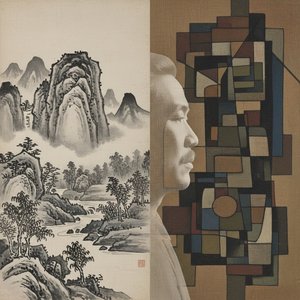 Yi Eungro: Bridging East & West in the Landscape of Korean ModernismExplore the captivating world of Yi Eungro (Lee Ungno), a pivotal figure in Korean modernism. Discover his unique fusion of Eastern and Wes…