 Vorschau anzeigen
 Versenden
 Teilen
 Details anzeigen

 Herunterladen
 Ähnliche Objekte
 Röntgenaufnahme
 Diashow
Old Man Looking Through a Window


 Weiterlesen
Handgefertigte Ölreproduktion
Handgemaltes Ölgemälde auf Leinwand in Ihrer Wunschgröße und mit Rahmen, auf Bestellung von unseren Künstlern angefertigt. ( Druck bestellen Bild kaufen)




P118B $10

P118H $10

P118W $10

P438Z $10

P508JH $12

P508YH $12

P805H $10

P805Z $10

P919BZ $10

P919G $10

P919XJ $10

P959ZH $10

P968JZ $12

W106C $8

W218G $10

W218JH $8

W218Y $10

W307PJ $10

W316G $10

W316PJ $8

W316Y $10

W398PJ $8

W4111J $10

W500HY $15

W500JH $15

W692G $12

W849H $8

W940BG $15

W953PJ $8




Wählen Sie aus unseren vordefinierten Formaten, die den ursprünglichen Proportionen des Kunstwerks entsprechen.

Sie können Ihre eigenen Maße eingeben, um einen bestimmten Rahmen oder Platz auszufüllen. Wenn die gewählte Größe nicht den Proportionen des Originalbildes entspricht, werden wir das Kunstwerk entweder beschneiden oder das Gemälde durch zusätzliche, handgemalte Elemente erweitern. Ein digitales Mockup wird Ihnen zur Genehmigung zugesandt, bevor die Produktion beginnt.
Bitte beachten Sie, dass die Bildschirmvorschau nicht die tatsächliche Beschneidung oder Erweiterung widerspiegelt. Nur das Mockup zeigt die endgültige Komposition exakt an.
Obwohl Sondermaße verfügbar sind, empfehlen wir, eine Größe aus der vordefinierten Liste zu wählen, um die ursprünglichen Proportionen beizubehalten.
Nach der Bestellung wird das OriginalUniqueArt.com-Team dem Kunden Anweisungen per E-Mail zusenden und eine Mockup-Vorschau bereitstellen.
Weltweiter Versand () in nur 3 bis 4 Wochen statt der üblichen 5 Wochen. (18 August). Keine Kompromisse bei der Qualität.

Kostenloser weltweiter Expressversand

Hochwertige Leinenleinwand

Umfassender Versicherungsschutz beim Versand

Zollgebühren-Rückerstattungsgarantie

Garantie für exakte Farbtreue

60 Tage Rückgaberecht (nur bei Mängeln)

100% Geld-zurück-Garantie

Mengenrabatt verfügbar
 Die Glasoption ist nur für Größen unter 110 cm verfügbar.

Old Man Looking Through a Window
Art der Reproduktion
Format der Reproduktion
-


Gesamtpreis
$ 300
Beschreibung des Kunstwerks
A Window Into Eternity: Exploring Samuel Dirksz van Hoogstraten’s “Old Man Looking Through a Window”
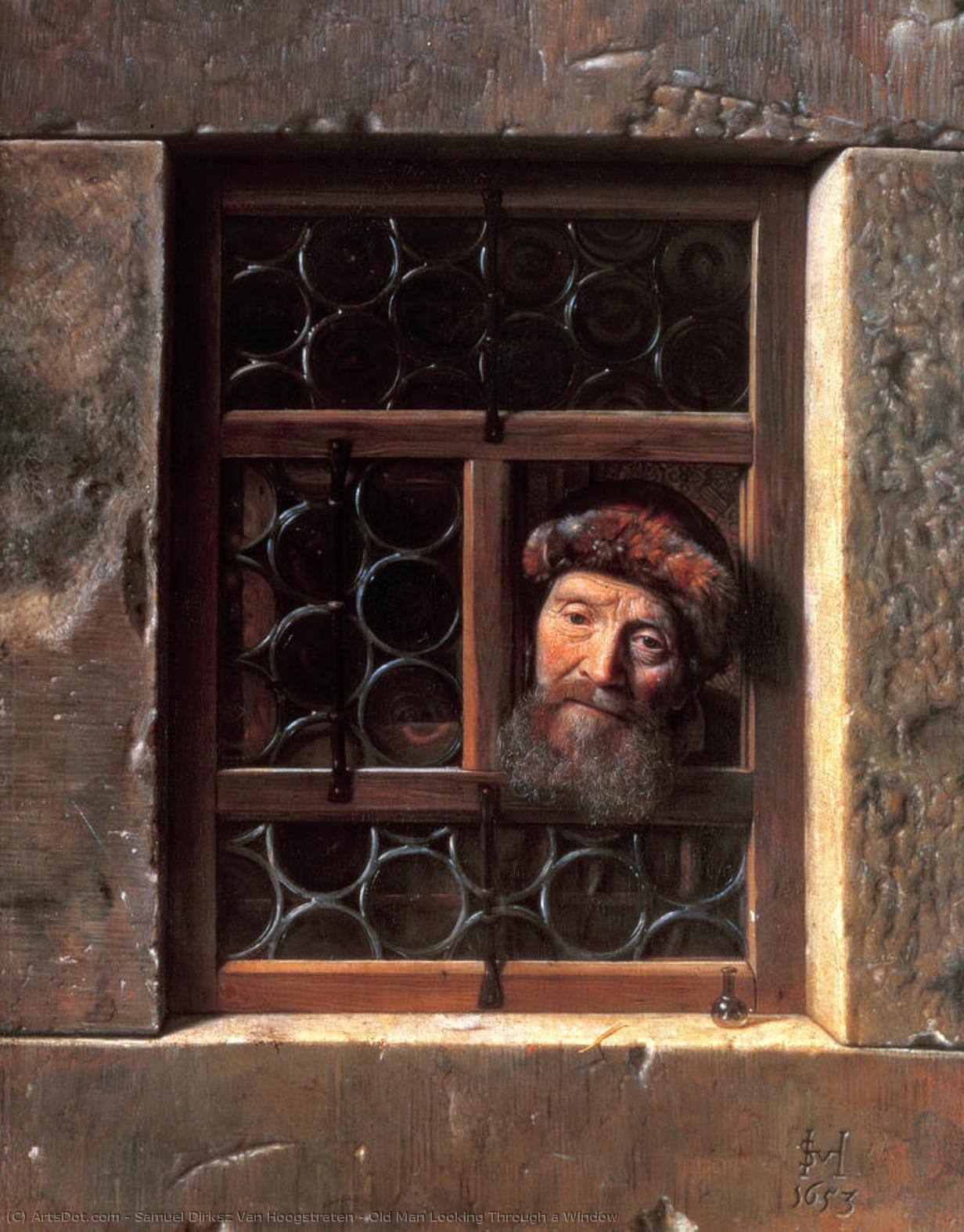
The painting "Old Man Looking Through a Window," completed in 1653 by Samuel Dirksz van Hoogstraten, stands as a testament to the Baroque mastery that flourished during the Dutch Golden Age. More than just a portrait, it's an intricate meditation on time, isolation, and the elusive nature of perception—themes central to the philosophical currents shaping seventeenth-century Europe. Van Hoogstraten wasn’t merely depicting an elderly man; he was crafting an illusion, inviting the viewer into a carefully constructed space where reality bends to artistic intention.The Baroque Vision: Illusion and Drama
Van Hoogstraten's stylistic allegiance firmly rooted in the Baroque tradition—a movement characterized by grandeur, dynamism, and theatricality—is immediately apparent. Unlike the calmer Renaissance ideals of balance and harmony, Baroque art prioritized emotional impact above all else. The artist skillfully employs chiaroscuro – dramatic contrasts between light and dark – to sculpt the figure’s form and heighten the sense of melancholy that permeates the scene. This technique isn't merely decorative; it serves as a crucial element in conveying psychological depth, mirroring the turbulent inner life of the subject.Technical Precision: Stone Carving Detail
The painting’s meticulous execution reveals Van Hoogstraten’s profound understanding of artistic craft. He approached his work with the precision of a stone carver, painstakingly rendering textures and surfaces to create an astonishingly realistic portrayal. Notice the subtle gradations of color within the man's beard—a feat of brushwork that captures the delicate interplay of light and shadow. Furthermore, Van Hoogstraten’s masterful depiction of the window frame itself contributes significantly to the overall illusion. The artist meticulously recreates the stone carving detail, emphasizing the materiality of the object and grounding the scene in tangible reality.Historical Context: Reflections on Mortality
“Old Man Looking Through a Window” emerged during a period marked by profound anxieties concerning mortality—a preoccupation that permeated artistic discourse throughout Europe. The Baroque era witnessed an increasing fascination with death and decay as artists sought to grapple with existential questions about human existence. This preoccupation is subtly conveyed through the man’s gaze, which appears fixed upon something beyond the window frame—perhaps contemplating eternity or reflecting on the passage of time. The painting serves as a poignant reminder of our own vulnerability and underscores the enduring power of art to confront uncomfortable truths.Symbolism: The Window as Portal
The window itself functions as a powerful symbol within the artwork, representing not merely an architectural feature but also a gateway—both literal and metaphorical—to another realm. Traditionally, windows have been associated with illumination and transcendence, inviting viewers into spaces of contemplation and spiritual insight. In “Old Man Looking Through a Window,” however, the window’s bars suggest confinement and restriction, mirroring the subject's psychological state. The man’s gaze outward is countered by his posture inward—a visual paradox that encapsulates the painting’s central theme: the struggle to reconcile our desire for freedom with the inescapable realities of human experience.Emotional Resonance: A Portrait of Quiet Desolation
Ultimately, “Old Man Looking Through a Window” succeeds in eliciting a profound emotional response from the viewer. The melancholic expression on the old man's face—coupled with the desolate atmosphere created by Van Hoogstraten’s masterful use of light and shadow—captures the essence of quiet desolation. It is a portrait that speaks volumes about human vulnerability and invites contemplation on themes of loss, remembrance, and the acceptance of mortality. This enduring emotional resonance ensures that Van Hoogstraten's masterpiece continues to inspire awe and provoke reflection centuries after its creation.Über den Künstler
Samuel Dirksz van Hoogstraten: A Master of Illusion and Intellect
Samuel Dirksz van Hoogstraten (1627-1678) stands as a towering figure in the annals of Dutch Golden Age art, an artist whose legacy extends far beyond his stunning visual creations. He wasn’t merely capturing scenes from his era; he was dissecting them, manipulating perception, and exploring the very essence of artistic representation—a pursuit that cemented his place as one of the most influential thinkers and practitioners of Baroque painting in Holland. Born in Dordrecht, Netherlands, into a family steeped in artisanal tradition – his father a silversmith and painter, his grandfather a guild member – Van Hoogstraten’s formative years instilled within him an appreciation for craftsmanship and a keen understanding of visual principles that would inform his entire artistic career.Early Training and Rembrandt's Influence
His formal artistic education began under the tutelage of his father, Dirk van Hoogstraten, grounding him in the foundational techniques of painting before he embarked on his apprenticeship with Rembrandt Harmenszoon van Rijn around 1640. This association proved transformative, exposing Van Hoogstraten to Rembrandt’s groundbreaking approach to chiaroscuro—the dramatic interplay of light and shadow—a technique that would become a hallmark of his own style. Unlike many artists of his time who slavishly imitated their masters, Van Hoogstraten possessed an inquisitive mind and a restless spirit that propelled him beyond mere replication. He meticulously studied Rembrandt’s compositions, analyzing the subtleties of tonal gradation and exploring how light could convey emotion and create illusionistic depth. This dedication to Rembrandt's method is evident in his early portraits, where he skillfully employs chiaroscuro to sculpt form and imbue his subjects with psychological nuance.A Journey Through Europe: Observation and Innovation
Driven by an unwavering desire for artistic advancement, Van Hoogstraten undertook extensive travels throughout Europe during the 1650s and early 1660s—a period marked by intellectual ferment and artistic experimentation. He visited Vienna, Rome, and London, immersing himself in diverse artistic traditions and absorbing influences from artists such as Johannes Vermeer and Pieter de Hooch. These journeys weren’t merely sightseeing expeditions; they were intensive studies of architecture, perspective, and the prevailing aesthetic sensibilities of each locale—observations that profoundly shaped his artistic vision. He meticulously documented his findings in notebooks filled with sketches and diagrams, demonstrating a commitment to scientific inquiry alongside artistic creativity. This meticulous attention to detail is particularly apparent in his architectural paintings, where he employs precise mathematical calculations to achieve breathtaking realism and convey spatial illusion.The Triumph of Trompe-l’œil and Perspective Boxes
Perhaps Van Hoogstraten's most remarkable achievement was his mastery of trompe-l’œil—the art of deceiving the eye—a technique that he elevated to unprecedented heights. He skillfully crafted illusions within still lifes, creating seemingly three-dimensional representations of objects that defied conventional perspective. His celebrated “Peepshow with Views of the Interior of a Dutch House,” housed at the National Gallery in London, exemplifies this innovative approach, transporting viewers into miniature worlds rendered with astonishing accuracy and depth. Similarly, he constructed perspective boxes—elaborate architectural models designed to simulate realistic interiors when viewed through peepholes—demonstrating his profound understanding of spatial illusion and challenging viewers’ perceptions of reality. These creations weren't merely decorative objects; they were intellectual puzzles that demanded careful observation and contemplation.A Theoretician's Legacy: Shaping Artistic Discourse
Beyond his artistic accomplishments, Van Hoogstraten was a prolific art theorist who sought to codify the principles of painting in his magnum opus, *Inleyding tot de hooge schoole der schilderkonst* (Introduction to the Academy of Painting), published in 1678. This ambitious treatise stands as one of the most comprehensive and intellectually rigorous explorations of art theory produced in the Dutch Republic during the Baroque era—a testament to his erudition and unwavering dedication to advancing artistic knowledge. Van Hoogstraten drew upon a vast range of sources, from classical philosophy to contemporary treatises on optics, analyzing issues of pictorial persuasion, illusionism, moral responsibility, and the relationship between painting and intellect. He built upon the foundations laid by Karel van Mander in his earlier work, *Het Schilder-Boeck*, aiming to establish a systematic framework for understanding and practicing the art of painting—a legacy that continues to inspire artists and scholars alike. His writings reflect both international influences gleaned from his travels and debates within Dutch artistic circles, securing his place as a pivotal figure in shaping the intellectual landscape of his time.
Samuel van Hoogstraten
1627 - 1678 , Niederlande
Kurzinfos
- Artistic Movement Or Style: Dutch Golden Age, Baroque
- Artists Who Influenced This Artist:
- Rembrandt
- Dirk van Hoogstraten
- Date Of Birth: August 2, 1627
- Date Of Death: October 19, 1678
- Full Name: Samuel Dirksz van Hoogstraten
- Nationality: Dutch
- Notable Artworks:
- Portrait of Mathys van den Brouck
- The Anemic Lady
- View of a Corridor
- Man at a Window
- Vanitas
- Place Of Birth: Dordrecht, Netherlands
Ähnliche Artikel

Chiaroscuro and Character: A Definitive Guide to Light and Shadow in the Dutch Baroque Era
Explore the dramatic mastery of the Dutch Baroque era. Discover how masters like Rembrandt used chiaroscuro to transform everyday life into timeless art. An expert guide for collectors and enthusiasts seeking to understand the profound interplay of light and shadow.

Golden Light & Dutch Skies: The Timeless Magic of Dutch Golden Age Landscapes
Discover the breathtaking beauty of Dutch Golden Age landscapes. Explore the mastery of light, chiaroscuro, and 17th-century realism through an expert art history lens, celebrating the enduring legacy of the Dutch Masters for discerning collectors and art lovers.

Golden Age Reflections: Dutch Baroque Painting & Cultural Innovation
Explore the Dutch Golden Age of painting! Discover key artists like Vermeer & ter Borch, their innovative techniques, and the rich cultural context behind these Baroque masterpieces. Learn about collecting & appreciating this iconic art period.

Chiaroscuro and Character: A Masterclass in Light and Shadow within Dutch Golden Age Painting
Explore the profound mastery of light and shadow in Dutch Golden Age painting. From chiaroscuro to atmospheric landscapes, discover the techniques that defined an era and learn how to bring these timeless masterpieces into your home through museum-quality oil reproductions.

Die 10 Meisterwerke des Goldenen Zeitalters der niederländischen Malerei |
Entdecken Sie die 10 Meisterwerke des Niederländischen Goldenen Zeitalters! Von Rembrandt bis Vermeer – erleben Sie Kunstgeschichte, Techniken & Emotionen. Hochwertige Gemäldereproduktionen für Ihr Zuhause auf .