Zum Druck wechseln
 Weiterlesen







































 Bei Kunstwerken oder Reproduktionen, die an einer Seite größer als 105 cm (ca. 41 Zoll) sind, wird der Rahmen zerlegt als Bausatz geliefert. Diese Methode gewährleistet eine sichere Zustellung und verhindert Schäden während des Transports.


A Bold Vision of Illusion and Reality: Gustave Doré’s “The Adventure with the Windmills”
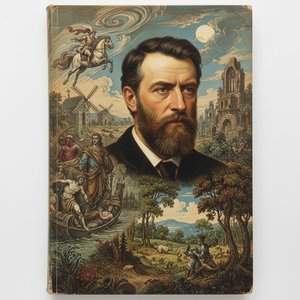
Gustave Doré's engraving, "The Adventure with the Windmills," stands as a testament to Romanticism’s fascination with dramatic narrative and psychological exploration. Created around 1868, this artwork isn’t merely a depiction of Cervantes’ iconic tale; it’s an embodiment of the era’s preoccupation with idealism colliding head-on with disillusionment—a theme powerfully conveyed through Doré's masterful technique and compositional choices.
- Subject Matter: The engraving captures Don Quixote’s legendary delusion – his unwavering belief that windmills are colossal giants, prompting him to charge valiantly against them. This central image serves as a cornerstone of the narrative, representing the protagonist's struggle to reconcile fantasy with tangible reality.
- Composition & Perspective: Doré employs a dynamic diagonal thrust, positioning Don Quixote and Rocinante prominently in the foreground. Three imposing windmills dominate the background, establishing a scale that underscores Quixote’s fantastical perception. Figures observing from below contribute depth and perspective, enhancing the dramatic impact of the scene.
- Style & Technique: Doré's engraving exemplifies Romantic illustration—characterized by meticulous detail and expressive tonal shading. The artist skillfully utilizes hatching and cross-hatching to sculpt form and texture, creating a palpable sense of movement and conveying the urgency of Quixote’s quest. Fine lines delineate figures and windmills with precision, reflecting the era’s commitment to realism within an emotionally charged framework.
Symbolism: Windmills as Embodiments of Illusion
Beyond its narrative depiction, “The Adventure with the Windmills” resonates deeply with symbolic significance. The windmills themselves represent Quixote's delusion—his inability to discern between imaginative grandeur and mundane reality. They symbolize not just physical obstacles but also the psychological barriers that prevent him from achieving his heroic aspirations. Doré’s portrayal underscores the Romantic preoccupation with confronting irrational beliefs and accepting the limitations of human experience.
Color Palette & Lighting: Monochromatic Drama
The engraving's monochrome palette—primarily shades of gray—amplifies its emotional intensity. Absence of color contributes to a sense of bleakness and reinforces the psychological drama at play. Subtle shading creates depth and highlights textural variations, mirroring the Romantic impulse to capture mood and atmosphere with uncompromising honesty. Diffusion of light lends an ethereal quality to the landscape, furthering the impression of grandeur and vulnerability.
Historical Context & Legacy
"The Adventure with the Windmills" emerged during a pivotal moment in artistic history—the waning years of Romanticism as realism began to gain ascendancy. Doré’s engraving cemented his reputation as a visionary illustrator, influencing subsequent artists and captivating audiences for generations. Its enduring appeal lies in its ability to distill complex themes into a visually arresting image that continues to inspire contemplation on the nature of imagination, delusion, and heroic aspiration—a timeless reflection of Cervantes' masterpiece.
Fragen & Antworten
Welches Motiv und welche Atmosphäre vereint "Die Abenteuer mit den Windmühlen" von Paul Gustave Doré?
"Die Abenteuer mit den Windmühlen" von Paul Gustave Doré zeigt don quixote, windmills, illustration, fantasy, illusion, humor, madness in einer Dramatisch Stimmung. Motiv und Atmosphäre beschreiben gemeinsam das Werk.
Wie alt war Paul Gustave Doré, als „Die Abenteuer mit den Windmühlen“ im Jahr 1868 geschaffen wurde?
Paul Gustave Doré war 36 Jahre alt, als Die Abenteuer mit den Windmühlen im Jahr 1868 geschaffen wurde. Das Alter berechnet sich aus dem Geburtsjahr des Künstlers, 1832.
Was für ein Kunstwerk ist "Die Abenteuer mit den Windmühlen"?
Im Katalog ist "Die Abenteuer mit den Windmühlen" von Paul Gustave Doré als Wandkunst geführt. Die Kategorie hilft dabei, ähnliche Werke zu finden.
 Vorschau anzeigen
 Versenden
 Teilen
 Details anzeigen
 Leitfaden

 Herunterladen
 Ähnliche Objekte
 Röntgenaufnahme
 Diashow
 Q&A
Q&A Statistiken