 Vorschau anzeigen
 Versenden
 Teilen
 Details anzeigen

 Herunterladen
 Ähnliche Objekte
 Röntgenaufnahme
 Diashow
The Prodigal Son
 Oil On Canvas
- WallArt
- Symbolist Painting
 1890
1890- 19th Century
 115.0 x 200.0 cm
 Weiterlesen
Handgefertigte Ölreproduktion
Handgemaltes Ölgemälde auf Leinwand in Ihrer Wunschgröße und mit Rahmen, auf Bestellung von unseren Künstlern angefertigt. ( Druck bestellen Bild kaufen)




P118B $10

P118H $10

P118W $10

P438Z $10

P508JH $12

P508YH $12

P805H $10

P805Z $10

P919BZ $10

P919G $10

P919XJ $10

P959ZH $10

P968JZ $12

W106C $8

W218G $10

W218JH $8

W218Y $10

W307PJ $10

W316G $10

W316PJ $8

W316Y $10

W398PJ $8

W4111J $10

W500HY $15

W500JH $15

W692G $12

W849H $8

W940BG $15

W953PJ $8




Wählen Sie aus unseren vordefinierten Formaten, die den ursprünglichen Proportionen des Kunstwerks entsprechen.

Sie können Ihre eigenen Maße eingeben, um einen bestimmten Rahmen oder Platz auszufüllen. Wenn die gewählte Größe nicht den Proportionen des Originalbildes entspricht, werden wir das Kunstwerk entweder beschneiden oder das Gemälde durch zusätzliche, handgemalte Elemente erweitern. Ein digitales Mockup wird Ihnen zur Genehmigung zugesandt, bevor die Produktion beginnt.
Bitte beachten Sie, dass die Bildschirmvorschau nicht die tatsächliche Beschneidung oder Erweiterung widerspiegelt. Nur das Mockup zeigt die endgültige Komposition exakt an.
Obwohl Sondermaße verfügbar sind, empfehlen wir, eine Größe aus der vordefinierten Liste zu wählen, um die ursprünglichen Proportionen beizubehalten.
Nach der Bestellung wird das OriginalUniqueArt.com-Team dem Kunden Anweisungen per E-Mail zusenden und eine Mockup-Vorschau bereitstellen.
Weltweiter Versand () in nur 3 bis 4 Wochen statt der üblichen 5 Wochen. (30 August). Keine Kompromisse bei der Qualität.

Kostenloser weltweiter Expressversand

Hochwertige Leinenleinwand

Umfassender Versicherungsschutz beim Versand

Zollgebühren-Rückerstattungsgarantie

Garantie für exakte Farbtreue

60 Tage Rückgaberecht (nur bei Mängeln)

100% Geld-zurück-Garantie

Mengenrabatt verfügbar
 Die Glasoption ist nur für Größen unter 110 cm verfügbar.

The Prodigal Son
Art der Reproduktion
Format der Reproduktion
-


Gesamtpreis
$ 300
A Visionary Descent into Symbolism
To gaze upon Gustave Moreau’s “The Prodigal Son” is to step beyond the veil of the visible world and enter a realm where the boundaries between reality and dream dissolve. Created around 1890, this masterpiece serves as a profound testament to the Symbolist movement, a period defined by an inward turn toward the mysteries of the human psyche. Moreau, often hailed as the "painter par excellence" of Symbolism, does not merely recount the biblical parable of the wayward son; he reimagines it as a haunting, psychological odyssey. The painting captures that pivotal moment of transition—the heavy weight of repentance meeting the ethereal promise of forgiveness. For the discerning collector or interior designer, this work offers more than just visual splendor; it provides a window into the spiritual anxieties and profound emotional depths that characterized the late 19th-century artistic consciousness.
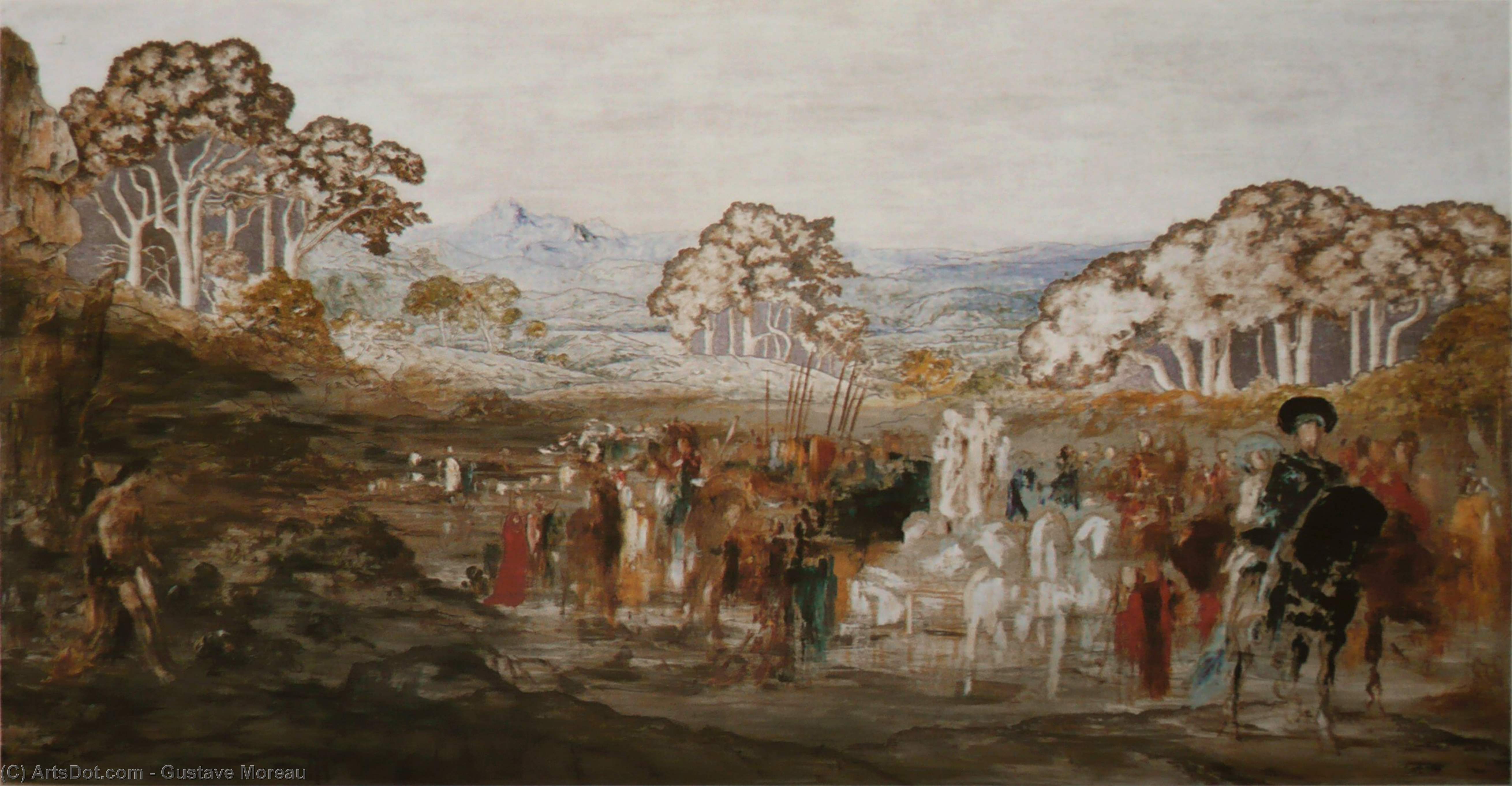
The composition is a dynamic tapestry of movement and narrative tension. Within the frame, we encounter a scene teeming with life yet shrouded in an enigmatic atmosphere. A man, perhaps the son himself, is depicted in a suit atop a horse, navigating a landscape populated by a diverse assembly of figures and animals. The presence of horses and donkeys, scattered from the immediate foreground to the distant periphery, lends a sense of bustling, unfolding history to the piece. This orchestrated chaos is not random but serves to ground the allegorical weight of the story in a palpable, breathing world. The interplay between the central figures and the surrounding activity creates a rhythmic energy that draws the eye through the canvas, making the viewer an active participant in this unfolding drama of redemption.
The Alchemy of Technique and Light
Moreau’s technical mastery is evident in the luminous, almost otherworldly texture of the work. Eschewing the fleeting, light-drenched impressions of his contemporaries, Moreau utilized a more deliberate and layered approach to achieve a sense of permanence and depth. The palette is masterfully restrained, dominated by earthy, evocative tones—ochre, umber, and ivory—which coalesce to create a dreamlike, sepia-toned atmosphere. Through the careful application of oil on canvas, he achieves a remarkable luminosity, where light does not simply strike the surface but seems to emanate from within the layers themselves. This technique imbues the figures with a sculptural presence, making the textures of fabric and the musculature of the animals feel both tactile and transcendent.
For those seeking to integrate such a profound piece into a curated space, the aesthetic versatility of "The Prodigal Son" is remarkable. The muted, sophisticated color scheme allows it to serve as a soulful anchor in a room, providing a sense of historical gravity and intellectual depth. Whether placed in a contemporary gallery setting or a classic, richly textured study, the painting’s ability to command attention through subtle nuance rather than garish color makes it an exquisite choice for high-end decor. It is a work that rewards long, contemplative stares, offering new layers of detail and emotional resonance with every encounter.
A Legacy of Spiritual Resonance
Beyond its formal beauty, the true power of Moreau’s work lies in its symbolic polyvalence. As a pioneer of Symbolism, Moreau sought to express truths that words often fail to capture. In "The Prodigly Son," the physical journey of the returning traveler becomes an allegory for the soul's return to grace. Every element—from the starkness of the landscape to the weary posture of the figures—contributes to a larger meditation on morality, faith, and the enduring power of familial love. It is a painting that speaks to the universal human experience of loss and recovery, making it eternally relevant.
Owning a high-quality reproduction of this masterpiece allows one to bring this sense of spiritual inquiry into the modern home. It is an invitation to reflect, to dream, and to find beauty in the complexities of the human condition. For the art lover, it is a piece of history; for the designer, it is a cornerstone of atmosphere; and for the soul, it is a profound encounter with the sublime.
Über den Künstler
**frühes Leben und Ausbildung**
Gustav Moreau, ein französischer Künstler, wurde am 6. April 1826 in Paris geboren. Er erhielt eine traditionelle akademische Ausbildung in der Malerei an der École des Beaux-Arts und zeigte von frühester Kindheit eine Begabung für Zeichnen.**Die Symbolismusbewegung**
Moreaus Werk, das durch allegorische und mythologische Themen geprägt ist, machte ihn zu einem führenden Symbolistenmaler, insbesondere in den 1890er Jahren. Seine Kunst (und der Symbolismus im Allgemeinen) verlor an Beliebtheit, wurde aber seit den 1960er Jahren neu bewertet und Moreau gilt heute als einer der wichtigsten Symbolistenmaler.**Bekannte Werke und Ausstellungen**
* Salomé im Gefängnis (Gemälde von 'Gustav Moreau') ist ein bemerkenswertes Beispiel für seine Arbeit und zeigt seine Meisterschaft im Symbolismus. * Das Selbstporträt (Gemälde von 'Gustav Moreau') ist eine weitere kraftvolle Darstellung des Künstlers selbst.**Musée Gustave Moreau**
Das Nationalmuseum Gustave Moreau (Musée Gustave Moreau Paris, Frankreich) in Paris ist dem Werk Moreaus gewidmet und beherbergt über 1.200 Gemälde, Aquarelle und Zeichnungen. Das Museum ist ein Zeugnis seines künstlerischen Erbes.**Vermächtnis und Einfluss**
Moreaus Einfluss auf die Symbolismusbewegung ist unbestreitbar. Er lehrte an der École des Beaux-Arts und beeinflusste namhafte Künstler wie Henri Matisse und Georges Rouault. Seine zurückgezogene Art hat seinen Einfluss auf die Kunstwelt nicht gemindert.- Entdecken Sie mehr über das Leben und Werk von Gustav Moreau auf OriginalUniqueArt.com
- Erkunden Sie das Nationalmuseum Gustave Moreau und seine beeindruckende Sammlung von Kunstwerken auf Musée Gustave Moreau Paris, Frankreich
- Erfahren Sie mehr über die Symbolismusbewegung und ihre Bedeutung für die Kunstgeschichte auf die Symbolismus-Kunstbewegung

Gustave Moreau
1826 - 1898 , Frankreich
Kurzinfos
- Beeinflusste Künstler:
- Henri Matisse
- Georges Rouault
- Bemerkenswerte Werke:
- Salomé im Gefängnis
- Selbstporträt
- Jupiter und Semele
- Orpheus
- Die Erscheinung
- Geburtsdatum: 6. April 1826
- Geburtsort: Paris, Frankreich
- Künstlerische Einflüsse:
- Eugène Delacroix
- Michelangelo
- Leonardo da Vinci
- Künstlerischer Stil: Symbolismus
- Nationalität: Französisch
- Sterbedatum: 1898
- Vollständiger Name: Gustave Moreau
Ähnliche Artikel

Gustav Klimt: Die 25 Meisterwerke des Wiener Jugendstils | OriginalUniqueArt
Entdecken Sie die 25 ikonischsten Gemälde von Gustav Klimt! Tauchen Sie ein in die Welt der Wiener Secession, des Jugendstils und der goldenen Phase. Hochwertige Reproduktionen & Inspiration für Ihr Zuhause auf OriginalUniqueArt.com.
Gustave Moreau: Der Enigmatische Visionär des Symbolismus und Wegbereiter moderner Fantasy-Kunst
Entdecken Sie das faszinierende Werk Gustave Moreaus, des wichtigsten Vertreters des Symbolismus! Analysen, Biografien und Einblicke in seine mythologischen Gemälde. Jetzt lesen!

The Noble Steed on Canvas: A Historical & Artistic Exploration of Horse Painting Across Cultures
Explore the rich history of horse painting! Discover masterpieces from Stubbs to Munnings & learn about symbolism, techniques & artists. Find museum-quality reproductions at OriginalUniqueArt.
Echoes of Olympus: Mythological Narratives in Western Art Through the Ages
Explore the captivating history of mythological narratives in Western art! From ancient Greece to modern masterpieces, discover iconic artworks & symbolism. Expert analysis and high-quality reproductions at OriginalUniqueArt.

The Equine Muse: A Historical & Artistic Exploration of Horses in Painting
Explore the captivating history of horses in painting! Discover Renaissance masterpieces, Baroque grandeur & expert insights for collecting equestrian art. Learn about symbolism, techniques & lasting value with OriginalUniqueArt.