In echtem Maßstab anzeigen
 Versenden als Grußkarte
 Teilen
 Details anzeigen
 Leitfaden öffnen

 Herunterladen
 Ähnliche Objekte
 Röntgenaufnahme
 Diashow
 Besucherstatistiken
Nachmittagliche Stimmen


 Mehr anzeigen
Handgefertigte Ölreproduktion
Handgemaltes Ölgemälde auf Leinwand in Ihrer Wunschgröße und mit Rahmen, auf Bestellung von unseren Künstlern angefertigt. ( Zum Druck wechseln Zum digitalen Bild wechseln)




P118B €10

P118H €10

P118W €10

P438Z €10

P508JH €12

P508YH €12

P805H €10

P805Z €10

P919BZ €10

P919G €10

P919XJ €10

P959ZH €10

P968JZ €12

W106C €8

W218G €10

W218JH €8

W218Y €10

W307PJ €10

W316G €10

W316PJ €8

W316Y €10

W398PJ €8

W4111J €10

W500HY €15

W500JH €15

W692G €12

W849H €8

W940BG €15

W953PJ €8




Wählen Sie aus unseren vordefinierten Formaten, die den ursprünglichen Proportionen des Kunstwerks entsprechen.

Geben Sie die Breite und die Höhe an, die Sie für Ihren Rahmen oder Ihre Wand benötigen. Da dieses Werk handgemalt ist, kann der Künstler bei einer anderen Form etwas mehr um das Bild herum malen oder etwas abschneiden – Sie entscheiden. Wir senden Ihnen ein digitales Mockup zur Freigabe, bevor mit dem Malen begonnen wird. Das auf dieser Seite gezeigte Bild stellt nicht das tatsächliche Ergebnis dar – dies tut nur das Mockup.
Nach der Bestellung wird das OriginalUniqueArt.com-Team dem Kunden Anweisungen per E-Mail zusenden und eine Mockup-Vorschau bereitstellen.
Weltweiter Versand () in nur 3 bis 4 Wochen statt der üblichen 5 Wochen. (24 Oktober). Keine Kompromisse bei der Qualität.

Kostenloser weltweiter Expressversand

Hochwertige Leinenleinwand

Vollständiger Versicherungsschutz beim Versand

Zollgebühren-Rückerstattungsgarantie

Garantie für exakte Farbtreue

100-tägiges Rückgaberecht (nur bei Mängeln)

100% Geld-zurück-Garantie

Angebot für Mengenrabatt
 Die Glasoption ist nur für Größen unter 110 cm verfügbar.

Nachmittagliche Stimmen
Reproduktionsmedium
Format der Reproduktion
-


Gesamtpreis
€ 263
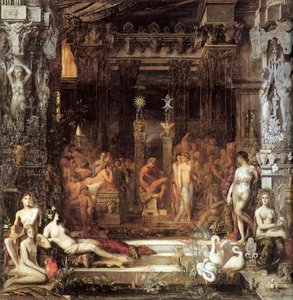
A Celestial Reverie: Exploring Gustave Moreau’s “Evening Voices”
Moreau's "Evening Voices," painted in 1885, transcends mere visual representation; it embodies the very soul of Symbolist art—a movement dedicated to delving into the subconscious and conveying profound spiritual truths through evocative imagery. Housed within the Musée Gustave Moreau in Paris, this watercolor masterpiece invites contemplation and rewards repeated viewing with layers of nuanced symbolism and masterful technique.The Composition’s Dance of Light and Shadow
The painting's visual arrangement is deliberately arresting. Three angelic figures ascend from varying heights, each cradling a cross—a potent emblem of Christian faith and redemption—creating a dynamic vertical axis that dominates the canvas. Beneath these celestial guardians rests a boat, symbolizing earthly journeys and aspirations, while a solitary tree anchors the scene on the right side, representing resilience and connection to nature’s enduring wisdom. Moreau skillfully manipulates light and shadow, fostering an atmosphere of serene solemnity and hinting at hidden depths beneath the surface tranquility.Moreau's Watercolor Alchemy: Technique and Texture
Gustave Moreau’s choice of watercolor as his medium speaks volumes about his artistic philosophy. Unlike oil paints which strive for realism, watercolor allows for a luminous quality that captures the ethereal essence of Symbolist ideals. Moreau achieved this effect through meticulous layering—thin washes gradually built upon one another to create subtle gradations of color and texture. The artist’s brushstrokes are delicate yet purposeful, conveying both precision and an expressive freedom that is characteristic of his distinctive style. Close examination reveals intricate details – the folds of drapery, the textures of bark – demonstrating a dedication to capturing not just what is seen but also what is felt.Symbolism Illuminated: Angels, Boats, and Trees
The painting’s symbolism resonates deeply within the Symbolist tradition. The angels themselves represent divine guidance and spiritual aspiration, mirroring Moreau's own preoccupation with religious themes. Beyond this immediate interpretation, the boat symbolizes humanity’s voyage through life—a journey fraught with challenges yet ultimately leading towards enlightenment. Similarly, the tree embodies constancy and connection to the natural world, serving as a grounding element amidst the celestial grandeur of the composition. These motifs invite viewers to consider questions of faith, morality, and the human condition.A Legacy of Dreamlike Beauty
Moreau’s “Evening Voices” stands as a testament to his unwavering commitment to artistic vision—a refusal to compromise on emotional resonance or spiritual contemplation. It exemplifies the Symbolist movement's fascination with mythology, folklore, and psychological exploration, resulting in an artwork that continues to captivate audiences today. Its haunting beauty and profound symbolism solidify Moreau’s place among the most influential painters of his era, inspiring artists and collectors alike who appreciate the power of art to transcend mere representation and communicate universal truths.Fragen & Antworten
Wo sollte eine Reproduktion von "Nachmittagliche Stimmen" von Gustave Moreau aufgehängt werden?
Format (Hochformat) und der empfohlene Raum (Wohnbereich) sind die zwei festgehaltenen Platzierungsdetails für "Nachmittagliche Stimmen" von Gustave Moreau.
Aus welchem Land stammt das Symbolist Bewegung-Werk „Nachmittagliche Stimmen"]?
Das Werk "Nachmittagliche Stimmen" aus der Epoche des Symbolist Bewegung wurde von einem Künstler geschaffen, der in Frankreich geboren wurde.
Wer ist der Urheber von "Nachmittagliche Stimmen" und aus welchem Jahr stammt das Werk?
Gustave Moreau schuf „Nachmittagliche Stimmen“ im Jahr 1885.
Biografie des Künstlers
**frühes Leben und Ausbildung**
Gustav Moreau, ein französischer Künstler, wurde am 6. April 1826 in Paris geboren. Er erhielt eine traditionelle akademische Ausbildung in der Malerei an der École des Beaux-Arts und zeigte von frühester Kindheit eine Begabung für Zeichnen.**Die Symbolismusbewegung**
Moreaus Werk, das durch allegorische und mythologische Themen geprägt ist, machte ihn zu einem führenden Symbolistenmaler, insbesondere in den 1890er Jahren. Seine Kunst (und der Symbolismus im Allgemeinen) verlor an Beliebtheit, wurde aber seit den 1960er Jahren neu bewertet und Moreau gilt heute als einer der wichtigsten Symbolistenmaler.**Bekannte Werke und Ausstellungen**
* Salomé im Gefängnis (Gemälde von 'Gustav Moreau') ist ein bemerkenswertes Beispiel für seine Arbeit und zeigt seine Meisterschaft im Symbolismus. * Das Selbstporträt (Gemälde von 'Gustav Moreau') ist eine weitere kraftvolle Darstellung des Künstlers selbst.**Musée Gustave Moreau**
Das Nationalmuseum Gustave Moreau (Musée Gustave Moreau Paris, Frankreich) in Paris ist dem Werk Moreaus gewidmet und beherbergt über 1.200 Gemälde, Aquarelle und Zeichnungen. Das Museum ist ein Zeugnis seines künstlerischen Erbes.**Vermächtnis und Einfluss**
Moreaus Einfluss auf die Symbolismusbewegung ist unbestreitbar. Er lehrte an der École des Beaux-Arts und beeinflusste namhafte Künstler wie Henri Matisse und Georges Rouault. Seine zurückgezogene Art hat seinen Einfluss auf die Kunstwelt nicht gemindert.- Entdecken Sie mehr über das Leben und Werk von Gustav Moreau auf OriginalUniqueArt.com
- Erkunden Sie das Nationalmuseum Gustave Moreau und seine beeindruckende Sammlung von Kunstwerken auf Musée Gustave Moreau Paris, Frankreich
- Erfahren Sie mehr über die Symbolismusbewegung und ihre Bedeutung für die Kunstgeschichte auf die Symbolismus-Kunstbewegung

Gustave Moreau
1826 - 1898 , Frankreich
Eckdaten zum Künstler
- Beeinflusste Künstler:
- Henri Matisse
- Georges Rouault
- Bemerkenswerte Werke:
- Salomé im Gefängnis
- Selbstporträt
- Jupiter und Semele
- Orpheus
- Die Erscheinung
- Geburtsdatum: 6. April 1826
- Geburtsort: Paris, Frankreich
- Künstlerische Einflüsse:
- Eugène Delacroix
- Michelangelo
- Leonardo da Vinci
- Künstlerischer Stil: Symbolismus
- Nationalität: Französisch
- Sterbedatum: 1898
- Vollständiger Name: Gustave Moreau
Verwandte Artikel

Die 10 legendärsten Aquarellwerke der Kunstgeschichte – Meisterwerke für Ihr Zuhause
Entdecken Sie die 10 legendärsten Aquarellwerke der Kunstgeschichte! Von Turner bis Monet – erleben Sie die Geschichten, Techniken & Farben dieser Meisterwerke. Finden Sie hochwertige Kunstdrucke auf OriginalUniqueArt.com und gestalten Sie Ihr Zuhause mit zeitloser Eleganz.

Ephemeral Visions: Exploring the Artistic Legacy & Nuances of Watercolor Painting
Explore the captivating world of watercolor painting! Discover its rich history, essential techniques, influential artists & collecting tips from art experts. A comprehensive guide for enthusiasts.

Gustav Klimt: Die 25 Meisterwerke des Wiener Jugendstils | OriginalUniqueArt
Entdecken Sie die 25 ikonischsten Gemälde von Gustav Klimt! Tauchen Sie ein in die Welt der Wiener Secession, des Jugendstils und der goldenen Phase. Hochwertige Reproduktionen & Inspiration für Ihr Zuhause auf OriginalUniqueArt.com.

Flüchtige Visionen: Die Geschichte und emotionale Resonanz der Aquarellmalerei
Entdecken Sie die faszinierende Welt der Aquarellmalerei! Von historischen Ursprüngen bis zu modernen Techniken – wir bieten Expertenwissen, Inspiration und Tipps für Anfänger & Fortgeschrittene.

Ephemeral Visions: Exploring the Artistic Legacy & Contemporary Practice of Watercolor Painting
Explore the captivating world of watercolor painting! Discover its rich history, essential techniques, influential artists & collecting tips. A comprehensive guide for art enthusiasts from OriginalUniqueArt.