Northern Renaissance · 1598
Forest Landscape (Gillis Van Coninxloo, 1598)
Gillis Van Coninxloo (1544–1607) schuf Forest Landscape. Es stammt aus dem Jahr 1598. Es gehört zur Northern Renaissance-Strömung. Es ist aus Oil On Panel gefertigt. Es befindet sich im Liechtenstein Museum in Wien, Österreich. Die Maße sind 42 × 61 cm.
- 1598
- Oil On Panel
- 42 × 61 cm
- Liechtenstein Museum, Wien

 Vorschau anzeigen

 Handgemaltes Ölgemälde
 Versenden
 Teilen
 Datenblatt


 Herunterladen
 Ähnliche Objekte
 Röntgenaufnahme
 Diashow
 Fragen & Antworten

 Statistiken
Forest Landscape im Überblick
- Titel
- Forest Landscape
- Künstler
- Gillis Van Coninxloo (1544–1607)
- Geburtsjahr des Künstlers
- Antwerpen, Belgien
- Datum
- 1598
- Medium
- Oil On Panel
- Maße
- 42 × 61 cm
- Ausstellungsort
- Liechtenstein Museum, Wien, Österreich
- Bewegung
- Northern Renaissance
- Epoche
- Early Modern
- Motiv
- forest landscape, dark woods, path, village view, atmospheric, tranquility
Was stellt Forest Landscape dar?
Identification of the Forest Landscape Artwork
The artwork titled Forest Landscape is a painting by the Flemish artist Gillis Van Coninxloo. Executed in 1598, this work is an oil on panel. The physical dimensions of the piece are 42 x 61 cm. It is currently held within the Liechtenstein Museum in Vienna, Austria.
This specific composition depicts a dense woodland environment. The scene features a winding path that leads into a thicket of trees. The foliage consists of various shades of green, while the trunks and branches create a heavy canopy overhead. In the background, a small village is visible through the gaps in the trees, providing a sense of distance within the forest setting.
The subject matter focuses on the natural world, specifically the textures of bark, leaves, and moss. A single, small human figure is positioned beneath a tree within the landscape. The composition utilizes a dark palette of browns, greens, and ochres to define the wooded area. Light filters through the upper branches, creating a contrast between the shadowed recesses of the undergrowth and the illuminated patches of the clearing.
Composition and Visual Elements
The composition is largely symmetrical, organized around a winding path that leads the eye toward the center of the image. This path cuts through a dense woodland, where the trunks and branches of trees intertwine to form a thick canopy overhead. Only a few small patches of sky are visible through the gaps in the foliage. Within this enclosed space, a single tiny human figure reclines beneath a tree, positioned near the center of the scene. The scale of the trees and the surrounding undergrowth dwarfs the figure, emphasizing the vastness of the natural environment.
Color is concentrated in the various hues of green found in the leaves and the mossy textures of the forest floor. These greens contrast with the dark browns and ochres of the tree trunks and the earth. In the background, a small village is visible through the trees, providing a sense of distance and depth. The lighting creates a chiaroscuro effect, with strong contrasts between the deep shadows of the thickets and the light that filters through the canopy onto the path and the reclining figure.
Technique and Artistic Style
The artist utilized oil on panel to establish a sense of depth and a tangible texture across the surface. The application of paint likely involves multiple layers and glazing, a method used to achieve a specific luminosity within the darker sections of the composition. This technique allows light to appear as though it is filtering through the canopy, creating a chiaroscuro effect through the deliberate placement of light and shadow. The resulting atmosphere is defined by a palette of dark colors and a high degree of intricate detail.
The composition is built upon a dense arrangement of ancient oaks and thick undergrowth. There is a clear priority placed on the textural richness of the natural elements, specifically the bark of the trees, the individual leaves, and the presence of moss. These organic forms are rendered with meticulous care, contributing to the overall density of the woodland scene. The interplay of light and shadow defines the verticality of the trunks and the irregular shapes of the foliage, emphasizing the physical presence of the forest environment.
Artistic Influence and Legacy
Gillis Van Coninxloo occupied a central position in the evolution of Northern landscape art. His technical approach functioned as a bridge between the intricate traditions of Mannerism and the atmospheric depth characteristic of the early Baroque. Through his development of the forest landscape, he moved away from panoramic vistas toward intimate, enclosed woodland scenes. This shift prioritized the textural details of bark, leaves, and moss, often submerging small human figures within an expansive, detailed natural environment.
The influence of his method extended to several prominent painters of the period. Jan Brueghel the Elder and Pieter Schoubroeck were among those affected by his stylistic developments. His approach to dense, immersive woodland compositions also impacted the work of Roeland Savery and various other Flemish and Dutch landscape painters. This specific work, created about 1598, represents his technical skill and craftsmanship in rendering the natural world.
In welchem Museum befindet sich Forest Landscape?
Liechtenstein Museum
Wien, Österreich
Ein Juwel des Wiener Barockglanzes Eingebettet im Herzen der historischen Wiener Ringstraße, befindet sich das Liechtenstein Museum in einem Rahmen, der ebenso sehr ein Meisterwerk ist wie die Schätze, die es bewahrt. Untergebracht im prächtigen Palais Liechtenstein, bietet das Museum eine immersive Reise in die Seele aristokratischer Eleganz und das tiefgreifende Erbe des Hauses Liechtenstein. Wenn Besucher sich dem palastartigen Bauwerk nähern, werden sie von der architektonischen Pracht einer vergangenen Ära begrüßt, in der jedes vergoldete Gesims und jede weitläufige Treppe Geschichten von imperialem Prestige flüstert.


Hochauflösende Bilder von Forest Landscape

Gemeinfrei: Der Künstler verstarb im Jahr 1607.
Andere Formate, Ausschnitte und Zitierhinweise →Gillis Van Coninxloo, Forest Landscape (1598), Liechtenstein Museum. Gemeinfreiheit
Fragen zu Forest Landscape, beantwortet
Wo kann man "Forest Landscape" von Gillis Van Coninxloo heute besichtigen?
"Forest Landscape" von Gillis Van Coninxloo wird im Liechtenstein Museum, Wien, Österreich ausgestellt. Die Museumsangabe bezieht sich auf das Originalwerk, nicht auf Reproduktionen.
In welchem Jahr wurde "Forest Landscape" von Gillis Van Coninxloo geschaffen?
"Forest Landscape" von Gillis Van Coninxloo entstand im Jahr 1598.
Welche Technik wurde für "Forest Landscape" von Gillis Van Coninxloo verwendet?
Gillis Van Coninxloo verwendete die Technik der Oil On Panel für „Forest Landscape“. Die Technik bestimmt die materielle Beschaffenheit des Originalwerks.
Welche Maße hat "Forest Landscape" von Gillis Van Coninxloo im Original?
Das Originalwerk "Forest Landscape" hat die Maße 42 x 61 cm. Die Originalmaße dienen als hilfreiche Orientierungshilfe bei der Wahl der Reproduktionsgröße.
Was stellt "Forest Landscape" dar?
Die Motive von "Forest Landscape" sind forest landscape, dark woods, path, village view, atmospheric, tranquility, nature scene, 16th century.
Ist "Forest Landscape" gemeinfrei?
Was das Urheberrecht betrifft, so ist "Forest Landscape" gemeinfrei – das Urheberrecht ist abgelaufen.
Wer hat "Forest Landscape" geschaffen?
"Forest Landscape" wurde von Gillis Van Coninxloo geschaffen. Die Informationen auf dieser Seite beschreiben das Originalwerk von Gillis Van Coninxloo.
Zu welcher Stilrichtung gehört "Forest Landscape"?
„Forest Landscape“ ist ein Werk der Northern Renaissance. Die Stilrichtung gibt die künstlerische Tradition an, der das Werk angehört.
Welcher Phase in der künstlerischen Entwicklung von Gillis Van Coninxloo lässt sich "Forest Landscape" zuordnen?
Innerhalb der Schaffensperiode von Gillis Van Coninxloo lässt sich „Forest Landscape“ der Late 16th Century zuordnen. Diese Phase ermöglicht einen Vergleich mit anderen Werken des Künstlers.
Über den Künstler, Gillis Van Coninxloo
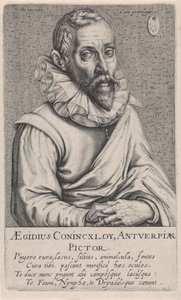
1544–1607, Belgien
Gillis Van Coninxloo
Ein Meister des grünen Reiches Gillis van Coninxloo gilt als eine Schlüsselfigur in der Entwicklung der nordischen Landschaftsmalerei und bildet eine entscheidende Brücke zwischen den komplexen Traditionen des Manierismus und der aufkeimenden atmosphärischen Tiefe des frühen Barock. Geboren in Antwerpen, Belgien, war sein Leben tief mit dem reichen künstlerischen Erbe der Niederlande verwoben. Als Sohn eines Malers war er in eine Welt eingetaucht, in der handwerkliches Geschick und die Beobachtung der Natur an oberster Stelle standen. Seine frühe Ausbildung unter Meistern wie Pieter Coeelle van Aelst dem Jüngeren und Lenaert Kroes verlieh ihm ein fundiertes Fundament, doch erst seine Zeit in der Werkstatt von Gillis Mostaert ermöglichte es seinem Talent, wahrlich zu erblühen; sie erlaubte ihm, an professionellen Werken mitzuwirken und gleichzeitig seine ganz eigene Vision zu schärfen.
Über Gillis Van Coninxloo Bemerkenswerte Werke von Gillis Van Coninxloo
Ebenfalls von Gillis Van Coninxloo
 Jona predigt den Niniviten1583
 Waldlandschaft mit dem Heiligen Hieronymus1583
 Landschaft mit dem Urteil des Midas1598
 Landschaft mit dem Urteil des Paris1610
Essays zu Forest Landscape
 Französische Barbizon-MalerEntdecken Sie die Meister der Barbizon-Schule wie Rousseau und Daubigny. Erleben Sie Ikonen der Landschaftsmalerei auf OriginalUniqueArt.co…
 Magische Wälder: 10 Meisterwerke, die die Seele des Waldes einfangenEntdecken Sie Wald-Meisterwerke von Van Gogh bis Klimt. Erleben Sie zeitlose Kunst auf OriginalUniqueArt.com. Jetzt die Kollektion online e…
 Mastering the Horizon: An Art Historian’s Guide to the World's Most Iconic Landscape PaintingsExplore the profound history of landscape painting with our expert guide. From Impressionist light to Chinese traditions, discover the tech…