Ölversion kaufen
 Alles über Pipe







































 Bei Kunstwerken oder Reproduktionen, die an einer Seite größer als 105 cm (ca. 41 Zoll) sind, wird der Rahmen zerlegt als Bausatz geliefert. Diese Methode gewährleistet eine sichere Zustellung und verhindert Schäden während des Transports.


The Quietude of Clay
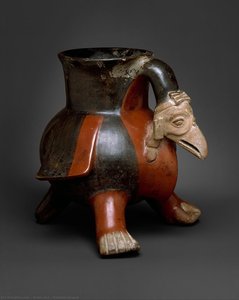
In the dim light of a private collection, this ceramic pipe from 1521 reveals itself through its deep, dark tones. It is a somber object, rendered in shades of brown and black that suggest the earth from which it was shaped. The surface is not merely colored but deeply worked, with geometric patterns carved directly into the clay. These lines—zigzags, curves, and circles—wrap around the body of the pipe, creating a rhythmic texture that catches the light softly. It is a piece of functional art, designed for the ritual of smoking, yet it carries a weight that transcends its utility.
Form and Symbolism
The craftsmanship speaks to a specific moment in the final years of the Aztec Empire. The artisan used hand-carving and burnishing to achieve a surface that is smooth to the touch, despite the intentional roughness of the incised patterns. There is a deliberate precision in the way the shapes repeat, reflecting a worldview where geometry and cosmology were inseparable.
- Material: Ceramic or terracotta
- Technique: Hand-carving and burnishing
- Motifs: Repeating zigzags, curves, and circles
- Color: Limited palette of brown and black
The patterns likely held ritualistic significance, perhaps connecting the user to the cosmic order through the very act of inhalation. The angularity of the shapes reflects the aesthetic conventions of Mesoamerican craftsmanship, where every line serves a purpose.
A Fragment of History
To hold such an object is to touch the edge of a vanished era. Created in 1521, this pipe belongs to the twilight of the Aztec civilization in Tenochtitlan, Mexico. It exists as a physical remnant of a culture that expressed its complex social and religious hierarchies through material objects. The simplicity of its composition—a single object against a neutral void—forces a direct encounter with the hand of the maker. It is a quiet, heavy presence that speaks of the rituals of the past without the need for ornament.
Fragen & Antworten
Ist das Kunstwerk Pipe handgemalt oder ein Druck?
Handgemalt: Ein ausgebildeter Maler repliziert Pipe in Öl auf Leinenleinwand.
Welche Größe sollte ich für Pipe wählen?
Die Größen reichen von 24.2 x 41.3 cm (€179) bis 141.6 x 241.7 cm (€1168); die Tabelle auf dieser Seite listet die wichtigsten Formate und deren Preise auf.
Wie lange dauert die Lieferung?
Die Lieferung dauert 4 bis 5 Wochen mit kostenlosem weltweiten Expressversand; auf dieser Seite wird eine Option für eine eilige Produktion angeboten. Sie können das Kunstwerk innerhalb von 100 Tagen ohne Einschränkungen an uns zurückgeben und erhalten eine vollständige Rückerstattung.
Wo befindet sich das Original von Pipe?
Das Original befindet sich in der Sammlung des Metropolitan Museum of Art, New York.
Welches Medium hat Azteken für Pipe verwendet?
Ceramic
 Versenden
 Teilen
 Details anzeigen
 Infoblatt


 Herunterladen
 Ähnliche Objekte
 Diashow
 Fragen & Antworten

 Statistiken