Zum Druck wechseln
 Weiterlesen







































 Bei Kunstwerken oder Reproduktionen, die an einer Seite größer als 105 cm (ca. 41 Zoll) sind, wird der Rahmen zerlegt als Bausatz geliefert. Diese Methode gewährleistet eine sichere Zustellung und verhindert Schäden während des Transports.


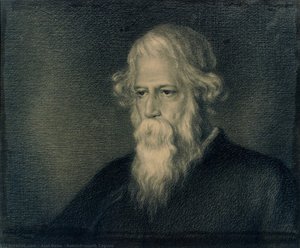
Rabindranath Tagore: A Portrait of Wisdom and Reflection
The painting “Rabindranath Tagore” by Atul Basu is more than just an image; it’s a distillation of intellect, compassion, and the enduring spirit of Bengali culture. Executed in 1944, during a period marked by significant political upheaval in India – specifically the waning days of British rule – Basu's artwork transcends mere representation, delving into the psychological depth of its subject. It captures Tagore not as a grand figure of history, but as a man wrestling with profound questions about humanity and spirituality.- Style: Basu’s approach leans heavily toward graphic art, prioritizing clarity and precision in line and form. This stylistic choice reflects the influence of René Magritte and Martin Gardner, artists who championed conceptual art and challenged viewers to engage actively with visual stimuli.
- Technique: The painting utilizes oil paints on plywood – a relatively inexpensive medium that allowed Basu to focus on capturing subtle nuances of expression. His meticulous brushstrokes convey a remarkable level of detail, particularly in the rendering of Tagore’s facial features and hair style, highlighting his distinctive appearance.
- Historical Context: Created amidst the tumultuous backdrop of India's independence movement, “Rabindranath Tagore” speaks to the anxieties and aspirations of a nation striving for self-determination. The painting subtly embodies the humanist ideals championed by Tagore himself – values rooted in Upanishadic philosophy that emphasized inner contemplation and ethical conduct.
- Symbolism: Beyond mere likeness, the painting embodies symbolic representations of wisdom and contemplation. Tagore’s beard and mustache serve as visual anchors for his intellectual stature, while his hairstyle reflects the traditions of Bengal.
- Emotional Impact: Basu's artwork evokes a feeling of serenity mingled with thoughtfulness. It invites viewers to contemplate the profound questions posed by Tagore’s gaze – questions about morality, spirituality, and the human condition.
Fragen & Antworten
Unter welchen Pseudonymen oder Alternativnamen ist Atul Basu bekannt?
Atul Basu ist auch unter den Namen Atul Bose bekannt.
Woher kommen die Besucher von "Rabindranath Tagore" von Atul Basu?
Für „Rabindranath Tagore“ gibt es eine Besucherzahlen-Seite. Sie zeigt die monatlichen Aufrufe des Kunstwerks sowie weiterer Werke des Künstlers mit einer Aufschlüsselung nach Land und Sprache an.
Welcher Kunstrichtung lässt sich "Rabindranath Tagore" von Atul Basu zuordnen?
„Rabindranath Tagore“ ist ein Werk der Graphic art. Die Stilrichtung gibt die künstlerische Tradition an, der das Werk angehört.
 Vorschau anzeigen
 Versenden
 Teilen
 Details anzeigen
 Leitfaden

 Herunterladen
 Ähnliche Objekte
 Röntgenaufnahme
 Diashow
 Fragen & Antworten
 Statistiken