Gotik · 1315
Maestæ (Simone Martini, 1315)
Simone Martini (1284–1344) har skabt Maestæ. Det er fra 1315. Det tilhører Gotik-bevægelsen. Den er udført i Fresco. Det opbevares på Palazzo Pubblico i Siena, Italien.
- 1315
- Fresco
- Palazzo Pubblico, Siena

 Håndmalet oliemalerie
 Del som kort
 Del
 Faktablad


 Download
 Lignende værker
 Diasshow
 Spørgsmål og svar

 Statistikker
Maestæ kort fortalt
- Titel
- Maestæ
- Kunstner
- Simone Martini (1284–1344)
- Kunstner født i
- Siena, Italien
- Dato
- 1315
- Medium
- Fresco
- Hvor det kan ses
- Palazzo Pubblico, Siena, Italien
- Bevægelse
- Gotik
- Periode
- Senmiddelalderen
- Motiv
- virgin mary, child jesus, religious iconography, medieval art, siena painting, fresco technique
Hvad forestiller Maestæ?
Simone Martini’s Maestà: A Symphony of Grace and Devotion
Simone Martini’s *Maestà*, completed around 1315, isn't merely a painting; it’s an emblem of Sienese artistic excellence during the Gothic Revival. Executed in fresco on the walls of Siena Cathedral, this monumental artwork represents arguably the pinnacle of Martini’s stylistic prowess and embodies the spiritual fervor of his era. The sheer scale of the commission speaks volumes about the importance placed upon religious iconography within the city's cultural landscape. It’s a testament to Martini’s ability to transform abstract theological concepts into palpable visual beauty—a feat achieved through meticulous observation and masterful execution.- Style & Technique: Martini’s approach distinguishes him from his predecessors, notably Giotto di Bondone. While Giotto championed realism, Martini prioritized elegance and refinement, drawing heavily on Byzantine influences – specifically the mosaics of Hagia Sophia in Constantinople. This stylistic choice resulted in a flattened perspective, prioritizing decorative detail over accurate representation. The fresco technique itself demanded incredible patience and precision; applying pigment onto wet plaster required painstaking layering and blending to achieve luminous colors and subtle gradations.
- Historical Context: Siena during Martini’s lifetime was a powerful papal state grappling with political instability and religious reform. The *Maestà* reflects this turbulent period, serving as a symbol of papal authority and piety—a deliberate statement intended to reaffirm the Church's dominance amidst challenges posed by burgeoning humanist thought. Its creation coincided with a renewed interest in Byzantine art, fueled by pilgrimages to Constantinople and the dissemination of illuminated manuscripts.
- Emotional Impact: *Maestà* transcends mere visual representation; it evokes a profound sense of serenity and reverence. The delicate colors—primarily blues, reds, and golds—harmoniously blend to create an atmosphere of ethereal beauty. Martini’s meticulous attention to detail invites viewers into a contemplative space where they can contemplate themes of faith, compassion, and divine grace. It remains a powerful reminder of the enduring legacy of medieval art and its capacity to inspire awe and wonder.
Hvilket museum udstiller Maestæ?
Palazzo Pubblico
Siena, Italien
Oprindelse og historie bag Palazzo Pubblico Palazzo Pubblico er et historisk palads beliggende i Siena, Italien. Opførelsen af denne storslåede struktur begyndte i 1297 med det formål at skabe en residens til regeringen i Republikken Siena. Dette styrende organ bestod af Podestàen og De Nines Råd, og Republikken Siena formåede at opretholde sin uafhængighed i over 400 år, fra dens eksistens i 1125 og frem til 1555.


Højopløselige billeder af Maestæ
Public domain: kunstneren døde i 1344.
Simone Martini, Maestæ (1315), Palazzo Pubblico. Public domain
Spørgsmål om Maestæ besvaret
Hvilket museum udstiller det originale "Maestæ"?
"Maestæ" af Simone Martini er udstillet på Palazzo Pubblico, Siena, Italien. Museets fortegnelse henviser til det originale værk og ikke til reproduktioner.
Hvornår er "Maestæ" af Simone Martini skabt?
"Maestæ" stammer fra 1315. Datoen placerer værket i Simone Martini's karriere og dets tidsalder.
Hvilket medie er "Maestæ" af Simone Martini udført i?
Simone Martini brugte Fresco-teknikken til "Maestæ". Teknikken definerer det originale værks materielle karakter.
Hvad forestiller "Maestæ" af Simone Martini?
"Maestæ" af Simone Martini forestiller: virgin mary, child jesus, religious iconography, medieval art, siena painting, fresco technique, renaissance elegance.
Er billedet af "Maestæ" af Simone Martini frit tilgængeligt i det offentlige domæne?
Ophavsretsstatus for "Maestæ" af Simone Martini: værket er i det offentlige domæne – ophavsretten er udløbet. Dette afgør, om der frit må foretages reproduktioner af billedet.
Hvem er kunstneren bag "Maestæ"?
"Maestæ" blev skabt af Simone Martini. Informationen på denne side beskriver Simone Martinis originale værk.
Hvilken kunstretning tilhører "Maestæ" af Simone Martini?
"Maestæ" af Simone Martini tilhører Gotik-bevægelsen. Denne bevægelse giver den stilistiske kontekst for værket.
Hvor i Simone Martinis karriere placerer "Maestæ" sig?
Inden for Simone Martinis karriere tilhører "Maestæ" perioden Mature Period, hvilket gør det muligt at sammenligne værket med kunstnerens øvrige værker.
Hvor gammel var Simone Martini, da "Maestæ" blev skabt?
Simone Martini skabte "Maestæ" i en alder af 31. Kunstneren blev født i 1284, og værket er dateret 1315.
Om kunstneren, Simone Martini

1284–1344, Italien
Simone Martini
Livet og identiteten bag Simone Martini Født i Siena, Italien, omkring 1284, levede Simone Martini et liv, der spejlede sin tids skiftende strømninger. Kendt også som Simone di Martino, var han en central skikkelse i udviklingen af det tidlige italienske maleri. Hans tilstedeværelse i kunstverdenen kunne mærkes fra hjertet af Toscana til de franske pavehoffer, hvilket markerede ham som en mand, hvis rækkevidde strakte sig langt ud over hans fødested. Han var en maler, der forstod sin tids sprog, og som bevægede sig gennem Europas religiøse og borgerlige centre med en stødig og målrettet hånd.
Om Simone Martini Bemærkelsesværdige værker af Simone Martini
Også af Simone Martini
 Bebudelsen og To Hellige1333
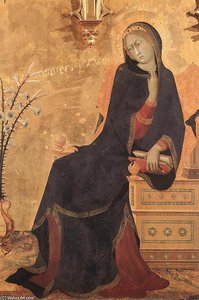 Bebudelsen og to helgener (detalje)1333
 Forkyndelsen med Sankt Margeret og Sankt Ansanus1333
 St Clare and St Elizabeth of Hungary1317
Essays om Maestæ
 Italian proto-renaissance paintersMasterpieces by Giotto and Duccio define the Italian Proto-Renaissance. Explore the full collection online at OriginalUniqueArt.com.
 14th century Italian paintersMasterpieces by Giotto and Duccio define the Trecento era. Explore museum-quality reproductions on OriginalUniqueArt.com.
 Understanding Gothic and Renaissance Art: Key Differences and FeaturesMaster the differences between Gothic and Renaissance art through expert analysis of technique and style. Discover the evolution of art tod…