Skift til printsalg
 Vis mere







































 For kunstværker eller reproduktioner, der er større end 105 cm (ca. 41 tommer) på en hvilken som helst side, vil rammen blive leveret som et adskilt sæt. Denne metode sikrer sikker levering og forhindrer skader under transport.


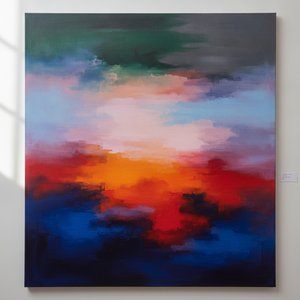
A Symphony of Color: Exploring Mark Rothko’s ‘Greens and White in Blue’
‘Greens and White in Blue’ is a quintessential example of Mark Rothko's mature style – a deeply resonant work that exemplifies the principles of Color Field painting. Created sometime between 1950-1970, this piece transcends mere visual representation, inviting viewers into a contemplative space defined by subtle color relationships and emotive power. It isn’t about *what* is depicted, but rather *how* the colors make you feel.Deconstructing the Composition
The painting presents three horizontal rectangular blocks stacked vertically, each a distinct yet harmoniously blended field of color. The uppermost band radiates a deep, saturated blue that gently lightens as it descends. Below this lies a transition from dark, earthy green to a luminous teal, evoking natural landscapes – perhaps forests meeting the sea. Finally, the bottom section is an ethereal white, subtly textured and nuanced, providing a grounding presence.- Layered Depth: The blurred edges between these color blocks aren’t accidental; they create a sense of atmospheric depth, as if peering through layers of mist or water.
- Brushwork & Texture: Rothko's broad brushstrokes are visible upon close inspection, lending the painting a tactile quality and emphasizing the physicality of the paint itself. This isn’t about smooth perfection; it’s about expressive gesture.
- Absence of Focal Point: The composition deliberately lacks a central focal point. Instead, your eye is encouraged to wander across the canvas, absorbing the subtle shifts in tone and color, fostering a meditative experience.
Rothko & The Color Field Movement
Mark Rothko (born Marcus Rothkowitz in Latvia in 1903) was a pivotal figure in the Abstract Expressionist movement. However, he soon diverged from his peers to pioneer what became known as Color Field painting. This style rejected representational imagery entirely, focusing instead on the emotional and spiritual impact of color itself. Influenced by modernist painters like Henri Matisse and Wassily Kandinsky, Rothko sought to create paintings that were akin to religious experiences – portals to a deeper realm of feeling. He believed color could express fundamental human emotions: tragedy, ecstasy, doom.Symbolism & Emotional Resonance
While Rothko resisted definitive interpretations of his work, the colors in ‘Greens and White in Blue’ carry inherent symbolic weight. Blue often represents tranquility, depth, and spirituality; green evokes nature, growth, and renewal; while white symbolizes purity, peace, and transcendence.- Evoking Nature: The color palette subtly hints at natural elements – sky, water, foliage – without directly depicting them.
- Emotional Landscape: The painting isn’t a depiction *of* emotion, but rather an attempt to *evoke* emotion within the viewer. It's about creating a space for introspection and personal connection.
- Spiritual Dimension: Rothko intended his paintings to be experienced as spiritual encounters, offering solace and contemplation in a chaotic world.
Integrating ‘Greens and White in Blue’ into Your Space
This artwork's serene palette and minimalist composition make it incredibly versatile for interior design. It would complement a range of styles:- Modern & Contemporary Spaces: Its abstract nature aligns perfectly with modern aesthetics, adding depth and sophistication.
- Minimalist Interiors: The painting’s simplicity enhances minimalist spaces without overwhelming them.
- Calming Environments: The cool tones of blue and green create a calming atmosphere, ideal for bedrooms, meditation rooms, or offices.
Spørgsmål og svar
Hvor kommer de besøgende til "Greens and White in Blue" af Mark Rothko fra?
Siden Besøgsstatistik for "Greens and White in Blue" af Mark Rothko præsenterer statistikker over offentlige besøg: månedlige besøg af dette kunstværk, en sammenligning med kunstnerens mest sete værker og hvor de besøgende kommer fra.
Er Mark Rothko, skaberen af "Greens and White in Blue", kendt under andre navne?
Mark Rothko optræder under de alternative navne Marcus Rothkowitz.
Hvilken stilart tilhører "Greens and White in Blue"?
Kunstretningen forbundet med "Greens and White in Blue" af Mark Rothko er Color Field Painting. Denne klassificering placerer værket blandt relaterede kunstnere og kunstværker.
 Se i rummet
 Del som kort
 Del
Del
 Detaljer
 Guide
Guide

 Download
 Lignende værker
 Røntgenundersøgelse
 Diasshow
 Spørgsmål og svar
 Statistikker