Abstract Expressionism
Abstrakt maleri (Mark Rothko)
Mark Rothko (1903–1970) har skabt Abstrakt maleri. Det tilhører Abstract Expressionism-bevægelsen. Den er udført i Olie på lærred.
- Olie på lærred

 Se i rummet

 Håndmalet oliemalerie
 Del som kort
 Del
 Faktablad


 Download
 Lignende værker
 Røntgenundersøgelse
 Diasshow
 Spørgsmål og svar

 Statistikker
Abstrakt maleri kort fortalt
- Titel
- Abstrakt maleri
- Kunstner
- Mark Rothko (1903–1970)
- Kunstner født i
- Daugavpils, Letland
- Medium
- Olie på lærred
- Bevægelse
- Abstract Expressionism
- Periode
- Moderne tid
- Motiv
- color field, geometric abstraction, emotional resonance, minimalism, monochromatic palette, rothko style
Hvad forestiller Abstrakt maleri?
Exploring Mark Rothko’s Abstract Expressionism
Mark Rothko (1903–1970) stands as one of the most influential figures in American abstract expressionism, a movement that irrevocably altered the course of 20th-century art. While seemingly simple—a large canvas dominated by deep gray—Rothko’s paintings are profoundly complex explorations of color, form, and emotional resonance. They represent more than just visual aesthetics; they embody a quest for spiritual experience and invite viewers into a contemplative dialogue. Born in Latvia to Jewish parents, Rothko emigrated to the United States as a child, shaping his artistic vision through experiences of displacement and loss—themes that permeate his oeuvre. His early work moved from figurative painting towards abstraction, mirroring broader cultural anxieties surrounding identity and faith during World War II.Deconstructing the Composition
Rothko’s signature technique – full-field application of paint – eschews traditional compositional devices like focal points or linear perspective. Instead, he presents rectangular blocks of color that extend across the entire canvas, creating an immersive environment for the observer. This deliberate absence of recognizable imagery is crucial to Rothko's intention: it compels viewers to bypass intellectual analysis and respond directly to the emotional impact of the colors themselves. The geometric simplicity of these rectangles—the canvas itself and its frame—emphasizes purity of form and contributes to a sense of serene contemplation. Careful consideration was given to the placement of each block, maximizing visual depth without resorting to illusionistic techniques.Technique & Materials
Rothko’s meticulous approach to painting involved layering paint multiple times to achieve subtle tonal variations within the monochromatic field. He utilized brushes or rollers with considerable precision, applying pigment evenly across the surface—a technique that prioritizes texture and materiality over expressive brushstrokes. The materials – canvas stretched tautly on a wooden frame and oil paint – were fundamental to Rothko’s artistic vision. Rejecting virtuoso brushwork, he sought to transcend technical skill and communicate emotion through pure color alone. This dedication to craft underscores the seriousness of his artistic endeavor.Historical Context & Artistic Evolution
Rothko emerged during a period marked by existential questioning and disillusionment following World War II—a time when artists grappled with questions of meaning and morality in the face of overwhelming trauma. He was deeply influenced by Surrealism, particularly André Masson’s exploration of automatic drawing techniques, which encouraged spontaneity and subconscious expression. Alongside Barnett Newman and Jackson Pollock, Rothko spearheaded the development of Color Field painting, a radical departure from representational art that challenged conventions of visual perception. His work reflects a desire to transcend rational thought and access deeper levels of consciousness—a pursuit that aligns with broader philosophical currents of the era.Symbolism & Emotional Impact
While Rothko resisted explicit interpretations of his paintings, their profound emotional depth speaks for itself. The dominant gray hue evokes feelings of quietude, melancholy, or perhaps spiritual yearning – inviting viewers to engage in a personal reflection on themes of mortality and transcendence. Critics have noted that Rothko’s canvases are “serious religious experiences,” reflecting his conviction that art could serve as a conduit for accessing the sublime. Consider this artwork when designing interior spaces—its minimalist aesthetic complements contemporary styles while fostering an atmosphere conducive to contemplation and introspection. The deliberate absence of visual distraction encourages viewers to immerse themselves in the experience of color, creating a connection between the viewer and the artwork that transcends mere observation.Højopløselige billeder af Abstrakt maleri
Protected by copyright: these files are for personal reference, not a licence to republish.
Mark Rothko, Abstrakt maleri.
Spørgsmål om Abstrakt maleri besvaret
Hvilket medie er "Abstrakt maleri" af Mark Rothko udført i?
"Abstrakt maleri" af Mark Rothko er udført i Olie på lærred. Reproduktionerne har til formål at gengive denne tekniks visuelle udtryk.
Hvad forestiller "Abstrakt maleri" af Mark Rothko?
"Abstrakt maleri" af Mark Rothko forestiller: color field, geometric abstraction, emotional resonance, minimalism, monochromatic palette, rothko style, meditative art.
Er "Abstrakt maleri" fri for ophavsret?
Hvad angår ophavsret, er "Abstrakt maleri" stadig beskyttet af ophavsret.
Hvilken kunstner tilskrives "Abstrakt maleri"?
Kunstneren bag "Abstrakt maleri" er Mark Rothko. Værket er katalogiseret under Mark Rothkos navn.
Hvilken kunstretning tilhører "Abstrakt maleri" af Mark Rothko?
"Abstrakt maleri" er et værk fra Abstract Expressionism. Denne stilart angiver den kunstneriske tradition, som værket indgår i.
Hvilken periode i Mark Rothkos karriere tilhører "Abstrakt maleri"?
"Abstrakt maleri" tilhører Mature Period i Mark Rothkos karriere. Denne klassificering knytter værket til kunstnerens udvikling.
Hvad er årsagen til ophavsretsstatus for "Abstrakt maleri" af Mark Rothko?
"Abstrakt maleri" af Mark Rothko er stadig beskyttet af ophavsret. Ophavsretten løber fra kunstnerens dødsår, som var 1970.
Hvordan passer "Abstrakt maleri" ind i Mark Rothkos temaer og stil?
"Abstrakt maleri" er et værk fra Mark Rothkos Abstract Expressionism-periode, hvis gennemgående temaer inkluderer post-war anxiety, existential reflection, color as emotion, rothko’s legacy, influence of surrealism, minimalist aesthetic, religious symbolism.
Hvor placerer "Abstrakt maleri" sig blandt Mark Rothkos gennemgående motiver?
"Abstrakt maleri" skildrer color field, geometric abstraction, emotional resonance, minimalism, monochromatic palette, rothko style, meditative art, mens Mark Rothkos registrerede temaer er post-war anxiety, existential reflection, color as emotion, rothko’s legacy, influence of surrealism, minimalist aesthetic, religious symbolism. En sammenligning af de to viser, hvordan værket relaterer sig til kunstnerens sædvanlige motiver.
Om kunstneren, Mark Rothko

1903–1970, Letland
Mark Rothko
Mark Rothkos tidlige liv Mark Rothko blev født som Markus Yakovlevich Rothkowitz i 1903. Han blev født i Dvinsk, Rusland, i et område, der i dag er kendt som Daugavpils i Letland. Hans familie levede inden for Pale of Settlement, en region præget af politisk uro og den konstante skygge fra pogromer. Denne atmosfære af ustabilitet fulgte med familien, da de emigrerede til USA i 1913.
Også af Mark Rothko
 Hvid Center1950
 Ingen.
 Nr. 61 (Rust og Blå)1953
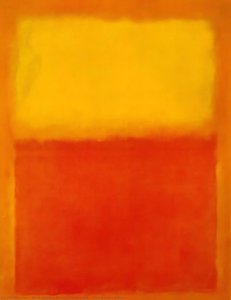 Orange og gul1956
Essays om Abstrakt maleri
 The Sublimity of Color: Exploring the Emotional Landscapes of Mark Rothko's Abstract ExpressionismExplore the profound emotional depth of Mark Rothko's abstract expressionism. Discover the history, techniques & lasting impact of this piv…
 Expressionism vs. Abstract Expressionism: Distinguishing the Two MovementsMaster the differences between Expressionism and Abstract Expressionism with our expert analysis. Learn to distinguish these key movements …
 Understanding Mark Rothko: The Emotional Power of Color Field AbstractionMaster the emotional depth of Mark Rothko's color field abstraction. Explore his technique and evolution through expert art history analysi…