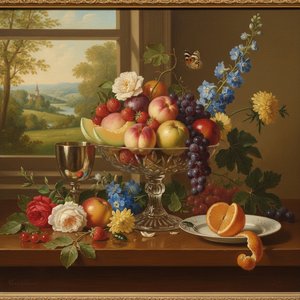
Still Life with Fruit
Håndlavet oliereproduktion
Håndmalet olie på lærred i din valgte størrelse og ramme, udført efter bestilling af vores kunstnere. ( Køb print
Køb billede)
P118B $10
P118H $10
P118W $10
P438Z $10
P508JH $12
P508YH $12
P805H $10
P805Z $10
P919BZ $10
P919G $10
P919XJ $10
P959ZH $10
P968JZ $12
W106C $8
W218G $10
W218JH $8
W218Y $10
W307PJ $10
W316G $10
W316PJ $8
W316Y $10
W398PJ $8
W4111J $10
W500HY $15
W500JH $15
W692G $12
W849H $8
W940BG $15
W953PJ $8
Vælg mellem vores forudindstillede størrelser, der matcher kunstværkets originale proportioner.
Du kan indtaste dine egne mål for at passe til en bestemt ramme eller plads. Hvis den valgte størrelse ikke stemmer overens med det originale billedes proportioner, vil vi enten beskære kunstværket eller udvide maleriet med yderligere håndmalede elementer. En digital skitse sendes til din godkendelse, før produktionen påbegyndes.

Bemærk venligst, at forhåndsvisningen på skærmen ikke afspejler den faktiske beskæring eller udvidelse. Kun skitsen vil nøjagtigt vise den endelige komposition.
Selvom specialmål er mulige, anbefaler vi at vælge en dimension fra den foruddefinerede liste for at bevare de originale proportioner.
Efter bestilling vil OriginalUniqueArt.com team sende en e-mail til kunden for at få instruktioner og levere et udkast til en skitse.
Levering i hele verden () på 3/4 uger i stedet for de standard 5 uger. (19 august). Ingen kompromiser med kvaliteten.
Gratis ekspresforsendelse til hele verden
Lærred af linned i høj kvalitet
Fuld transportforsikring
Garanti for refusion af told og importafgifter
Garanti for præcis farvegengivelse
60 dages returret (kun ved fabrikationsfejl)
100% Tilfredshedsgaranti
Mængderabat tilgængelig
Still Life with Fruit
Reproduktionsmetode
Størrelse på reproduktion
-
Samlet pris
$ 300
Beskrivelse af kunstværket
A Symphony of Color and Form: James Peale’s Still Life with Fruit
James Peale's Still Life with Fruit, painted circa 1821, is more than just a depiction of perishable bounty; it’s a meticulously crafted window into the burgeoning aesthetic sensibilities of early America. This remarkable work, now housed within the collections of museums and art institutions worldwide, reveals a masterful blend of Neoclassical restraint and Baroque exuberance – a testament to Peale's artistic versatility and his deep understanding of both European traditions and the evolving American visual landscape.
The painting immediately captivates with its rich palette. Deep crimson peaches glow alongside the vibrant yellows of ripe pears, while the verdant greens of grapes and leafy foliage provide a grounding counterpoint. Peale’s technique is characterized by an almost obsessive attention to detail; each fruit is rendered with astonishing realism – the subtle variations in skin texture, the delicate veins tracing across leaves, even the slight imperfections that speak to their natural origins. This commitment to accuracy wasn't merely technical; it reflected a broader fascination with the natural world prevalent during this period, fueled by advancements in scientific observation and botanical illustration.
The Miniature Master’s Grand Vision
While often associated with his exquisite miniature portraits – a genre where Peale truly excelled – Still Life with Fruit demonstrates his ambition to tackle larger-scale works. This shift reflects a growing interest in still life painting within the American art world, influenced by European trends and a desire to elevate the status of decorative arts. Peale’s background as a cabinetmaker undoubtedly informed his approach; he clearly valued craftsmanship and sought to imbue his paintings with a sense of tactile richness. The arrangement of the fruit itself is carefully considered – a deliberate composition designed to draw the eye across the canvas, creating a dynamic visual rhythm.
Interestingly, Peale’s career was punctuated by military service during the American Revolution, an experience that instilled in him a disciplined approach to observation and execution. This dedication translates into the painting's remarkable clarity and precision. The lighting is particularly noteworthy – a dramatic chiaroscuro effect that casts deep shadows and highlights the luminous surfaces of the fruit, adding depth and drama to the scene.
Symbolism and the American Spirit
Beyond its technical merits, Still Life with Fruit carries symbolic weight. Fruit, in this context, represents abundance, prosperity, and the rewards of labor – themes deeply resonant within the developing American identity. The variety of fruits—peaches, pears, grapes—suggests a connection to the land and a celebration of its bounty. It’s a visual affirmation of the nation's potential for growth and success.
Furthermore, the painting can be viewed as an embodiment of Neoclassical ideals – order, balance, and harmony. The carefully arranged composition, the restrained color palette, and the meticulous rendering of detail all contribute to this sense of formal elegance. However, Peale subtly infuses this formality with a touch of Baroque exuberance—the dramatic lighting, the rich colors, and the sheer abundance of fruit create an atmosphere of opulent delight.
A Timeless Appeal
Still Life with Fruit remains a captivating work of art, offering a glimpse into the artistic and cultural landscape of early America. Its meticulous detail, evocative symbolism, and masterful technique continue to resonate with viewers today. Whether admired for its historical significance or simply appreciated for its aesthetic beauty, this painting stands as a testament to James Peale’s artistry and his enduring legacy.
Kunstnerens biografi
James Peale: A Quiet Master of Miniature and Still Life
James Peale (1749 – May 24, 1831) was an American painter celebrated for his exquisite miniature portraits & vibrant still life paintings, and a younger brother of noted painter Charles Willson Peale. He captured colonial America with neoclassical grace, establishing himself as one of the foremost artists of his time—a figure whose understated brilliance continues to resonate today.- Early Life and Apprenticeships
- Military Service and Revolutionary Experience
- Collaboration with Charles Peale and Artistic Development
- The Miniature Portrait Genre: Precision and Emotion
- Still Life Painting: Light, Texture, and Observation
Early Life and Apprenticeships
James Peale was born in Chestertown, Maryland, the second child, after Charles, of Charles Peale (1709–1750) and Margaret Triggs (1709–1791). His father died when he was an infant, and the family moved to Annapolis shortly thereafter. Young James began his artistic education early, undertaking apprenticeships in saddlery and cabinetmaking—trades that instilled within him a meticulous attention to detail and craftsmanship, qualities which would prove invaluable throughout his career. These formative experiences shaped his understanding of material and technique, laying the groundwork for his later mastery of watercolor on ivory.Military Service and Revolutionary Experience
The burgeoning revolutionary fervor dramatically altered James Peale’s trajectory. In 1769 he enlisted in William Smallwood's regiment within the Continental Army—a decision driven not only by patriotic duty but also by a profound immersion into the realities of war. He swiftly ascended through the ranks, demonstrating courage and tactical acumen during pivotal battles—Long Island, White Plains, Trenton, Brandywine, Germantown, Princeton, and Monmouth—witnessing firsthand the hardships endured by soldiers and the heroism displayed on the battlefield. This military service instilled within him not only bravery but also a keen observational skill—a capacity to register nuance under pressure—influencing his artistic sensibility.Collaboration with Charles Peale and Artistic Development
Following his return from London in 1769, where he studied under Benjamin West, James Peale joined forces with his brother Charles, establishing a studio that became a crucible for artistic innovation. Together they designed floats for Philadelphia’s grand procession celebrating the ratification of the United States Constitution—a testament to their shared commitment to republican ideals and their collaborative spirit. This partnership fostered intellectual exchange and propelled both artists toward new creative horizons.The Miniature Portrait Genre: Precision and Emotion
James Peale distinguished himself as a master of watercolor on ivory, achieving unparalleled renown for his miniature portraits. These exquisitely detailed depictions captured not merely likeness but also the essence of character—a feat accomplished through painstaking observation and masterful technique. Unlike larger canvases that prioritize grandeur, miniatures demanded an intimacy of execution, requiring artists to convey profound emotion within a confined space. Peale’s miniatures stand as enduring symbols of personal connection and artistic refinement.Still Life Painting: Light, Texture, and Observation
Beyond portraiture, James Peale excelled in still life compositions—particularly those featuring fruit—demonstrating an exceptional ability to render textures, light, and form with breathtaking realism. His canvases glowed with luminosity, capturing the subtle nuances of color and surface detail—a testament to his unwavering dedication to scientific observation and artistic expression. Like his brother Charles, Peale’s work embodies the neoclassical aesthetic—characterized by clarity, restraint, and an appreciation for natural beauty.Legacy and Influence
James Peale's contribution to American art history is undeniable. He solidified his place as a pivotal figure in establishing an authentically American artistic identity—a legacy preserved through the enduring beauty of his paintings and the influence he exerted on generations of artists who followed him. His meticulous approach, combined with his sensitivity to emotion, continues to inspire admiration and scholarly study.James Peale
1749 - 1831 , USA
Kort om kunstneren
- Artistic Movement Or Style: Neoklassicisme
- Artists Or Movements Influenced By This Artist: ['Charles Willson Peale']
- Artists Who Influenced This Artist: ['Benjamin West']
- Date Of Birth: 1749
- Date Of Death: 1831
- Full Name: James Peale
- Nationality: Amerikaner
- Notable Artworks:
- Portrætter af prominente personer
- Fruit Still Lifes
- Place Of Birth: Chestertown, Maryland


Glasmulighed er kun tilgængelig i størrelser under 110 cm