Portrét Valentin De Boulogne

54 nejslavnějších obrazů autora Valentin De Boulogne, každý naprosto unikátní

Aktualizováno listopad 2026 · seřazeno podle našeho skóre popularity (vyhledávání, návštěvy a objednávky u každého díla) · 55 děl umělce Valentin De Boulogne v našem katalogu

Stručně řečeno

The Last Supper (1625) je obraz autora Valentin De Boulogne, který přitahuje nejvíce pohledů; originál se nachází v Galleria Nazionale d'Arte Antica, Řím. Poté se zrak přesouvá k Card-sharpers (1620) a The Judgment of Solomon (1625). Z 55 děl umělce Valentin De Boulogne v našem katalogu je těchto 54 těch nejznámějších; každé z nich je unikátním originálem s uvedením roku vzniku, muzea a důvodu jeho nesmrtelnosti.

1591 – 1632, Coulommiers Baroque Nejvíce děl: Louvre

Top 10 obrazů autora Valentin De Boulogne podle výběru galerie

1
The Last Supper (1625) od Valentin De Boulogne

The Last Supper

1625 · Oil On Canvas · Galleria Nazionale d'Arte Antica, Řím

To gaze upon this depiction of The Last Supper is to step directly into a moment suspended between profound intimacy and monumental historical weight. It captures the ultimate communion—the final meal shared by Jesus Christ and his twelve apostles. More than just a religious scene, it is a masterful study in human reaction under divine revelation. The composition centers around the long, richly appointed dining table, which dominates the foreground,…

2
Card-sharpers (1620) od Valentin De Boulogne

Card-sharpers

1620 · Oil On Canvas · Gemäldegalerie Alte Meister, Dresno

To gaze upon Valentin de Boulogne's Card-sharpers is to step directly into the smoky, charged atmosphere of a clandestine gathering in early 17th-century Rome. This oil on canvas, dating from 1620, is far more than a mere depiction of a card game; it is a masterful study in human psychology, tension, and the subtle art of misdirection. De Boulogne captures that fleeting moment when concentration borders on obsession, where the…

3
The Judgment of Solomon (1625) od Valentin De Boulogne

The Judgment of Solomon

1625 · Oil On Canvas · Louvre, Paříž

To stand before Valentin de Boulogne’s depiction of The Judgment of Solomon is to be enveloped in an atmosphere thick with dramatic tension and profound moral weight. This monumental oil on canvas, executed in 1625, transcends a mere biblical illustration; it is a visceral study in human conflict played out under the guise of divine decree. The scene immediately arrests the viewer with its theatrical intensity. At the heart of…

4
Dream of Saint Joseph (1624) od Valentin De Boulogne

Dream of Saint Joseph

1624 · Oil On Canvas

The painting before us is Dream of Saint Joseph, a work executed by Valentin de Boulogne in 1624. This piece captures a quiet yet urgent moment of divine intervention. It depicts the specific biblical instance where an angel appears to Joseph during a dream, providing him with the necessary guidance to protect his family.

5
Crowning with Thorns od Valentin De Boulogne

Crowning with Thorns

Oil · Alte Pinakothek, Mnichov

In this depiction of the crucifixion, the atmosphere is heavy with a sense of immediate, visceral pain. We find ourselves in a moment of profound tension, where the light does not merely illuminate the scene but seems to struggle against an encroaching darkness. Jesus is the central focus, his figure emerging from a deep, impenetrable void. He wears a crown of thorns, a detail that anchors the composition in the…

6
A Musical Party (1626) od Valentin De Boulogne

A Musical Party

1626 · Oil On Canvas · Los Angeles County Museum of Art, Los Angeles

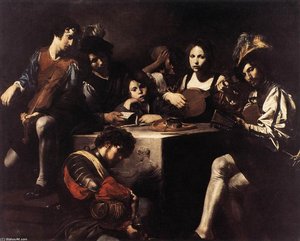
In the dim, flickering light of a tavern or a private chamber, A Musical Party unfolds as a lively gathering of souls. Created by the French painter Valentin de Boulogne about 1623-1626, this oil on canvas captures a moment of rhythmic intensity. The scene breathes with the presence of various figures, each caught in a specific gesture of performance or indulgence. A woman holds a tambourine, her movement suggesting a…

7
Martyrdom of St Lawrence (1621) od Valentin De Boulogne

Martyrdom of St Lawrence

1621 · Oil On Canvas · Museo del Prado, Madrid

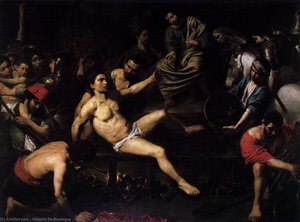
A single light source carves a figure from an impenetrable void. In this scene, St. Lawrence lies upon a gridiron, his body caught in the brutal transition between life and death. The air feels heavy with the heat of the coals. Around him, thirteen figures gather in a public square, their faces partially swallowed by darkness. Some stand near the edge of the flame, while others linger in the periphery…

8
Soldiers Playing Dice (1611) od Valentin De Boulogne

Soldiers Playing Dice

1611 · Oil On Canvas · Bavarské státní sbírky malby, Mnichov

In Soldiers Playing Dice by Valentin de Boulogne, the composition is crowded and dynamic, centering on a group of men gathered around a table. The figures are pushed toward the viewer through a shallow depth of field, creating an intimate perspective. This arrangement includes men dressed in metallic armor alongside others in civilian clothing. The subjects exhibit a range of expressions, from intense concentration to sudden alarm. Diagonal lines move…

9
Saint Paul Writing His Epistles (1619) od Valentin De Boulogne

Saint Paul Writing His Epistles

1619 · Oil On Canvas · Muzeum umění Houston, Houston

In Saint Paul Writing His Epistles by Valentin de Boulogne, the world narrows to a single, focused point of devotion. The composition centers entirely on the solitary figure of Saint Paul, who leans heavily over a weathered wooden desk. A strong, directional light descends from the upper left, carving his forehead and hands out of the gloom. This light strikes the white parchment with a sharp intensity, making the act…

10
Saint John the Evangelist (1621) od Valentin De Boulogne

Saint John the Evangelist

1621 · Oil On Canvas

In this 1621 oil on canvas, we find the visionary evangelist caught in a moment of profound stillness. He is depicted in the act of writing, his hand poised to transcribe the opening line of his gospel: "In the beginning was the word..." There is a striking sense of presence here, as if the figure is not merely a representation of a saint, but a real person momentarily interrupted by…

Slavná díla umělce Valentin De Boulogne, čísla 11 až 54

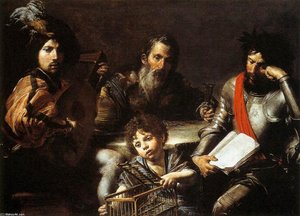
11Innocence of Susanna (1621) od Valentin De BoulogneInnocence of Susanna1621 12Untitled (D2WVZ4) (1615) od Valentin De BoulogneUntitled (D2WVZ4)1615 · Statens Museum for Kunst 13Portrait of a young Artist (1626) od Valentin De BoulognePortrait of a young Artist1626 · Národní muzeum umění, architektury a designu 14Abraham Sacrificing Isaac (1629) od Valentin De BoulogneAbraham Sacrificing Isaac1629 15Moses (1625) od Valentin De BoulogneMoses1625 · Kunsthistorisches Museum 16Dornenkrönung und Verspottung Christi (1627) od Valentin De BoulogneDornenkrönung und Verspottung Christi1627 · Alte Pinakothek 17Saint Mark (1624) od Valentin De BoulogneSaint Mark1624 18Soldiers Playing Cards and Dice (The Cheats) (1618) od Valentin De BoulogneSoldiers Playing Cards and Dice (The Cheats)1618 · National Gallery of Art 19Company with Fortune-Teller (1631) od Valentin De BoulogneCompany with Fortune-Teller1631 · Liechtenstein Museum 20Expulsion of the Money-Changers from the Temple (1620) od Valentin De BoulogneExpulsion of the Money-Changers from the Temple1620 · Státní Ermitáž 21Christ Crowned with Thorns (1616) od Valentin De BoulogneChrist Crowned with Thorns1616 · Alte Pinakothek 22St John the Baptist (1628) od Valentin De BoulogneSt John the Baptist1628 · Santa Maria in Via 23The Judgment of Solomon (1620) od Valentin De BoulogneThe Judgment of Solomon1620 · Galleria Nazionale d'Arte Antica 24Crowning with Thorns (1613) od Valentin De BoulogneCrowning with Thorns1613 25Return of the Prodigal Son (1615) od Valentin De BoulogneReturn of the Prodigal Son1615 26Denial of Saint Peter (1615) od Valentin De BoulogneDenial of Saint Peter1615 27Christ Driving the Money Changers out of the Temple (1618) od Valentin De BoulogneChrist Driving the Money Changers out of the Temple1618 · Galleria Nazionale d'Arte Antica 28Company with Fortune-Teller (detail) (1631) od Valentin De BoulogneCompany with Fortune-Teller (detail)1631 · Liechtenstein Museum 29Company with Fortune-Teller (detail) (1631) od Valentin De BoulogneCompany with Fortune-Teller (detail)1631 · Liechtenstein Museum 30Portrait of Raffaello Menicucci (1625) od Valentin De BoulognePortrait of Raffaello Menicucci1625 · Indianapolis Museum of Art 31Untitled (D2X88H) (1628) od Valentin De BoulogneUntitled (D2X88H)1628 32Musical Company od Valentin De BoulogneMusical CompanyKunsthistorisches Museum 33The Fortune teller od Valentin De BoulogneThe Fortune tellerGemäldegalerie 34Saint John the Baptist (1620) od Valentin De BoulogneSaint John the Baptist1620 35Martyrdom of Saint Bartholomew (1613) od Valentin De BoulogneMartyrdom of Saint Bartholomew1613 36Musicians and Soldiers (1625) od Valentin De BoulogneMusicians and Soldiers1625 · Statens Museum for Kunst 37Saint Jerome (1628) od Valentin De BoulogneSaint Jerome1628 38Saint John the Baptist (1613) od Valentin De BoulogneSaint John the Baptist1613 39Portrait of a Prelate, probably Angelo Giori (1620) od Valentin De BoulognePortrait of a Prelate, probably Angelo Giori1620 40Martyyrdom of st lawrence od Valentin De BoulogneMartyyrdom of st lawrence 41The Concert (1622) od Valentin De BoulogneThe Concert1622 · Louvre 42Lute Player (1625) od Valentin De BoulogneLute Player1625 · Metropolitan Museum of Art 43The Fortune Teller (1620) od Valentin De BoulogneThe Fortune Teller1620 · Toledo Museum of Art 44Judith (1626) od Valentin De BoulogneJudith1626 · Musée des Augustins 45The Four Ages of Man (1626) od Valentin De BoulogneThe Four Ages of Man1626 · National Gallery 46The Fortune Teller (1628) od Valentin De BoulogneThe Fortune Teller1628 · Louvre 47Musician and Drinkers (1625) od Valentin De BoulogneMusician and Drinkers1625 · Louvre 48Martyrdom of St Processus and St Martinian (1629) od Valentin De BoulogneMartyrdom of St Processus and St Martinian1629 · Vatikánská pinakotéka 49Judith and Holofernes (1626) od Valentin De BoulogneJudith and Holofernes1626 · National Museum of Fine Arts 50The Tribute to Caesar (1620) od Valentin De BoulogneThe Tribute to Caesar1620 · Château de Versailles 51David with the Head of Goliath and Two Soldiers (1620) od Valentin De BoulogneDavid with the Head of Goliath and Two Soldiers1620 · Thyssen-Bornemisza Museum 52Concert (1615) od Valentin De BoulogneConcert1615 · Indianapolis Museum of Art 53Christ and the Adulteress (1618) od Valentin De BoulogneChrist and the Adulteress1618 · J. Paul Getty Museum 54Samson (1631) od Valentin De BoulogneSamson1631 · Clevelandské muzeum umění

Slavná díla Valentin De Boulogne podle jednotlivých období

Motivy, které zaujaly Valentin De Boulogne

Čtyři témata, která se v těchto originálech nejčastěji objevují, z nichž každé má svůj nejlepší příklad.

Muzea, v nichž jsou vystavena originálna umělce Valentin De Boulogne

8 muzea, v nichž je umístěno nejvíce obrazů z této stránky.

Muzeum Město Díla autora Valentin De Boulogne Obrazy z tohoto seznamu
Louvre, PařížLouvre Paříž 4 The Judgment of Solomon, The Concert, The Fortune Teller
Galleria Nazionale d'Arte Antica, ŘímGalleria Nazionale d'Arte Antica Řím 3 The Last Supper, The Judgment of Solomon, Christ Driving the Money Changers out of the Temple
Alte Pinakothek, MnichovAlte Pinakothek Mnichov 3 Crowning with Thorns, Dornenkrönung und Verspottung Christi, Christ Crowned with Thorns
Liechtenstein Museum, VídeňLiechtenstein Museum Vídeň 3 Company with Fortune-Teller, Company with Fortune-Teller (detail), Company with Fortune-Teller (detail)
Statens Museum for Kunst, KodaňStatens Museum for Kunst Kodaň 2 Untitled (D2WVZ4), Musicians and Soldiers
Kunsthistorisches Museum, VídeňKunsthistorisches Museum Vídeň 2 Moses, Musical Company
Indianapolis Museum of Art, IndianapolisIndianapolis Museum of Art Indianapolis 2 Portrait of Raffaello Menicucci, Concert
Gemäldegalerie Alte Meister, DresnoGemäldegalerie Alte Meister Dresno 1 Card-sharpers

Valentin De Boulogne napříč desetiletími: jeden unikátní originál pro každou dekádu

Díla podle dekád

Vyberte si dekádu a prohlédněte si originál, který ji definuje.

Obrazy umělce Valentin De Boulogne: dotazy pro galerii

Kterým nejznámějším dílem je Valentin De Boulogne?Odhalit odpověď

The Last Supper (1625), Galleria Nazionale d'Arte Antica, Řím. Následují Card-sharpers (1620) a The Judgment of Solomon (1625).

V jakém věku vytvořil(a) Valentin De Boulogne dílo The Last Supper?Odhalit odpověď

34 let: dílo The Last Supper pochází z roku 1625 a Valentin De Boulogne se narodil/a v roce 1591.

Kterých deset obrazů autora Valentin De Boulogne je nejznámějších?Odhalit odpověď

The Last Supper, Card-sharpers, The Judgment of Solomon, Dream of Saint Joseph, Crowning with Thorns, A Musical Party, Martyrdom of St Lawrence, Soldiers Playing Dice, Saint Paul Writing His Epistles a Saint John the Evangelist. Hodnocení výše uvádí rok a muzeum pro každé z nich.

Kolik známých děl má autor Valentin De Boulogne?Odhalit odpověď

Náš katalog obsahuje 55 děl umělce Valentin De Boulogne z let 1611 až 1631.

Kde lze vidět nejznámější originály umělce Valentin De Boulogne?Odhalit odpověď

Většinou v Louvre (Paříž), Galleria Nazionale d'Arte Antica (Řím) a Alte Pinakothek (Mnichov). V tabulce muzeí výše jsou vypsány všechny.

V jakém období vytvořil(a) Valentin De Boulogne svá nejznámější obrazy?Odhalit odpověď

V období 1620s: 33 z celkem 54 děl na této stránce vzniklo právě tehdy, z toho The Last Supper z nich.

Který slavný obraz od Valentin De Boulogne je nejstarší a který nejnovější?Odhalit odpověď

Na této stránce je nejstarší dílo z Soldiers Playing Dice (1611) a nejnovější z Company with Fortune-Teller (1631).

Jakým tématům se Valentin De Boulogne věnoval/a nejčastěji?Odhalit odpověď

Man (11), People (7) a Table (6) napříč 54 díly na této stránce.

Jaké materiály používal(a) Valentin De Boulogne nejčastěji?Odhalit odpověď

Oil On Canvas, u 36 z 54 děl na této stránce.

K kterému směru patří dílo umělce Valentin De Boulogne?Odhalit odpověď

Baroque a Caravaggism, podle originálů na této stránce.

Jaká originální díla Valentin De Boulogne mohu vidět v Louvre?Odhalit odpověď

The Judgment of Solomon, The Concert a The Fortune Teller: muzeum Louvre, Paříž má v obsluze 4 děl z této stránky.

Valentin De Boulogne: portrét umělce

Malíř stínů římského: Život a odkaz Valenta de Boulogne

V chvějícím se světle svíček počátku sedmnáctého století se do plátna evropského umění vrylo nové druh drama. V srdci tohoto hnutí stál Valentin de Boulogne, umělec, jehož štětec disponoval vzácnou schopností vyvolat hluboké emoce i z těch nejhlubších stínů. Narodil se kolem roku 1590 nebo 1591 ve Coulommiers ve Francii a jeho osud byl již od počátku spojen s pigmenty a oleji. Vycházel z linie tvůrců, neboť jak jeho otec, tak strýc byli malíři, což mu poskytlo ranou, intimní výchovu v mechanice světla a formy. Ačkoliv byly jeho kořeny pevně zakořeněno ve francouzské půdě, jeho duch byl určen k poutím po živých a bouřlivých ulicích Říma, kde se nakonec stal jednou z nejuchopitelnějších postav barokní éry.

Trajektorie Valentinovy kariéry byla formována neklidnou snahou o mistrovství, která ho dovedla z disciplinovaných pařížských ateliérů až do rebelské srdce Itálie. Jeho raná výchova pod předním mistrem Simonem Vouetem mu vštěpila přísnou ovládnutí anatomické přesnosti a klasické perspektivy. Přesto akademická preciznost, kterou se ve Francii naučil, nedokázala udržet rostoucí naturalismus, který začal prostupovat Evropou. Když kolem roku ředho 1620 dorazil do Říma, neomezil se pouze na pozorování tehdejší umělecké scény; zcela se do ní ponořil a připojil se k Bentvueghels, hlučnému a často neukázněnému společenství zahraničních umělců. V rámci této komunity si získal něžné přezdívku „innamorato“, což je důkaz jeho vášnivého zapojení jak do uměleckých zápasů svých vrstevníků, tak do smyslných potěšení římského života.

Mistrovství tenebrismu a caravaggiovské drama

Pochopení díla Valenta de Boulogne znamená pochopení jazyka tenebrismu. Byl hlubokým dědicem odkazu Caravaggia, když převzal a zdokonalil techniku využívající extrémní kontrasty mezi světlem a tmou k vytvoření pocitu teatrální naléhavosti. V jeho rukou jediný pronikavý zdroj světla dělá víc než jen osvětluje subjekt; vytesává postavy z neproniknutelné prázdnoty a prohlubuje psychologické napětí každé scény. Toto ovládnutí chiaroscuro mu umožnilo proměnit obyčejné okamžiky v monumentální dramata. Ať už zachycoval tichou intenzitu hudebníka nebo násilnou posvátnost mučedníka, Valentin nepoužíval stín jako absenci světla, ale jako fyzickou přítomnost, která tíží duši.

Jeho repertoář byl neuvěřitelně rozmanitý, od intimních žánrových scén až po grandiózní náboženské zakázky. Obzvláště úspěšný byl v zachycování syrové, prožitých reality tehdejšího života, často zobrazoval:

  • Soldáty a hudebníky: Díla jako Loutnista nebo Soldáti hrající karty a kostky demonstrují jeho schopnost vykreslit texturu, od lesku leštěného brnění až po jemný rezonance strunného nástroje.
  • Náboženské mučednictví: Jeho hluboká náboženská díla, včetně Mučednictví sv. Processa a sv. Martiniana, ukazují, jak aplikoval svůj tenebristický styl k vyjádření duchovní agónie a neochvějné víry svatých.
  • Biblické příběhy: V dílech jako Mojžíš využil klasickou velkolepost k oživování starobylých proroků, čímž spojil historickou váhu s dramatickým realismem.

Trvalý dojem z éry baroka

Význam Valenta de Boulogne sahá daleko za hranice jeho technické zdatnosti; byl mostem mezi francouzskou akademickou tradicí a italským revolučním duchem. Jeho schopnost získat prestižní zakázky od mocných patronů, jako byla rodina Barberini či kardinál Francesco Barberini, svědčí o jeho postavení v nejvyšších patrech římské společnosti. I když čerpal inspiraci z děl Bartolomea Manfrediho, Valentin si zachoval vlastní, odlišný hlas – hlas jedinečně citlivý k lidské podmínce a pomíjivosti času.

Ačkoliv byl jeho život tragicky krátký a skončil v roce 1632 ve věku přibližně čtyřiceti jedna let, dopad jeho „malování stínů“ zůstává nezmazatelný. Zanechal po sobě dílo, které i nadále straší a inspiruje, připomínaje divákům moc temnoty definovat světlo. Skrze jeho plátna jsme zváni být svědky triumfů a úrazů lidstva, zachycených v věčném, dramatickém tanci světla a stínu. Jeho odkaz přežívá v každém rysnutí štětcem, které se odváží najít krásu v šeru, a zajišťuje, že jméno Le Valentin bude navždy šeptáno v chodbách historie umění.