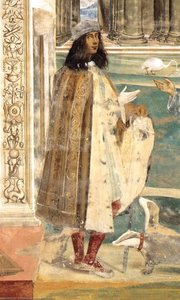
Portrét Giovanni Antonio Bazzi

69 nejslavnějších obrazů autora Giovanni Antonio Bazzi, výběr z galerie

Aktualizováno listopad 2026 · seřazeno podle našeho skóre popularity (vyhledávání, návštěvy a objednávky u každého díla) · 71 děl umělce Giovanni Antonio Bazzi v našem katalogu

Stručně řečeno

Z všech originálů, které Giovanni Antonio Bazzi zanechal, je nejslavnější Násilné zajetí Sabinek (1506), který se nachází ve sbírce Galleria Nazionale d'Arte Antica, Řím. Hned za ním následují Head of Christ (1537) a The Holy Family with Saint Elizabeth and the Infant Saint John the Baptist (1527). Náš katalog obsahuje 71 děl umělce Giovanni Antonio Bazzi; galerie si zachovala 69 děl, která obdivuje celý svět, přičemž každé je znázorněno s datem vzniku, názevem muzea a jeho příběhem.

1477 – 1549, Vercelli Renesance Nejvíce děl: National Gallery

10 nejlepších obrazů umělce Giovanni Antonio Bazzi: výběr galerie

1
Násilné zajetí Sabinek (1506) od Giovanni Antonio Bazzi

Násilné zajetí Sabinek

1506 · Olej na panelu · Galleria Nazionale d'Arte Antica, Řím

Il Sodoma: Síň Říše Konfliktů – Studium „Rape of Sabine Women“ Římská Galleria Nazionale d’Arte Antica uchovává obraz Il Sodomy „Rape of Sabine Women“, dílo, které vypráví příběh založený na legendě o dobových jednání mezi Římem a Sabinou. Tento olejový obraz vytvořený roku 1506 není jen estetickou nádherou; je komplexním kulturním dokumentem doby renesance, který odráží intelektuální vývoj období a fascinující otázky lidské povahy. Il Sodoma byl významným představitelem pozdní…

2
Head of Christ (1537) od Giovanni Antonio Bazzi

Head of Christ

1537 · Oil · National Gallery, Londýn

In "Head of Christ" by Giovanni Gerolamo Savoldo, the viewer is met with a close-up portrait that focuses tightly on the face and upper shoulders. The subject is framed by long, dark, wavy hair and a full beard. A crown of thorns rests upon the brow, rendered through textured, dark lines that press against the skin. The eyes are cast downward, heavy with a sense of sadness or exhaustion. This…

3
The Holy Family with Saint Elizabeth and the Infant Saint John the Baptist (1527) od Giovanni Antonio Bazzi

The Holy Family with Saint Elizabeth and the Infant Saint John the Baptist

1527 · Oil · Walters Art Museum, Baltimore

Within the circular confines of this tondo, a quiet intimacy unfolds. The air feels heavy with the warmth of a Mediterranean afternoon, filtered through a soft, directional light that carves the figures out of the surrounding landscape. We find ourselves watching a tender moment of familial connection, where the boundaries between the divine and the human seem to blur. The Holy Family gathers closely, their forms wrapped in heavy, tactile…

4
The Ecstasy of Saint Catherine of Siena (1532) od Giovanni Antonio Bazzi

The Ecstasy of Saint Catherine of Siena

1532 · Oil · Yale University Art Gallery, New Haven

The spiritual intensity of The Ecstasy of Saint Catherine of Siena unfolds before us through the hand of Il Sodoma. This religious art piece captures a profound moment of divine connection, centering entirely on the figure of Catherine of Siena. The scene invites a sense of wonder as the saint experiences a celestial encounter, her presence anchoring the composition amidst a swirling, sacred atmosphere. Every brushstroke seeks to translate the…

5
The Holy Family and St. John (1477) od Giovanni Antonio Bazzi

The Holy Family and St. John

1477 · Oil On Panel · Detroit Institute of Arts, Detroit

The Holy Family and St. John is a devotional work by the Italian artist Il Sodoma. This oil on wood panel depicts a sacred grouping of figures, centering on the intimate connection between Mary, Joseph, and the young Saint John the Baptist. The composition focuses on the quiet, tender interactions shared between the holy figures, presented in a manner that invites a sense of spiritual closeness.

6
The Madonna and Child with Saints and a Donor (1530) od Giovanni Antonio Bazzi

The Madonna and Child with Saints and a Donor

1530 · Oil On Panel · National Gallery, Londýn

Step closer to observe the way the light settles upon these figures. In this composition from around 1530, we find a sense of stability born from a pyramidal arrangement. At the apex sits the Virgin Mary, her presence anchoring the group. She holds the Christ Child with a natural, unforced tenderness that grounds the divine subject in something deeply human. The palette relies on deep ultramarine blue in her mantle…

7
Saint Jerome in Penitence (1540) od Giovanni Antonio Bazzi

Saint Jerome in Penitence

1540 · Oil On Canvas · National Gallery, Londýn

A muscular, semi-nude figure occupies the center of this 1540 oil painting, captured in a dynamic, crouching pose that cuts a diagonal path across the canvas. The subject, Saint Jerome, is immersed in a moment of intense religious devotion and physical hardship. Deep, earthy tones of brown and dark green dominate the composition, grounded by the heavy textures of a rugged, rocky landscape. A strong directional light source, characteristic of…

8
Death of Lucretia (1515) od Giovanni Antonio Bazzi

Death of Lucretia

1515 · Oil On Panel · Galleria Sabauda, Turín

In this work, we find ourselves witnessing the final, harrowing moments of Lucretia, a woman whose life is being extinguished in a flash of steel and sorrow. The scene freezes a moment of profound tragedy, capturing the climactic end of a Roman noblewoman whose life was defined by virtue and ended by violence. The composition is thick with tension; the stillness of her form contrasts sharply with the looming presence…

9
Holy Family with St. John the Baptist as child (1525) od Giovanni Antonio Bazzi

Holy Family with St. John the Baptist as child

1525 · Oil · Kunsthistorisches Museum, Vídeň

This oil painting, dated 1525, is presented within an arched lunette format. The scene focuses on a group of four figures: the Virgin Mary, the Christ Child, Saint Joseph, and a young Saint John the Baptist. Mary is positioned centrally, wearing a red tunic beneath a deep blue mantle. Her pale skin and the skin of the infants are illuminated by a soft, directional light that emerges from the side,…

10
The Madonna and Child (1525) od Giovanni Antonio Bazzi

The Madonna and Child

1525 · Oil On Panel · National Gallery, Londýn

The composition centers on the Virgin Mary and the infant Jesus, set against an atmospheric landscape of distant hills and trees. A soft, directional light illuminates the faces of the subjects and the child's body, while much of the background remains in shadow. This use of chiaroscuro creates a sense of three-dimensionality, sculpting the figures through subtle gradations of tone.

Výběr umělce Giovanni Antonio Bazzi pokračuje, od 11 do 69

11charity (1504) od Giovanni Antonio Bazzicharity1504 · Gemäldegalerie 12Benedict Presents the Olivetan Monks with His Rule (1505) od Giovanni Antonio BazziBenedict Presents the Olivetan Monks with His Rule1505 13Life of St Benedict, Scene 13: Benedict Frees a Monk (1505) od Giovanni Antonio BazziLife of St Benedict, Scene 13: Benedict Frees a Monk1505 14Life of St Benedict, Scene 12: Benedict Receives Maurus and Placidus (1505) od Giovanni Antonio BazziLife of St Benedict, Scene 12: Benedict Receives Maurus and Placidus1505 15Life of St Benedict, Scene 32: Benedict Appears in the Dreams of Two Monks (1505) od Giovanni Antonio BazziLife of St Benedict, Scene 32: Benedict Appears in the Dreams of Two Monks1505 16Holy Family with young Saint John (1525) od Giovanni Antonio BazziHoly Family with young Saint John1525 17Terrestrial Venus with Eros and Celestial Venus with Anteros and Two Cupids (1525) od Giovanni Antonio BazziTerrestrial Venus with Eros and Celestial Venus with Anteros and Two Cupids1525 18St Sebastian (1525) od Giovanni Antonio BazziSt Sebastian1525 · Palác Pitti 19Christ Carrying the Cross (1545) od Giovanni Antonio BazziChrist Carrying the Cross1545 · Gemäldegalerie 20The Crucifixion (1549) od Giovanni Antonio BazziThe Crucifixion1549 · Clevelandské muzeum umění 21The Presentation of the Virgin in the Temple (1518) od Giovanni Antonio BazziThe Presentation of the Virgin in the Temple1518 · Oratory of San Bernardino 22The Holy Family (1511) od Giovanni Antonio BazziThe Holy Family1511 · Bavarské státní sbírky malby 23The Death of Lucretia (1513) od Giovanni Antonio BazziThe Death of Lucretia1513 · Szépművészeti Múzeum 24The Mystic Marriage of St Catherine (1539) od Giovanni Antonio BazziThe Mystic Marriage of St Catherine1539 · Galleria Nazionale d'Arte Antica 25Pietà (1540) od Giovanni Antonio BazziPietà1540 · Galleria Borghese 26Holy Family with the Infant Saint John the Baptist (1530) od Giovanni Antonio BazziHoly Family with the Infant Saint John the Baptist1530 27Ecce Homo (1510) od Giovanni Antonio BazziEcce Homo1510 · Pinacoteca di Brera 28The Confirmation of the Olivetan Order by the Bishop of Arezzo (1503) od Giovanni Antonio BazziThe Confirmation of the Olivetan Order by the Bishop of Arezzo1503 29Man of Sorrow (1505) od Giovanni Antonio BazziMan of Sorrow1505 30Life of St Benedict, Scene 5: The Devil Destroys the Little Bell (1505) od Giovanni Antonio BazziLife of St Benedict, Scene 5: The Devil Destroys the Little Bell1505 31The Road to Calvary (1510) od Giovanni Antonio BazziThe Road to Calvary1510 · Szépművészeti Múzeum 32Life of St Benedict, Scene 6: A Priest Shares His Easter Meal with Benedict (1505) od Giovanni Antonio BazziLife of St Benedict, Scene 6: A Priest Shares His Easter Meal with Benedict1505 33Life of St Benedict, Scene 3: Benedict Repairs a Broken Colander through Prayer (detail) (1505) od Giovanni Antonio BazziLife of St Benedict, Scene 3: Benedict Repairs a Broken Colander through Prayer (detail)1505 34Deposition from the Cross (detail) (1510) od Giovanni Antonio BazziDeposition from the Cross (detail)1510 · Pinacoteca Nazionale 35Life of St Benedict, Scene 8: Benedict is Tempted (detail) (1505) od Giovanni Antonio BazziLife of St Benedict, Scene 8: Benedict is Tempted (detail)1505 36Life of St Benedict, Scene 19: Benedict Sends away the Harlots (1505) od Giovanni Antonio BazziLife of St Benedict, Scene 19: Benedict Sends away the Harlots1505 37Life of St Benedict, Scene 4: The Monk Romanus Dresses Benedict (detail) (1505) od Giovanni Antonio BazziLife of St Benedict, Scene 4: The Monk Romanus Dresses Benedict (detail)1505 38The Women of Darius's Family before Alexander the Great (1517) od Giovanni Antonio BazziThe Women of Darius's Family before Alexander the Great1517 · Villa Farnesina 39Life of St Benedict, Scene 19: Benedict Sends away the Harlots (detail) (1505) od Giovanni Antonio BazziLife of St Benedict, Scene 19: Benedict Sends away the Harlots (detail)1505 40Life of St Benedict, Scene 3: Benedict Repairs a Broken Colander through Prayer (1505) od Giovanni Antonio BazziLife of St Benedict, Scene 3: Benedict Repairs a Broken Colander through Prayer1505 41Life of St Benedict, Scene 15: Benedict Fishes the Pieces of a Broken Ax (detail) (1505) od Giovanni Antonio BazziLife of St Benedict, Scene 15: Benedict Fishes the Pieces of a Broken Ax (detail)1505 42Deposition from the Cross (1510) od Giovanni Antonio BazziDeposition from the Cross1510 · Pinacoteca Nazionale 43Life of St Benedict, Scene 1: Benedict Leaves His Parent's House (1505) od Giovanni Antonio BazziLife of St Benedict, Scene 1: Benedict Leaves His Parent's House1505 44Life of St Benedict, Scene 12: Benedict Receives Maurus and Placidus (detail) (1505) od Giovanni Antonio BazziLife of St Benedict, Scene 12: Benedict Receives Maurus and Placidus (detail)1505 45Life of St Benedict, Scene 11: Benedict Founds Twelve Monasteries (1505) od Giovanni Antonio BazziLife of St Benedict, Scene 11: Benedict Founds Twelve Monasteries1505 46Life of St Benedict, Scene 33: Benedict Gives Posthumous Absolution to Two Nuns (1505) od Giovanni Antonio BazziLife of St Benedict, Scene 33: Benedict Gives Posthumous Absolution to Two Nuns1505 47Life of St Benedict, Scene 31: Benedict Feeds the Monk (1505) od Giovanni Antonio BazziLife of St Benedict, Scene 31: Benedict Feeds the Monk1505 48Life of St Benedict, Scene 30: Benedict Foretells the Destruction of Montecassino (1505) od Giovanni Antonio BazziLife of St Benedict, Scene 30: Benedict Foretells the Destruction of Montecassino1505 49Life of St Benedict, Scene 30: Benedict Foretells the Destruction of Montecassino (detail) (1505) od Giovanni Antonio BazziLife of St Benedict, Scene 30: Benedict Foretells the Destruction of Montecassino (detail)1505 50Life of St Benedict, Scene 7: Benedict Instructs the Peasants (1505) od Giovanni Antonio BazziLife of St Benedict, Scene 7: Benedict Instructs the Peasants1505 51Saint George and the Dragon (1518) od Giovanni Antonio BazziSaint George and the Dragon1518 · National Gallery of Art 52The Beheading of Niccolò di Tuldo (1526) od Giovanni Antonio BazziThe Beheading of Niccolò di Tuldo1526 · San Domenico 53View of the Oratory (1520) od Giovanni Antonio BazziView of the Oratory1520 · Oratory of San Bernardino 54View of the Cappella di Santa Caterina (1526) od Giovanni Antonio BazziView of the Cappella di Santa Caterina1526 · San Domenico 55Wedding of Alexander and Roxane (detail) (1517) od Giovanni Antonio BazziWedding of Alexander and Roxane (detail)1517 · Villa Farnesina 56The Death of Lucretia (1535) od Giovanni Antonio BazziThe Death of Lucretia1535 · Szépművészeti Múzeum 57Cupid in a Landscape (1510) od Giovanni Antonio BazziCupid in a Landscape1510 · Státní Ermitáž 58Flagellation of Christ (1510) od Giovanni Antonio BazziFlagellation of Christ1510 · Szépművészeti Múzeum 59Mary Magdalene od Giovanni Antonio BazziMary Magdalene 60Christ Carrying the Cross od Giovanni Antonio BazziChrist Carrying the CrossPalazzo d'Arco 61St George and the Dragon od Giovanni Antonio BazziSt George and the DragonNational Gallery of Art 62A Scene from the Vita of Saint Catherine of Siena / The Execution of Niccolò Tuldo od Giovanni Antonio BazziA Scene from the Vita of Saint Catherine of Siena / The Execution of Niccolò TuldoGemäldegalerie 63self-portrait od Giovanni Antonio Bazziself-portrait 64Allegory of Celestial Love od Giovanni Antonio BazziAllegory of Celestial LoveChigi Saracini Collection 65Christ Presented to the People (Ecce Homo) (1544) od Giovanni Antonio BazziChrist Presented to the People (Ecce Homo)1544 · Metropolitan Museum of Art 66Wedding of Alexander and Roxane (1517) od Giovanni Antonio BazziWedding of Alexander and Roxane1517 · Villa Farnesina 67Man of Sorrows (1500) od Giovanni Antonio BazziMan of Sorrows1500 68Holy Family with Saint John the Baptist and an Angel (1530) od Giovanni Antonio BazziHoly Family with Saint John the Baptist and an Angel1530 · Musée des Beaux-Arts de Strasbourg 69Pietà (1533) od Giovanni Antonio BazziPietà1533

Slavná díla Giovanni Antonio Bazzi podle jednotlivých období

Motivy, které zaujaly Giovanni Antonio Bazzi

Čtyři témata, která se v těchto originálech nejčastěji objevují, z nichž každé má svůj nejlepší příklad.

Muzea, v nichž jsou vystavena originálna umělce Giovanni Antonio Bazzi

8 muzea, v nichž je umístěno nejvíce obrazů z této stránky.

Muzeum Město Díla autora Giovanni Antonio Bazzi Obrazy z tohoto seznamu
National Gallery, LondýnNational Gallery Londýn 4 Head of Christ, The Madonna and Child with Saints and a Donor, Saint Jerome in Penitence
Szépművészeti Múzeum, BudapešťSzépművészeti Múzeum Budapešť 4 The Death of Lucretia, The Road to Calvary, The Death of Lucretia
Gemäldegalerie, BerlínGemäldegalerie Berlín 3 charity, Christ Carrying the Cross, A Scene from the Vita of Saint Catherine of Siena / The Execution of Niccolò Tuldo
Villa Farnesina, ŘímVilla Farnesina Řím 3 The Women of Darius's Family before Alexander the Great, Wedding of Alexander and Roxane (detail), Wedding of Alexander and Roxane
Galleria Nazionale d'Arte Antica, ŘímGalleria Nazionale d'Arte Antica Řím 2 Násilné zajetí Sabinek, The Mystic Marriage of St Catherine
Oratory of San Bernardino, SienaOratory of San Bernardino Siena 2 The Presentation of the Virgin in the Temple, View of the Oratory
Pinacoteca Nazionale, SienaPinacoteca Nazionale Siena 2 Deposition from the Cross (detail), Deposition from the Cross
National Gallery of Art, WashingtonNational Gallery of Art Washington 2 Saint George and the Dragon, St George and the Dragon

Giovanni Antonio Bazzi dekáda po dekádě: originální díla, která definují každou z nich

Díla podle dekád

Vyberte si dekádu a prohlédněte si originál, který ji definuje.

Otázky sběratelů o obrazech umělce Giovanni Antonio Bazzi

Kterým dílem je Giovanni Antonio Bazzi nejznámější?Odhalit odpověď

Násilné zajetí Sabinek (1506), Galleria Nazionale d'Arte Antica, Řím. Následují Head of Christ (1537) a The Holy Family with Saint Elizabeth and the Infant Saint John the Baptist (1527).

Kolik let bylo Giovanni Antonio Bazzi, když bylo vytvořeno dílo Násilné zajetí Sabinek?Odhalit odpověď

29 let: dílo Násilné zajetí Sabinek pochází z roku 1506 a Giovanni Antonio Bazzi se narodil/a v roce 1477.

Kterých deset nejslavnějších obrazů má Giovanni Antonio Bazzi?Odhalit odpověď

Násilné zajetí Sabinek, Head of Christ, The Holy Family with Saint Elizabeth and the Infant Saint John the Baptist, The Ecstasy of Saint Catherine of Siena, The Holy Family and St. John, The Madonna and Child with Saints and a Donor, Saint Jerome in Penitence, Death of Lucretia, Holy Family with St. John the Baptist as child a The Madonna and Child. Hodnocení výše uvádí rok a muzeum pro každé z nich.

Kolik obrazů zanechal(a) Giovanni Antonio Bazzi?Odhalit odpověď

Náš katalog obsahuje 71 děl umělce Giovanni Antonio Bazzi z let 1500 až 1549.

Ve kterých muzeích jsou vystavena díla mistrovská umělce Giovanni Antonio Bazzi?Odhalit odpověď

Většinou v National Gallery (Londýn), Szépművészeti Múzeum (Budapešť) a Gemäldegalerie (Berlín). V tabulce muzeí výše jsou vypsány všechny.

V jakých letech namaloval Giovanni Antonio Bazzi svá nejznámější díla?Odhalit odpověď

V období 1500s: 26 z celkem 69 děl na této stránce vzniklo právě tehdy, z toho Násilné zajetí Sabinek z nich.

Jaká jsou první a poslední slavná originální díla umělce Giovanni Antonio Bazzi?Odhalit odpověď

Na této stránce je nejstarší dílo z Man of Sorrows (1500) a nejnovější z The Crucifixion (1549).

Jaká témata si Giovanni Antonio Bazzi vybíral nejčastěji?Odhalit odpověď

Man (21), People (21) a Woman (14) napříč 69 díly na této stránce.

Kterou techniku používal(a) Giovanni Antonio Bazzi nejčastěji?Odhalit odpověď

Fresco, u 29 z 69 děl na této stránce.
K kterému uměleckému směru patří Giovanni Antonio Bazzi?Odhalit odpověď

Renesance, podle originálů na této stránce.

Která díla umělce Giovanni Antonio Bazzi jsou vystavena v National Gallery?Odhalit odpověď

Head of Christ, The Madonna and Child with Saints and a Donor a Saint Jerome in Penitence: muzeum National Gallery, Londýn má v obsluze 4 děl z této stránky.

Giovanni Antonio Bazzi: život a dílo

Engnatická duše siénské renesance

V živobité tkanině italské renesance má jen málo postav jméno tak provokativní nebo odkaz tak mnohostranný jako Giovanni Antonio Bazzi, který je historie zná v evokativní přezdívce Il Sodoma. Bazzi, narozený ve Vercelli kolem roku 1477, se neobjevil pouze jako malíř, ale jako transformativní síla, která překlenula propast mezi zářivým, vyváženým idealismem vrcholné renáscence a emotickým, často znepokojujícím dramatem manierismu. Jeho umělecká cesta byla hlubokou syntézou, kde se disciplinované tradice siénské školy setkaly s rozsáhlými, atmosférickými inovacemi lombardského stylu a jemnou psychologickou hloubkou inspirovanou Leonardem da Vinci.

Raná léta Bazziho života byla poznamenána přísným učňovstvím, které položilo základy jeho technické dokonalosti. Pod vedením mistrů, jako byli „archaický“ Martino Spanzotti a Giovenone, osvojil si základní porozumění formě a barvě. Když se přesunul do kulturního epicentra Sieny, jeho dílo začalo odrážet jedinečnou stylistickou evoluci. Disponoval vzácnou schopností nanést sofistikovanou, klasickou eleganci Říma počátku 16. století na více provinční, dekorativní tradice Toskánska. Tato fúze mu umožnila vytvářet díla, která působila pevně zakořeněně v místním dědictví a zároveň jako součást mnohem větší, celoitalské umělecké revoluce.

Mistrovství světla, emocí a formy

Sledovat dílo Il Sodoma znamená být svědkem jemného tance mezi klidem a napětím. Jeho technika byla charakterizována vynikajícím ovládnutím sfumato a bohatým, emotivním využíváním barvy, která se mohla měnit od něžného tepla tváře Madonny až po dramatické stíny mytologického zápasu. Tato všestrannost je snad nejvýraznější v jeho rozmanité škále témat, která s patovou vášní pokrývala jak to sakrální, tak to profánní.

Jeho přínos k tradici fresky je prostě monumentální. V Oratoriu San Bernardino ve Sieně Bazzi demonstroval svou schopnost ovládat rozsáhlé architektonické prostory a tkanět komplexní příběhy prostřednictím vyvážených kompozic, které přesto pulzovaly lidskými emocemi. Jeho náboženská díla, jako například Představení Panny Marie v chrámu, vykazují hlubokou duchovní eleganci, zatímco jeho světské a mytologické kusy, jako okouzlující Amor v krajině, odhalují fascinaci smyslností a idylou. V těchto krajinách nacházíme klidnou italskou vyhlídku, která slouží jako scéna pro božské či mytologické, vykreslenou s takovou jasností, že diváka pohroutí do stavu podobného snu.

Odkaz přechodného mistra

Historický význam Il Sodoma spočívá v jeho roli stylistického spojence. On neobchodoval pouze s trendy své éry; pomohl utvářet přechod od harmonické stability vrcholné renesance k experimentálnějšímu, zkreslenému a expresivnímu jazyku manierismu. Zavedením exagurovaných gest a zvýšené emočnosti do zavedeného siénského rámce připravil cestu následující generaci umělců k prozkoumávání složitostí lidské psychiky.

I když jeho jméno neslo určitou pověst, jeho umělecká tvorba zůstala svědectvím o technické brilanci a intelektuální hloubce. Jeho schopnost zvládat prestižní zakázky papežů i mocných patronů – včetně vazeb na vlivného Agostina Chigiho – zajistila, že jeho vliv bude rezonovat daleko za hramí Sieny. Dnes stojí Bazzi jako klíčová postava, jejíž dílo nadále fascinuje a připomíná nám období, kdy umění bylo hlubokým zkoumáním jak pozemské krásy, tak duchovních tajemství lidské existence.