


1

The Grand Canal near the Salute
The Grand Canal near the Salute is an oil on canvas painting created by Michele Marieschi in 1733. This artwork is currently housed at the Musée du Louvre in Paris, France.

Aktualizováno listopad 2026 · seřazeno podle našeho skóre popularity (vyhledávání, návštěvy a objednávky u každého díla) · 46 děl umělce Michele Marieschi v našem katalogu
Stručně řečeno
The Grand Canal near the Salute (1733) je obraz autora Michele Marieschi, který přitahuje nejvíce pohledů; originál se nachází v Louvre, Paříž. Poté se zrak přesouvá k Capriccio with Classical Arch and Goats (1741) a The Grand Canal with the Ca' Rezzonico and the Campo San Samuele (1742). Z 46 děl umělce Michele Marieschi v našem katalogu je těchto 39 těch nejznámějších; každé z nich je unikátním originálem s uvedením roku vzniku, muzea a důvodu jeho nesmrtelnosti.
The Grand Canal near the Salute is an oil on canvas painting created by Michele Marieschi in 1733. This artwork is currently housed at the Musée du Louvre in Paris, France.

The composition centers on the intersection of human architecture and the persistent force of the natural world. Crumbling stone arches and weathered columns, once symbols of structural precision, now lie partially reclaimed by thick foliage and creeping vines. In the foreground, a man, a boy, and a dog move through the ruins, providing a sense of scale against the heavy, decaying masonry. Beyond this immediate scene, a body of water…

The oil on canvas titled The Grand Canal with the Ca' Rezzonico and the Campo San Samuele captures a specific slice of Venetian life. Painted by Michele Marieschi, the work dates to about 1742. It presents a wide view of the waterways that define the city, focusing on the intersection of grand architecture and the constant movement of the canals.

Courtyard with a Staircase is an oil on canvas work by Michele Marieschi, executed in 1735. The composition functions as an architectural fantasy, presenting a structured arrangement of a staircase within a courtyard setting. This work belongs to the Venetian School, reflecting the topographical and imaginative traditions of 18th-century Italy.

In the heart of the eighteenth century, Venice was not merely a city but a stage, a shimmering spectacle of light and water where every canal served as a corridor for drama and commerce. Michele Marieschi, a master of the veduta, captures this ephemeral magic in his breathtaking work, The Grand Canal in Venice. This painting serves as a portal to a bygone era, inviting the viewer to step onto…

Michele Marieschi: Životopisný Přehled a Významné Dílo Michele Giovanni Marieschi (1710 – 18 يناير 1744) představuje jedinečnou osobnost v uměleckém kraji Benátek během Rokoko období, především pro své ohromující krajinky a panoramatické výhledy – veduty –, které zachycují ducha doby s pozoruhodným životností a inovací. Jeho biografické údaje zůstávají nedostatečné, Marieschiho dědictví však spočívá v jeho schopnosti transformovat obyčejné výhledy na nádherná obrazová díla nabitá světlem, barvami a mistrovským porozuměním…

The oil on canvas depicts the Grand Canal in Venice, Italy, as it appeared in 1730. At the terminus of the waterway, the Santa Maria della Salute church occupies the central focus. The structure features a prominent dome and smaller domes situated on either side. The building's architecture is characterized by its position at the end of the canal, which directs the eye toward the church's facade. Numerous gondolas and…

An Architectural Capriccio with Figures beside a River is an 18th-century architectural capriccio executed in the Veduta style. The work is attributed to the Venetian artist Michele Marieschi. This composition presents a romanticized, imaginary landscape where crumbling classical ruins are integrated with rustic dwellings. The scene depicts a tranquil river and distant mountains, populated by several small figures engaged in various activities near the water's edge.

In this 1740 oil on canvas, we find ourselves observing a specific, quiet moment within the Venetian cityscape. The composition centers on the Rialto Bridge, its structural arches spanning the waterway with a sense of permanence amidst the constant movement of the Grand Canal. There is a particular attention paid to the boats floating below the stone spans and the figures gathered along the water's edge, suggesting a city that…

Fantastic Architecture of a Prison Courtyard is a work by Michele Marieschi, an artist born in Venice in 1710. Created about 1730, the piece belongs to the tradition of 18th-century architectural capriccios. Marieschi, the son of a woodcarver, brought a specific understanding of structure and texture to his depictions of built environments.
 Fantastic Architecture of a Palace Courtyard1730 · Národní muzeum ve Varšavě
12
 Riva degli Schiavoni1730 · Národní muzeum ve Varšavě
13
 Coastal Landscape1730 · Národní muzeum ve Varšavě
14
 Fantastic Landscape with Ruins1730 · Národní muzeum ve Varšavě
15
 Italian scenery with figures1727
16
 View of the Piazzetta dei Leoni1734 · Bavarské státní sbírky malby
17
 Saint Mark's Church and the Square in Venice1739
18
 View of the Grand Canal near Cà Pesaro1734 · Bavarské státní sbírky malby
19
 Landscape Capriccio1735 · Minneapolis Institute of Art
20
 The Church of Santa Maria della Salute, Venice1740 · Art Institute of Chicago
21
 Courtyard in a Renaissance House1742 · Nationalmuseum
22
 Stairwell in a Renaissance Palace1742 · Nationalmuseum
23
 Architectural fantasy featuring a palace courtyard1738 · Národní muzeum ve Varšavě
24
 The Grand Canal with the Fishmarket (detail)1740
25
 The Grand Canal at San Geremia1740
26
 The Grand Canal with the Fishmarket1740
27
 View of the Rio di Cannareggio1740
28
 The Grand Canal at San Geremia (detail)1740
29
 The Grand Canal with the Palazzo Labia and Entry to the Cannareggio1742 · Staatliche Museen zu Berlin
30
 Capriccio with Gothic Building and Obelisk1741 · Gallerie dell'Accademia di Venezia
31
 Piazza San Marco, Venice, with Saint Mark's Basilica, the Campanile and the Procuratie NuoveNational Gallery of Ireland
32
 View of the Dogana and Santa Maria della SaluteMuzeum umění Houston
33
 View of Canale Grande in Venice with the Rialto BridgeStatens Museum for Kunst
34
 View of Canale Grande in VeniceStatens Museum for Kunst
35
 Landscape with ruins and a bridgeNárodní muzeum ve Varšavě
36
 Landscape with ruinsNárodní muzeum ve Varšavě
37
 Architectural fantasy featuring a prison courtyardNárodní muzeum ve Varšavě
38
 Imaginative View with Obelisk
39
 View of Campo SS. Giovanni e Paolo, Venice
Čtyři témata, která se v těchto originálech nejčastěji objevují, z nichž každé má svůj nejlepší příklad.
8 muzea, v nichž je umístěno nejvíce obrazů z této stránky.
| Muzeum | Město | Díla autora Michele Marieschi | Obrazy z tohoto seznamu |
|---|---|---|---|
 Národní muzeum ve Varšavě |
Varšava | 10 | Ponte di Rialto, Fantastic Architecture of a Prison Courtyard, Fantastic Architecture of a Palace Courtyard |
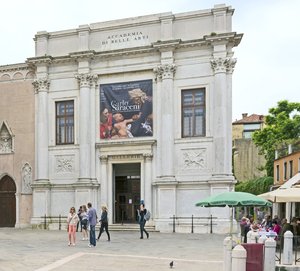 Gallerie dell'Accademia di Venezia |
Benátky | 2 | Capriccio with Classical Arch and Goats, Capriccio with Gothic Building and Obelisk |
 Staatliche Museen zu Berlin |
Berlín | 2 | The Grand Canal with the Ca' Rezzonico and the Campo San Samuele, The Grand Canal with the Palazzo Labia and Entry to the Cannareggio |
 Státní Ermitáž |
Sankt-Petěrburg | 2 | Courtyard with a Staircase, Most Rialto z Riva del Vin |
 Bavarské státní sbírky malby |
Mnichov | 2 | View of the Piazzetta dei Leoni, View of the Grand Canal near Cà Pesaro |
 Nationalmuseum |
Stockholm | 2 | Courtyard in a Renaissance House, Stairwell in a Renaissance Palace |
 Statens Museum for Kunst |
Kodaň | 2 | View of Canale Grande in Venice with the Rialto Bridge, View of Canale Grande in Venice |
 Louvre |
Paříž | 1 | The Grand Canal near the Salute |
Vyberte si dekádu a prohlédněte si originál, který ji definuje.

The artwork titled Italian scenery with figures is a work by the Venetian painter Michele Marieschi. Born in Venice, Italy, in 1710, the artist spent his life capturing the architectural essence of his home city. This specific piece, executed about 1727, offers a glimpse into the structured world of the eighteenth century through its focus on stone and human presence.
The Grand Canal near the Salute is an oil on canvas painting created by Michele Marieschi in 1733. This artwork is currently housed at the Musée du Louvre in Paris, France.
The composition centers on the intersection of human architecture and the persistent force of the natural world. Crumbling stone arches and weathered columns, once symbols of structural precision, now lie partially reclaimed by thick foliage and creeping vines. In the foreground, a man, a boy, and a dog move through the ruins, providing a sense of scale against the heavy, decaying masonry. Beyond this immediate scene, a body of water…
The Grand Canal near the Salute (1733), Louvre, Paříž. Následují Capriccio with Classical Arch and Goats (1741) a The Grand Canal with the Ca' Rezzonico and the Campo San Samuele (1742).
23 let: dílo The Grand Canal near the Salute pochází z roku 1733 a Michele Marieschi se narodil/a v roce 1710.
The Grand Canal near the Salute, Capriccio with Classical Arch and Goats, The Grand Canal with the Ca' Rezzonico and the Campo San Samuele, Courtyard with a Staircase, The Grand Canal in Venice, Most Rialto z Riva del Vin, The Grand Canal with Santa Maria della Salute, An Architectural Capriccio with Figures beside a River, Ponte di Rialto a Fantastic Architecture of a Prison Courtyard. Hodnocení výše uvádí rok a muzeum pro každé z nich.
Náš katalog obsahuje 46 děl umělce Michele Marieschi z let 1727 až 1742.
Většinou v Národní muzeum ve Varšavě (Varšava), Gallerie dell'Accademia di Venezia (Benátky) a Staatliche Museen zu Berlin (Berlín). V tabulce muzeí výše jsou vypsány všechny.
V období 1730s: 14 z celkem 39 děl na této stránce vzniklo právě tehdy, z toho The Grand Canal near the Salute z nich.
Na této stránce je nejstarší dílo z Italian scenery with figures (1727) a nejnovější z The Grand Canal with the Ca' Rezzonico and the Campo San Samuele (1742).
Architecture (18), Water (14) a Sky (12) napříč 39 díly na této stránce.
Oil On Canvas, u 20 z 39 děl na této stránce.
Rococo, podle originálů na této stránce.
Ponte di Rialto, Fantastic Architecture of a Prison Courtyard a Fantastic Architecture of a Palace Courtyard: muzeum Národní muzeum ve Varšavě, Varšava má v obsluze 10 děl z této stránky.
V zlatém věku benátského rococó zachytilo málo umělců éterickou magii Serenissimy s takovou vitalitou jako Michele Marieschi. Narodil se v Benátkách v roce 1710 a vyrostl v rodině řemeslníků jako syn dřevosoustaže—tento původ mu pravděpodobně vnesl do duše hluboký respekt k textuře, struktuře a fyzické podstatě objektů, které maloval. Ačkoliv byl jeho život relativně krátký a skončil již na začátku roku 1744, jeho vliv na tradici veduta zůstává nezastupitelný. Neomezil se pouze na dokumentaci architektury Benátek; on vdechl život jejich kameni i vodě a proměnil statické městské krajiny v živoucí, zářivé narativy světla a pohybu.
Rozvoj unikátního stylu, který Michele Marieschi vytvořil, byl hluboce zakořeněn v uměleckých proudech protékajících 18. století Itálií. Historici často poukazují na vliv mistrů jako Gaspare Diziani a legendárního Canaletta, jejichž díla sloužila jako vzor pro zachycení velkoleposti městských prostředí. Zatímco však Canaletto usiloval o určitou topografickou přesnost a střízlivou, klasickou jasnost, Michele Marieschi našel svůj hlas v odvážnějším a emotivnějším přístupu. Přijal paletu, která pulzovala barvami, a způsob nanášení barev, který působil spontánně a energicky. Tento stylistický rozdíl mu umožnil vystoupit nad rámec pouhého architektonického záznamu a vnést do svých krajin pocit teatrálnosti a atmosféry, která naznačovala samotný tep benátského života.
Přínos Michele Marieschi k žánru veduta—vysoko detailním, velkolepým topografickým malbám—je charakterizován neuvěřitelnou ovladovností perspektivy a světla. Jeho díla často obsahují ikonické památky, jako je Grand Canal, Salute či pelikán různorodých majestátních paláců, přičemž jsou daleko od pouhých tehoto pohledů své éry. Místo toho využíval techniku, která propojovala precizní detail s představivou, čímž vytvářel scény působící zároveň reálně i snově. Skrze jeho oči se voda v kanálech mění v zrcadlo odrážející proměnlivou oblohu a stíny vrhané starobylými kostely se stávají nádobami pro tajemno a hloubku.
Jeho technická zdatnost je nejvíce patrná v schopnosti manipulovat se světlem pro vyvolání specifických nálad:
Historický význam, kterým se vykázal Michele Marieschi, spočívá v jeho schopnosti překlenout propast mezi rigidní dokumentací raného 18. století a expresivnějšími, emotivními krajinami, které následovaly. Byl klíčovou postavou při přechodu benátského pohledu od čistě pozorovatelského média k umělecké formě schopné vyjadřovat hlubokou emocionální rezonanci. Jeho dílo slouží jako vitální okno do zmizelého světa, které uchovává nádheru Benátek před seismickými změnami konce 18. století, jež navždy změnily její sociální a politickou krajinu.
Dnes plátna Michele Marieschi nadále fascinují sběratele i historiky. Ať už jde o dechající pohled na Grand Canal u baziliky Salute nebo o jeho intimnější architektonické studie, jeho obrazy zůstávají mistrovskými lekcemi v duchu rococó. Zůstává oslavovanou postavou pro ty, kteří chtějí zažít vibraci energie, zářivé světlo a nesmrtelnou eleganci Benátek, které neustále nacházejí místo v kolektivní představivosti světa umění.


