Portrét Jan Miel

71 nejslavnějších obrazů autora Jan Miel, každý naprosto unikátní

Aktualizováno listopad 2026 · seřazeno podle našeho skóre popularity (vyhledávání, návštěvy a objednávky u každého díla) · 71 děl umělce Jan Miel v našem katalogu

Stručně řečeno

Scene from the Life of Tramps (Lazzaroni) (1650) je obraz autora Jan Miel, který přitahuje nejvíce pohledů; originál se nachází v Státní Ermitáž, Sankt-Petěrburg. Poté se zrak přesouvá k Hunters at Rest (1650) a Carnival Entertainment (1635). Z 71 děl umělce Jan Miel v našem katalogu je těchto 71 těch nejznámějších; každé z nich je unikátním originálem s uvedením roku vzniku, muzea a důvodu jeho nesmrtelnosti.

1599 – 1663, Beveren Baroque Nejvíce děl: Státní Ermitáž

Top 10 obrazů autora Jan Miel podle výběru galerie

1
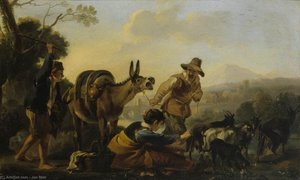
Scene from the Life of Tramps (Lazzaroni) (1650) od Jan Miel

Scene from the Life of Tramps (Lazzaroni)

1650 · Oil On Canvas · Státní Ermitáž, Sankt-Petěrburg

A heavy, ochre light settles over the crumbling stone of ancient ruins. Here, the shadows are thick and deep, swallowing the corners of a chaotic street scene. Figures move through the haze of smoke and dust, their bodies caught in a sudden, sharp glare of sun. A man gestures with urgency, his hands carving shapes into the air, while others sit in the dirt, anchored by the weight of their…

2
Hunters at Rest (1650) od Jan Miel

Hunters at Rest

1650 · Oil On Canvas · Státní Ermitáž, Sankt-Petěrburg

is an oil on canvas painting by the Flemish artist Jan Miel. Created about 1650, the work captures a quiet moment within a pastoral scene. It depicts a hunting party finding respite amidst the landscape. The scene is anchored by the presence of horses and the sturdy silhouette of a fortified tower.

3
Carnival Entertainment (1635) od Jan Miel

Carnival Entertainment

1635 · Oil On Canvas · Bavarské státní sbírky malby, Mnichov

In "Carnival Entertainment" by Jan Miel, we find ourselves amidst a dense and dynamic urban scene. The composition is crowded, capturing a street festival where a large group of figures occupies the foreground and middle ground. These individuals—musicians, dancers, and various onlookers—are arranged to create a sense of constant movement. The perspective is a ground-level view, which provides a palpable sense of depth through the careful layering of people and…

4
Sine Cerere et Baccho Friget Venus (1645) od Jan Miel

Sine Cerere et Baccho Friget Venus

1645 · Oil

The oil painting titled Sine Cerere et Baccho Friget Venus presents a mythological scene of abundance. Jan Miel rendered this work in 1645. It captures a moment where classical deities gather amidst the symbols of harvest and intoxication. The figures exist within a lush, Baroque-style arrangement of life and plenty.

5
The Veneration of St. Lambert (1648) od Jan Miel

The Veneration of St. Lambert

1648 · Oil On Canvas · Fitzwilliam Museum

The air in the grand, classical space feels heavy with the scent of incense and the weight of sudden grief. In the center of this dramatic scene, St. Lambert lies in repose, his body a pale, still anchor amidst a sea of movement. Above him, the celestial realm breaks through the gloom; an angel descends with fluid, sweeping drapery that seems to catch a wind from another world. The light…

6
Soothsayer at an inn (1644) od Jan Miel

Soothsayer at an inn

1644 · Oil

The air at the roadside inn feels heavy with the scent of dust and old stone. Under a rugged stone archway, a group of travelers huddles in a moment of quiet tension. A woman in a garment of lapis blue leans toward a man, her presence a cool contrast to the earthy ochre and deep crimson that define the crowd. He is the soothsayer, a figure caught in the flickering…

7
Two hunters resting in a landscape (the standing hunter is a woman in men's clothes) (1639) od Jan Miel

Two hunters resting in a landscape (the standing hunter is a woman in men's clothes)

1639 · Oil On Canvas · New York Historical Society, New York

The scene unfolds within the oil on canvas work titled Two hunters resting in a landscape (the standing hunter is a woman in men's clothes). This composition emerges from the hand of Jan Miel, a painter who brings a sense of immediate life to the quietude of the hunt. The work is dated 1639, capturing a specific moment of stillness amidst the natural world.

8
Three peasants having fun with music and dance (1639) od Jan Miel

Three peasants having fun with music and dance

1639 · Oil On Panel · Rafael Valls Limited, City of Westminster

Three peasants having fun with music and dance by Jan Miel presents a lively genre scene centered on three figures engaged in rhythmic activity. The composition is dynamic, utilizing an intimate perspective that places the viewer in close proximity to the subjects. Within this shallow space, the central figure is captured mid-motion, a choice that establishes a sense of rhythmic movement throughout the scene. To the left of the main…

9
The Travelers' Dinner. Peasants Eating Near an Inn or Resting (1650) od Jan Miel

The Travelers' Dinner. Peasants Eating Near an Inn or Resting

1650 · Oil On Canvas

The Travelers' Dinner. Peasants Eating Near an Inn or Resting is a genre painting by Jan Miel. This work emerged around 1650, a period when the artist was active within the artistic circles of the seventeenth century. The canvas captures a specific slice of rural life through the eyes of a painter who understood the weight of stone and the texture of coarse cloth.

10
An Italianate Landscape with Peasants Dancing (1650) od Jan Miel

An Italianate Landscape with Peasants Dancing

1650 · Oil On Canvas · Nostell Priory, Wakefield

We are looking at An Italianate Landscape with Peasants Dancing, a work by Jan Miel. This piece dates to about 1650, a period when the artist was deeply engaged with the stylistic shifts occurring within the Italian Baroque. It is a significant example of how Miel navigated the transition from the gritty, everyday observations of the Bamboccianti to more expansive, classical compositions.

Slavná díla umělce Jan Miel, čísla 11 až 71

11Falcon hunters in front of an inn in a ruin (1650) od Jan MielFalcon hunters in front of an inn in a ruin1650 12The beggar (1650) od Jan MielThe beggar1650 13Barber and roulette players (1650) od Jan MielBarber and roulette players1650 14Military resting with a fortune teller (1650) od Jan MielMilitary resting with a fortune teller1650 15Carnival parade in Rome (1660) od Jan MielCarnival parade in Rome1660 16Hannibal's dream (1661) od Jan MielHannibal's dream1661 17Figures in the vicinity of architectural ruins (1650) od Jan MielFigures in the vicinity of architectural ruins1650 18The gathering of the hunters (1660) od Jan MielThe gathering of the hunters1660 · Galleria Sabauda 19Boar hunt (1660) od Jan MielBoar hunt1660 · Královský palác ve Venaria Reale 20Bear hunt (1659) od Jan MielBear hunt1659 · Královský palác ve Venaria Reale 21Diana the Huntress (1658) od Jan MielDiana the Huntress1658 · Královský palác ve Venaria Reale 22Adoration of the Shepherds (1650) od Jan MielAdoration of the Shepherds1650 · Pushkinovo státní muzeum umění 23Serenade with dancers and musician (1650) od Jan MielSerenade with dancers and musician1650 24The Race of the Berber Horses in Rome (1664) od Jan MielThe Race of the Berber Horses in Rome1664 25Traveling theatre (1700) od Jan MielTraveling theatre1700 26Harbour (1652) od Jan MielHarbour1652 · Státní Ermitáž 27La curea - curée - con corte Regale, Carlo Emanuele II e Franesca d (1661) od Jan MielLa curea - curée - con corte Regale, Carlo Emanuele II e Franesca d1661 · Královský palác ve Venaria Reale 28Dance in the Trattoria (1647) od Jan MielDance in the Trattoria1647 · Akademie výtvarních umění Praha 29LE BARBIER NAPOLITAIN od Jan MielLE BARBIER NAPOLITAINLouvre 30St John the Baptist Preaching in the Desert od Jan MielSt John the Baptist Preaching in the DesertNationalmuseum 31The Arch of Constantine in Rome (1648) od Jan MielThe Arch of Constantine in Rome1648 · Barber Institute of Fine Arts 32Scene in front of a tavern (1638) od Jan MielScene in front of a tavern1638 · Národní muzeum ve Varšavě 33Figures Feasting at a Fair in Prati, Outside the Walls of Rome, with the Saint Peter's Basilica and Monte Mario Beyond (1650) od Jan MielFigures Feasting at a Fair in Prati, Outside the Walls of Rome, with the Saint Peter's Basilica and Monte Mario Beyond1650 34Deer hunt (1661) od Jan MielDeer hunt1661 · Královský palác ve Venaria Reale 35The death of the deer (1660) od Jan MielThe death of the deer1660 · Královský palác ve Venaria Reale 36The Courtyard of Palazzo Nardini in Rome (1650) od Jan MielThe Courtyard of Palazzo Nardini in Rome1650 · Palazzo Barberini 37Hunters at Rest od Jan MielHunters at RestMuseo del Prado 38Architectural Landscape (1638) od Jan MielArchitectural Landscape1638 · Státní Ermitáž 39Carnival Time in Rome (1653) od Jan MielCarnival Time in Rome1653 · Museo del Prado 40The snack od Jan MielThe snackMuseo del Prado 41Cottage with inhabitants od Jan MielCottage with inhabitantsMuseo del Prado 42The local Barber od Jan MielThe local BarberMuseo del Prado 43Popular scene od Jan MielPopular sceneMuseo del Prado 44The Flight into Egypt od Jan MielThe Flight into EgyptStatens Museum for Kunst 45Soldiers Resting od Jan MielSoldiers RestingNationalmuseum 46Peasants Resting od Jan MielPeasants RestingNationalmuseum 47Hunters Resting od Jan MielHunters RestingNationalmuseum 48Fox hunting od Jan MielFox huntingKrálovský palác ve Venaria Reale 49Jugglers passing – Carnival od Jan MielJugglers passing – CarnivalNárodní muzeum ve Varšavě 50MARCHAND D'ESCARGOTS od Jan MielMARCHAND D'ESCARGOTS 51Road in the Roman Campagna od Jan MielRoad in the Roman CampagnaStátní Ermitáž 52PAYSAGE AVEC FIGURES od Jan MielPAYSAGE AVEC FIGURES 53Maraudeurs italiens Une halte (autre titre) od Jan MielMaraudeurs italiens Une halte (autre titre) 54Pastorale avec bergère endormie od Jan MielPastorale avec bergère endormie 55The fugitive Erminia asks a fellow countryman for admission od Jan MielThe fugitive Erminia asks a fellow countryman for admission 56Schůzka (1660) od Jan MielSchůzka1660 · Château de Versailles 57The vihuela player od Jan MielThe vihuela playerMuseo del Prado 58LA DINEE DES VOYAGEURS od Jan MielLA DINEE DES VOYAGEURSLouvre 59Genre Scene (1650) od Jan MielGenre Scene1650 · Státní Ermitáž 60Landscape with herders od Jan MielLandscape with herdersMuseo del Prado 61LA HALTE MILITAIRE od Jan MielLA HALTE MILITAIRELouvre 62Landscape with a Battle between Two Rams (1640) od Jan MielLandscape with a Battle between Two Rams1640 · Metropolitan Museum of Art 63Hunters at Rest od Jan MielHunters at RestStátní Ermitáž 64Shepherds and herd in a mountainous landscape od Jan MielShepherds and herd in a mountainous landscapeMusée Calvet 65Carnival in the Piazza Colonna, Rome od Jan MielCarnival in the Piazza Colonna, RomeWadsworth Atheneum 66Roman Lime Kiln with Peasants Gambling od Jan MielRoman Lime Kiln with Peasants Gambling 67Italian Peasants outside a Tavern od Jan MielItalian Peasants outside a TavernRoyal Collection 68Un savetier od Jan MielUn savetier 69The bowls players od Jan MielThe bowls players 70LE MENDIANT od Jan MielLE MENDIANTLouvre 71Charlatan od Jan MielCharlatanStátní Ermitáž

Slavná díla Jan Miel podle jednotlivých období

Motivy, které zaujaly Jan Miel

Čtyři témata, která se v těchto originálech nejčastěji objevují, z nichž každé má svůj nejlepší příklad.

Muzea, v nichž jsou vystavena originálna umělce Jan Miel

8 muzea, v nichž je umístěno nejvíce obrazů z této stránky.

Muzeum Město Díla autora Jan Miel Obrazy z tohoto seznamu
Státní Ermitáž, Sankt-PetěrburgStátní Ermitáž Sankt-Petěrburg 8 Scene from the Life of Tramps (Lazzaroni), Hunters at Rest, Harbour
Museo del Prado, MadridMuseo del Prado Madrid 8 Hunters at Rest, Carnival Time in Rome, The snack
Královský palác ve Venaria Reale, Venaria RealeKrálovský palác ve Venaria Reale Venaria Reale 7 Boar hunt, Bear hunt, Diana the Huntress
Louvre, PařížLouvre Paříž 4 LE BARBIER NAPOLITAIN, LA DINEE DES VOYAGEURS, LA HALTE MILITAIRE
Nationalmuseum, StockholmNationalmuseum Stockholm 4 St John the Baptist Preaching in the Desert, Soldiers Resting, Peasants Resting
Národní muzeum ve Varšavě, VaršavaNárodní muzeum ve Varšavě Varšava 2 Scene in front of a tavern, Jugglers passing – Carnival
Bavarské státní sbírky malby, MnichovBavarské státní sbírky malby Mnichov 1 Carnival Entertainment
Fitzwilliam MuseumFitzwilliam Museum 1 The Veneration of St. Lambert

Jan Miel napříč desetiletími: jeden unikátní originál pro každou dekádu

Díla podle dekád

Vyberte si dekádu a prohlédněte si originál, který ji definuje.

Obrazy umělce Jan Miel: dotazy pro galerii

Kterým nejznámějším dílem je Jan Miel?Odhalit odpověď

Scene from the Life of Tramps (Lazzaroni) (1650), Státní Ermitáž, Sankt-Petěrburg. Následují Hunters at Rest (1650) a Carnival Entertainment (1635).

V jakém věku vytvořil(a) Jan Miel dílo Scene from the Life of Tramps (Lazzaroni)?Odhalit odpověď

51 let: dílo Scene from the Life of Tramps (Lazzaroni) pochází z roku 1650 a Jan Miel se narodil/a v roce 1599.

Kterých deset obrazů autora Jan Miel je nejznámějších?Odhalit odpověď

Scene from the Life of Tramps (Lazzaroni), Hunters at Rest, Carnival Entertainment, Sine Cerere et Baccho Friget Venus, The Veneration of St. Lambert, Soothsayer at an inn, Two hunters resting in a landscape (the standing hunter is a woman in men's clothes), Three peasants having fun with music and dance, The Travelers' Dinner. Peasants Eating Near an Inn or Resting a An Italianate Landscape with Peasants Dancing. Hodnocení výše uvádí rok a muzeum pro každé z nich.

Kolik známých děl má autor Jan Miel?Odhalit odpověď

Náš katalog obsahuje 71 děl umělce Jan Miel z let 1635 až 1661.

Kde lze vidět nejznámější originály umělce Jan Miel?Odhalit odpověď

Většinou v Státní Ermitáž (Sankt-Petěrburg), Museo del Prado (Madrid) a Královský palác ve Venaria Reale (Venaria Reale). V tabulce muzeí výše jsou vypsány všechny.

V jakém období vytvořil(a) Jan Miel svá nejznámější obrazy?Odhalit odpověď

V období 1650s: 18 z celkem 71 děl na této stránce vzniklo právě tehdy, z toho Scene from the Life of Tramps (Lazzaroni) z nich.

Který slavný obraz od Jan Miel je nejstarší a který nejnovější?Odhalit odpověď

Na této stránce je nejstarší dílo z Carnival Entertainment (1635) a nejnovější z Hannibal's dream (1661).

Jakým tématům se Jan Miel věnoval/a nejčastěji?Odhalit odpověď

People (21), Landscape (15) a Architecture (14) napříč 71 díly na této stránce.

Jaké materiály používal(a) Jan Miel nejčastěji?Odhalit odpověď

Oil On Canvas, u 34 z 71 děl na této stránce.

K kterému směru patří dílo umělce Jan Miel?Odhalit odpověď

Baroque, podle originálů na této stránce.

Jaká originální díla Jan Miel mohu vidět v Státní Ermitáž?Odhalit odpověď

Scene from the Life of Tramps (Lazzaroni), Hunters at Rest a Harbour: muzeum Státní Ermitáž, Sankt-Petěrburg má v obsluze 8 děl z této stránky.

Jan Miel: portrét umělce

Jan Miel: Most mezi nizozemským realismem a barokní velkolepostí

Jan Miel (1599–1663) představuje klíčovou postavu sedmnáctého století, která v sobě ztělesňuje fascinující spojení flamandské tradice a italské inovace. Narodil se v belgickém Beverenu—ačkoliv za jeho rodiště mohou kandidovat i Antverpy či ’s-Hertogenbosch—jeho raný život zůstává zahalen mlhou relativní obscurity, což činí biografické detaily vzácnými. Přesto z odborných výzkumů vyvstává neuvěřivá umělecká cesta, charakterizovaná stylistickou evolucí a tvůrčí spoluprící, které mu zajistily pevné místo v pulzujícím kulturním prostředí Říma i Turína.

Své formativní roky strávil zdokonalováním svého řemesla především v Antverpích, kde nasávl vlivy významných flamandských mistrů, jako byl Anthony van Dyck. Ačkoliv přesný rozsah jeho výcviku zůstává nejasný, nepochybně v něm zakořenila schopnost precizní pozorovatelnosti a vytříbená technika—vlastnosti, které budou definovat velkou část jeho pozdějšího díla. Toto základní ukotvení v klasické kresbě a portrétní malbě mu poskytlo nezbytný nákladní vozek pro kariéru, která nakonec překonala i regionální hranice.

Římská transformace a duch Bamboccianti

Mielův příjezd do Říma kolem roku 1636 znamenal zásadní zlom v jeho umělecké dráze. Rychle se připojil k Bentvueghels, vlivnému společenství nizozemských a flamandských umělců sídlících v Věčném městě. V rámci tohoto bratrstva si osvojil nezapomenutelnou přezdívku „bieco“, která odrážela jeho charakteristický šedivý pohled—rysu, jenž se stal synonymem pro jeho uměleckou osobnost. Toto spojenectví mu umožnilo navázat hluboké vazby v širší umělecké komunitě, která byla silně ovlivněna stylem Bamboccianti od Pietersa van Laera.

Toto hnutí se věnovalo zachycování scén každodenního života nižších vrstev v Římě a jeho okolí, přičemž se vyhýbalo idealizované velkoleposti vysoké renesance ve prospěch něčeho mnohem naléhavějšího a syrovějšího. Miel tento trend přijal celým srdcem a vytvářel poutavé žánrové malby, které zachycovaly ducha městské existence s neuvěřitelným realismem a citlivostí. Jeho díla často obsahovala:

  • Živoucí pouliční scény osazené cestujícími, obchodníky a dělníky.
  • Mistrovské využití světla k vyvolání prašné, sluncem zalité atmosféry římských uliček.
  • Subtilní propojování lidských emocí v přeplněném a chaotickém prostředí.
  • Důslednou pozornost věnovanou texturám látek, kamene a země.

Evoluce směrem k klasicismu a dvorské grandióznosti

Jak jeho kariéra postupovala, Mielova umělecká vize prošla významnou metamorfózou. Přestože zůstal mistrem žánrové scény, začal se vzdalovat od syrového realismu Bamboccianti směrem k více klasizujícím historickým malbam. Tento posun odrážel širší trend v evropském umění, kde byla surová energie baroka stále více tlumena touhou po řádu, vznešenosti a klasické alegorii.

Tato evoluce ho nakonec dovedla k prestižním povoláním, z nichž nejvýznamnějším bylo působení jako dvorského malíře u Karála Emanuelova II., vévody savojského. V službě turínského dvora získala Mielova tvorba formálnější a majestátnější charakter. Intimita jeho dřívějších římských scén ustoupila kompozicím většího měřítka a složitosti, navrženým tak, aby odrážely moc a prestiž jeho královského patrona. Toto období představuje vrchol jeho profesního úspěchu, kde se jeho flamandské kořeny v detailu setkaly s velkolepými příběhy vyžadovanými evropskou aristokracií.

Historický význam Jana Miela spočívá v jeho schopnosti pohybovat se mezi těmito odlišnými světy. Byl umělcem, který dokázal najít krásu v pokorném boji římského pouličního chudáka i důstojnost v epických talech antiky. Propojováním propasti mezi precizním realismem Severu a dramatickým klasicismem Jihu zanechal Miel nezmazatelnou stopu v dekanonu sedmnáctého století a zajistil si odkaz skutečného kosmopolity barokní éry.