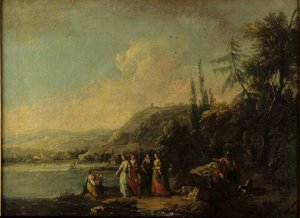
Portrét Giuseppe Zais

31 nejslavnějších obrazů autora Giuseppe Zais, každý naprosto unikátní

Aktualizováno listopad 2026 · seřazeno podle našeho skóre popularity (vyhledávání, návštěvy a objednávky u každého díla) · 35 děl umělce Giuseppe Zais v našem katalogu

Stručně řečeno

The Rest on the Flight into Egypt (1730) je obraz autora Giuseppe Zais, který přitahuje nejvíce pohledů; originál se nachází v Walters Art Museum, Baltimore. Poté se zrak přesouvá k Italian landscape with river, figures and cattle (1749) a Italian landscape with a lake, figures and animals (1749). Z 35 děl umělce Giuseppe Zais v našem katalogu je těchto 31 těch nejznámějších; každé z nich je unikátním originálem s uvedením roku vzniku, muzea a důvodu jeho nesmrtelnosti.

1709 – 1781, Canale d'Agordo Nejvíce děl: Gallerie dell'Accademia di Venezia

Top 10 obrazů autora Giuseppe Zais podle výběru galerie

1
The Rest on the Flight into Egypt (1730) od Giuseppe Zais

The Rest on the Flight into Egypt

1730 · Oil · Walters Art Museum, Baltimore

In this monochromatic oil painting, a biblical scene unfolds through a dramatic, grayscale lens. The composition is asymmetrical, guiding the eye from the immediate foreground toward a complex arrangement of ancient ruins and a turbulent sky. In the lower left, a woman sits nestled among foliage, cradling an infant in her arms. To the right, a solitary figure rides a donkey across a vast plain. The landscape is defined by…

2
Italian landscape with river, figures and cattle (1749) od Giuseppe Zais

Italian landscape with river, figures and cattle

1749 · Oil On Canvas

The oil on canvas work titled Italian landscape with river, figures and cattle is an 18th Century painting. This piece, which dates to about 1749, originated in Italy. The composition depicts a pastoral scene featuring a river, various figures, and cattle within a landscape setting.

3
Italian landscape with a lake, figures and animals (1749) od Giuseppe Zais

Italian landscape with a lake, figures and animals

1749 · Oil On Canvas

The scene unfolds in a soft, diffused light, as if the sun is filtering through a thin veil of afternoon clouds. A lake sits at the heart of the composition, its surface a muted mirror for the pale sky. Along the shoreline, the earth is rendered in warm ochre and terracotta, the colors of baked clay and sun-dried stone. Figures move through this landscape, their small forms engaged in the…

4
Landscape with Figures (1750) od Giuseppe Zais

Landscape with Figures

1750 · Oil On Canvas · Rijksmuseum, Amsterdam

Giuseppe Zais captures a quiet moment in Landscape with Figures. Created about 1750, this oil on canvas presents a pastoral scene where humanity and the natural world exist in a soft, steady balance. Small groups of people move near a winding stream, their presence integrated into the lush, hilly terrain. The landscape unfolds with a sense of stillness, framed by the dark, heavy weight of a large tree on the…

5
By the Stream (1755) od Giuseppe Zais

By the Stream

1755 · Oil On Canvas · Isabella Stewart Gardner Museum, Boston

In this 1755 oil on canvas, we find ourselves drawn into a serene, pastoral scene that captures a fleeting moment of rural life. The composition is anchored by large, leafy trees on the left, their foliage rendered with a feathery touch that frames the view and directs the eye toward a central group of figures. These figures, engaged in quiet activities near the water, exist in a state of harmony…

6
At the Fountain (1755) od Giuseppe Zais

At the Fountain

1755 · Oil · Isabella Stewart Gardner Museum, Boston

A tranquil landscape unfolds in this 1755 oil painting, centered on a stone fountain that anchors a quiet, pastoral scene. To the far left, a large, detailed tree frames the composition, its dark bark providing a structural weight that directs the eye toward the middle ground. Here, a man leads a white cow and two sheep past the architectural ruins of the fountain, while a woman and child rest nestled…

8
PAYSAGE PASTORAL od Giuseppe Zais

PAYSAGE PASTORAL

Oil On Canvas · Louvre, Paříž

To gaze upon this depiction of a pastoral landscape is to step through a veil into an idealized moment of timeless tranquility. The scene unfolds with the gentle grandeur characteristic of 18th-century landscape painting, inviting the viewer to breathe in the soft air and feel the quiet rhythm of rural life. Rolling hills, rendered in harmonious washes of earthy greens and muted yellows, cradle a winding river that acts as…

10
Mountain Landscape with Picturesque Buildings (1754) od Giuseppe Zais

Mountain Landscape with Picturesque Buildings

1754 · Oil On Canvas · Statens Museum for Kunst, Kodaň

Giuseppe Zais began his life in 1709 in the mountain town of Canale d'Agordo, Italy. This rugged, alpine origin left a mark on his eye, a way of seeing the earth through the lens of stone and height. By 1754, when he painted Mountain Landscape with Picturesque Buildings, he had become a steady voice in the Venetian landscape tradition. He moved from the quietude of the mountains toward the light…

Slavná díla umělce Giuseppe Zais, čísla 11 až 31

Slavná díla Giuseppe Zais podle jednotlivých období

Motivy, které zaujaly Giuseppe Zais

Čtyři témata, která se v těchto originálech nejčastěji objevují, z nichž každé má svůj nejlepší příklad.

Muzea, v nichž jsou vystavena originálna umělce Giuseppe Zais

8 muzea, v nichž je umístěno nejvíce obrazů z této stránky.

Muzeum Město Díla autora Giuseppe Zais Obrazy z tohoto seznamu
Gallerie dell'Accademia di Venezia, BenátkyGallerie dell'Accademia di Venezia Benátky 4 Landscape with Ruins and Archway, Ancient Ruins with a Great Arch and a Column, Landscape with River and Bridge
National Gallery, LondýnNational Gallery Londýn 3 Landscape with a Ruined Tower, Landscape with a Group of Figures, Landscape with a Group of Figures Fishing
Isabella Stewart Gardner Museum, BostonIsabella Stewart Gardner Museum Boston 2 By the Stream, At the Fountain
Statens Museum for Kunst, KodaňStatens Museum for Kunst Kodaň 2 Mountain Landscape with Picturesque Buildings, An Italian Landscape with Figures and Cattle
Harvard Art Museums, CambridgeHarvard Art Museums Cambridge 2 Landscape with Figures, Landscape with Figures
Reading Museum, ReadingReading Museum Reading 2 Hilly Landscape, with Two Country Women and a Dog by a Small Waterfall and a Rider on a Road, River Landscape with Two Country Women and Four Sheep on a Winding Road, a Fisherman, and Farm Buildings Round an Old Round Tower in the Middle
Walters Art Museum, BaltimoreWalters Art Museum Baltimore 1 The Rest on the Flight into Egypt
Rijksmuseum, AmsterdamRijksmuseum Amsterdam 1 Landscape with Figures

Giuseppe Zais napříč desetiletími: jeden unikátní originál pro každou dekádu

Díla podle dekád

Vyberte si dekádu a prohlédněte si originál, který ji definuje.

Obrazy umělce Giuseppe Zais: dotazy pro galerii

Kterým nejznámějším dílem je Giuseppe Zais?Odhalit odpověď

The Rest on the Flight into Egypt (1730), Walters Art Museum, Baltimore. Následují Italian landscape with river, figures and cattle (1749) a Italian landscape with a lake, figures and animals (1749).

V jakém věku vytvořil(a) Giuseppe Zais dílo The Rest on the Flight into Egypt?Odhalit odpověď

21 let: dílo The Rest on the Flight into Egypt pochází z roku 1730 a Giuseppe Zais se narodil/a v roce 1709.

Kterých deset obrazů autora Giuseppe Zais je nejznámějších?Odhalit odpověď

The Rest on the Flight into Egypt, Italian landscape with river, figures and cattle, Italian landscape with a lake, figures and animals, Landscape with Figures, By the Stream, At the Fountain, Landscape with Ruins and Archway, PAYSAGE PASTORAL, Ancient Ruins with a Great Arch and a Column a Mountain Landscape with Picturesque Buildings. Hodnocení výše uvádí rok a muzeum pro každé z nich.

Kolik známých děl má autor Giuseppe Zais?Odhalit odpověď

Náš katalog obsahuje 35 děl umělce Giuseppe Zais z let 1730 až 1765.

Kde lze vidět nejznámější originály umělce Giuseppe Zais?Odhalit odpověď

Většinou v Gallerie dell'Accademia di Venezia (Benátky), National Gallery (Londýn) a Isabella Stewart Gardner Museum (Boston). V tabulce muzeí výše jsou vypsány všechny.

V jakém období vytvořil(a) Giuseppe Zais svá nejznámější obrazy?Odhalit odpověď

V období 1750s: 6 z celkem 31 děl na této stránce vzniklo právě tehdy, z toho Landscape with Figures z nich.

Který slavný obraz od Giuseppe Zais je nejstarší a který nejnovější?Odhalit odpověď

Na této stránce je nejstarší dílo z The Rest on the Flight into Egypt (1730) a nejnovější z The Swing (1765).

Jakým tématům se Giuseppe Zais věnoval/a nejčastěji?Odhalit odpověď

Sky (10), Landscape (8) a Figures (7) napříč 31 díly na této stránce.

Jaké materiály používal(a) Giuseppe Zais nejčastěji?Odhalit odpověď

Oil On Canvas, u 13 z 31 děl na této stránce.

Jaká originální díla Giuseppe Zais mohu vidět v Gallerie dell'Accademia di Venezia?Odhalit odpověď

Landscape with Ruins and Archway, Ancient Ruins with a Great Arch and a Column a Landscape with River and Bridge: muzeum Gallerie dell'Accademia di Venezia, Benátky má v obsluze 4 děl z této stránky.

Giuseppe Zais: portrét umělce

A Venetian Voice: The Life and Art of Giuseppe Zais

Giuseppe Zais, born in the humble mountain town of Forno di Canale near Belluno in 1709, emerged as a significant, though often overlooked, figure within the vibrant landscape painting tradition of 18th-century Venice. His life story, while lacking dramatic flourishes, speaks to the dedication and subtle artistry that characterized his nearly five decades of work. Moving to Venice at a young age – likely around 1725 or 1730 – Zais immersed himself in the artistic currents of the city, a period already steeped in the legacy of masters like Canaletto and Guardi. While he wouldn’t achieve their widespread renown, his contribution to the *veduta* genre—the highly detailed, often panoramic views of cities—is nonetheless noteworthy, offering a unique perspective on the beauty and atmosphere of the Venetian lagoon.

Early Influences and Artistic Development

Zais's artistic journey was shaped by two key figures: Marco Ricci and Francesco Zuccarelli. Ricci, also hailing from Belluno, profoundly influenced his initial approach to landscape. He absorbed Ricci’s penchant for scenographic compositions—landscapes framed by lush trees with villages nestled within—and adopted the use of etching as a means of disseminating his designs. These early works reveal a focus on descriptive power and a pleasing aesthetic simplicity. However, Zais soon sought further refinement, turning to Francesco Zuccarelli for guidance. Zuccarelli’s influence softened Ricci's dramatic effects, introducing an increased elegance into Zais’s palette and technique. This period saw the development of his distinctive style—a blend of atmospheric luminosity, rich color, and a delicate touch that often bordered on affectation. While contemporaries like Bartolomeo Pedon and Matteo Stom had already established a strong tradition of Venetian landscape painting, Zais carved out his own niche through this synthesis of influences.

Frescoes and Patronage: A Career in Venice

Zais’s career unfolded primarily within the confines of Venice itself. Registered with the Fraglia, the city's painters’ guild, from 1748 to 1768, he steadily built a reputation as a skilled landscape artist. His most celebrated achievement lies in the frescoes adorning Villa Pisani in Stra, created between 1760 and 1765. These expansive works showcase his mastery of decorative painting and his ability to capture the idyllic beauty of the Venetian countryside. Beyond this commission, Zais benefited from a network of patrons, including Joseph Smith, a prominent English consul residing in Venice. Smith’s support likely played a crucial role in establishing Zais's position within the artistic community. In 1774, he was elected to the Accademia Veneziana—a testament to his growing recognition among his peers.

A Legacy of Tranquility and Vedute

Despite achieving membership in the Academy, Zais’s later years were marked by financial hardship. He died in poverty at Treviso in 1784, a fate not uncommon for artists of the period. However, his artistic legacy endures through the surviving examples of his work. His paintings—often depicting pastoral scenes and tranquil harbor views—offer a glimpse into the everyday life and picturesque landscapes of 18th-century Venice. While he may not have possessed the virtuosity of Canaletto or the dramatic flair of Guardi, Zais’s art possesses a unique charm and sensitivity. He excelled at capturing the subtle nuances of light and atmosphere, creating scenes that evoke a sense of peace and serenity. His *vedute* paintings, though less focused on architectural precision than those of his contemporaries, offer a more intimate and emotionally resonant portrayal of the Venetian world.

Rediscovering Zais: A Place in Art History

Today, Giuseppe Zais is increasingly recognized as an important figure within the broader context of Italian landscape painting. His works can be found in prominent collections such as the Gallerie dell'Accademia in Venice and the Museum of Bassano del Grappa. Scholars continue to explore his artistic development, highlighting the influence of Ricci and Zuccarelli while also acknowledging his unique contributions to the *veduta* genre. Zais’s art serves as a reminder that beauty can be found not only in grand spectacle but also in quiet contemplation. His paintings offer a valuable window into the social and cultural life of 18th-century Venice, capturing the essence of a city renowned for its artistic splendor and enduring allure. His legacy is one of tranquility, skillful execution, and a deep appreciation for the natural world—qualities that continue to resonate with viewers today.